Police chiefs are failing to reach ‘expected standards of professional behaviour’, a watchdog has said.
It also revealed the force had failed to report all allegations of senior officer wrongdoing to the Scottish Police Authority (SPA).
Officials at the SPA, the civilian oversight body for policing, ‘sought advice from other senior officers within Police Scotland about how to progress concerns involving their peers’.
His Majesty’s Inspectorate of Constabulary in Scotland (HMICS) also revealed drug tests for civilian workers had been stopped after protest by staff associations – putting the force at potential risk of blackmail by organised crime networks.
Chief Constable Jo Farrell was accused of ‘undermining public confidence’ in March by blocking the publication of the HMICS report until after May’s election.
The review by HM Chief Inspector of Constabulary Craig Naylor said ‘feedback from officers and staff stated that there were occasions where Police Scotland senior leaders did not consistently exemplify the expected standards of professional behaviour’.
The report said the force’s ‘existing performance and appraisal process is widely regarded as ineffective’ and officers can remain under investigation for ‘relatively minor matters’ for several years.
Between 2013 and 2024, 20 per cent of Police Scotland officers and staff who died by suicide had been subject to ‘live complaints or discipline processes’.

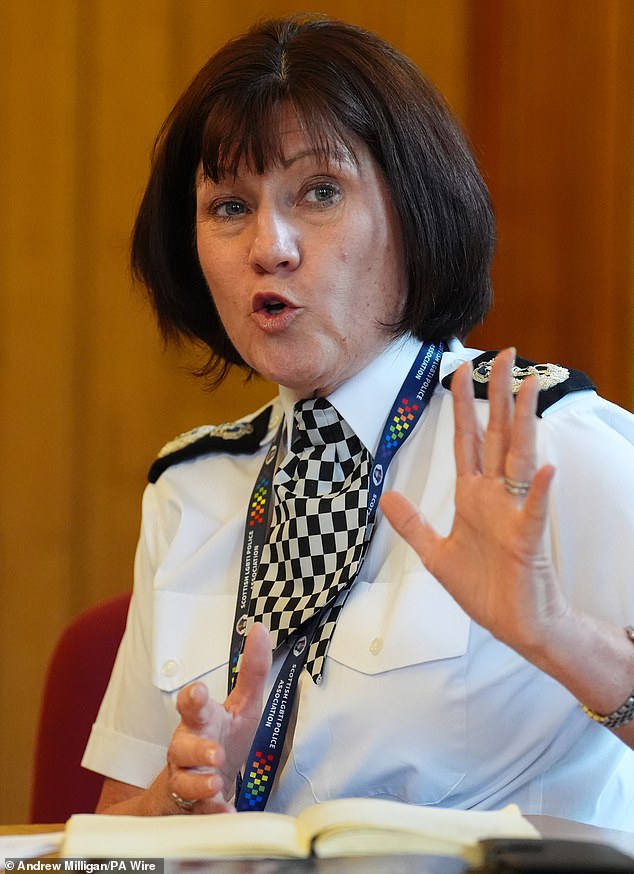
Chief Constable Jo Farrell
The report recommended a review to ‘identify opportunities to fast-track any on-and-off duty criminal cases where the accused person is a police officer or member of police staff’.
The watchdog also voiced concern about how policing deals with allegations of wrongdoing involving its most senior officers.
Allegations of misconduct concerning senior officers must be referred to the SPA to carry out an initial assessment of any potential misconduct or other unsatisfactory behaviour.
But the HMICS review found Police Scotland had failed to report all allegations of senior officer wrongdoing to the SPA.
The report said the absence of an independent body to probe whistleblowing disclosures was a ‘critical gap’.
HMICS said this year that Police Scotland had requested its report on conduct and discipline be delayed to give it ‘time to consider any potential implications for proceedings that are currently ongoing’, which is understood to refer to a bullying investigation into Deputy Chief Constable Jane Connors, who has been ‘redeployed’ to a job with the London-based National Police Chiefs’ Council, despite the ongoing probe.
Scottish Tory justice spokesman Stephen Kerr said: ‘After nearly two decades of SNP control of policing and justice, serious concerns are once again being raised about standards and leadership at the top of Police Scotland.
‘Frontline officers deserve leadership that sets the standard, not leadership that raises questions about conduct and accountability.’
Responding to the report, Association of Scottish Police Superintendents (ASPS) president Chief Superintendent Rob Hay said: ‘ASPS members are held to some of the highest standards of professional accountability anywhere in public service.
‘Superintendents and chief superintendents operate under significant scrutiny, with clear expectations around ethics, candour, integrity, and leadership.
‘Against that backdrop, it is important that conduct arrangements at every level of policing command are seen to be fair, transparent and consistent.’
He said: ‘The most powerful people within the organisation cannot be the least accountable.’
Police Scotland said it ‘acknowledges commentary in the report around issues relating to senior officers’ and it is ‘considering carefully observations of what is a small evidence base’.
The SPA said: ‘Robust and effective complaint, conduct and discipline processes are essential to maintaining public trust and confidence in policing.’