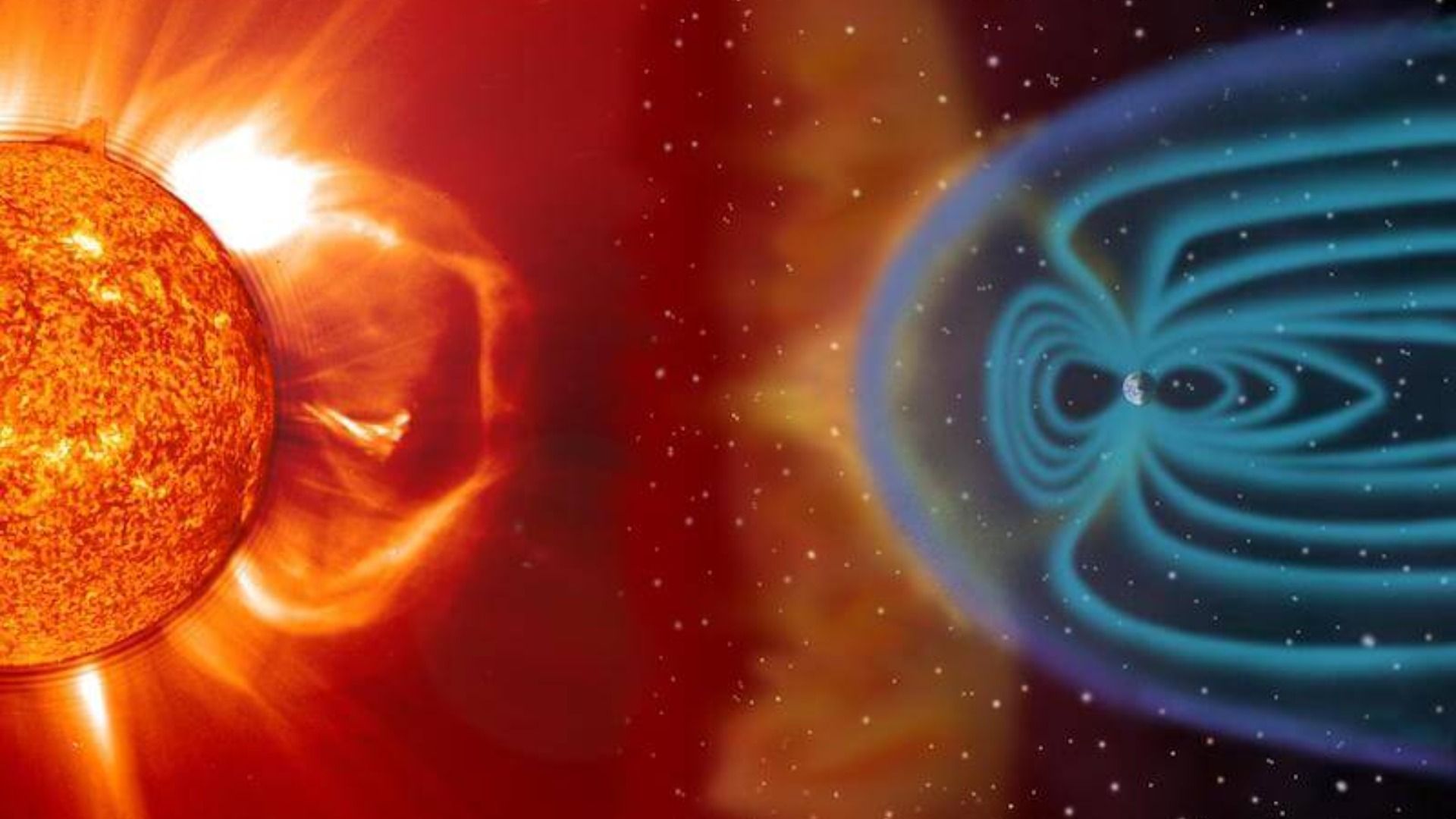
When severe solar storms hurtle toward Earth, the planet’s first line of defense is its magnetosphere, a vast magnetic bubble that deflects the brunt of the sun’s dangerous charged particles. Historically, humanity has only attempted to forecast the storms and brace for impact.
Now, however, a team led by Brian Walsh of Boston University has proposed a bold method to actively strengthen that natural defense using a fleet of spacecraft designed to blunt the impact of space weather before it hits.
The concept, dubbed StormWall, uses computer simulations to show that reinforcing the magnetosphere could reduce the intensity of a major geomagnetic storm by more than half. If realized, the researchers say the system could protect vulnerable satellites, global communications networks, GPS systems and electrical grids from potentially catastrophic disruptions.
“People have always thought, ‘space is huge, the sun is massive, we just have to sit here and take whatever it gives us,'” Walsh said in a statement. “But what we found is that we can impact it.”
During particularly powerful solar eruptions, Earth’s natural shield can be breached through a process called magnetic reconnection. When magnetic fields carried by the solar wind align perfectly with Earth’s magnetic field, they temporarily link together. This opens a celestial pathway, allowing massive amounts of solar energy to pour into near-Earth space and trigger geomagnetic storms.
The StormWall concept is designed to interrupt this process. The system would deploy six spacecraft into geosynchronous orbit. Each satellite would carry stores of a “mass-loading material”— substances like barium, lithium, sodium, or calcium — that can be stored safely as a solid or liquid and vaporized on command.
If a dangerous solar storm is detected heading toward Earth, mission controllers would command the fleet to release the material. Sunlight would quickly ionize the vaporized particles, transforming them into a cloud of electrically charged plasma, the study notes.
This artificial plasma would drift toward the sun-facing edge of the magnetosphere, effectively thickening the boundary between Earth and the incoming solar wind. By adding mass to this critical frontier, the team found it could stall the efficiency of magnetic reconnection, forcing the harsh space weather to bounce around and past our planet.
“It’s like people in a village who see a river flooding — maybe they can predict when that will happen, but probably what’s even better is if they could build a storm wall,” Walsh said in the statement. “That’s what we’re proposing here.”
To test the viability of the concept, the researchers simulated the historic May 2024 geomagnetic storm, often called the Mother’s Day storm. One model recreated the event under normal conditions, while a second simulated the storm with the StormWall plasma shield active.
The results showed that while StormWall would not eliminate a geomagnetic storm entirely, it could reduce its intensity by more than 50%, according to the study. By disrupting the flow of energy at the boundary of the magnetosphere, the artificial plasma would essentially force the space weather to bounce around and past our planet, the paper notes.
“When you apply some really serious physics to it, it does work,” Walsh said in the statement. “And the amount of mass we need, the launch capacities — it’s all within our capabilities.”
To provide enough coverage, the fleet would collectively need to carry a payload equivalent to about a dozen oil trucks’ worth of material, according to the statement. That would not be inexpensive, and costs would be further compounded by the fact that once the payload is fired out and photoionizes, the system would be dead and unable to be replenished — making it a “one-and-done” solution.
However, as private companies pour billions into orbital infrastructure and contemplate launching space-based data centers, Walsh and his team argues that the financial math could soon tip in favor of such a proactive defense.
The study also acknowledges that modifying an interconnected system requires careful evaluation of unintended consequences. The risk of long-term contamination using the StormWall approach is low, it adds, because the artificial plasma would leave the system “relatively quickly,” getting swept away by the solar wind within roughly six hours rather than re-entering Earth’s atmosphere.
And because the magnetosphere blankets the entire globe, StormWall would serve as a collective shield for the entire planet, the researchers say.
“If you built it, if it was deployed, it would help all people on the planet,” Walsh said in the statement. “You couldn’t make it in a way that helped only one country, one group of satellites.”
Further details about the concept were published on June 2 in the in the journal Space Weather.