
Researchers may have just revealed a new way of looking for alien life — it’s based on the idea that it isn’t just the type of biosignatures that are important, but also how they are organized.
“Our approach could help make the search for life more efficient. If a molecular assemblage shows no life-like organization, that may make it a lower priority target,” Fabian Klenner of the University of California, Riverside told Space.com.
First, it should be noted that life uses and produces a range of biologically useful materials such as amino acids, peptides, proteins, fatty acids and so forth. These compounds are therefore considered potential “biosignatures” — if we find them on another world, it is quite possible that they have been produced by life’s processes (life as we know it, at least).
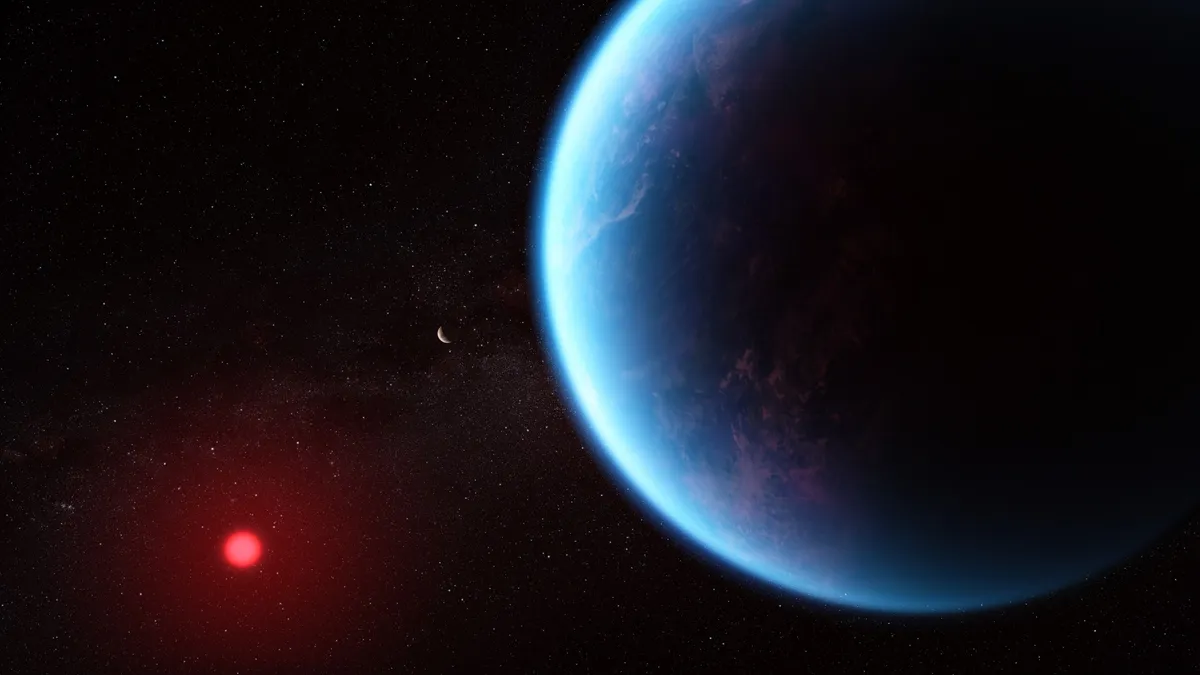
However, these compounds are not exclusively biological — abiotic chemical reactions that have no connection to biology can also produce them, and distinguishing between the two possible sources is one of astrobiology’s greatest challenges. For example, methane plumes on Mars could be biological or geological in origin, and the same uncertainty also clouds the detection of phosphine in Venus‘ atmosphere, or the potential discovery of dimethyl sulfide (DMS) in the atmosphere of the exoplanet K2-18b.
This sows confusion because detecting biosignatures does not necessarily mean we have detected life.
However, Klenner is part of a team led by Gideon Yoffe of the Weizmann Institute in Israel that showed there may be a way to distinguish between biological and abiotic origins.
To do so, they took a leaf out of ecologists’ book, where life is measured by two metrics: its diversity and how evenly spread its distribution is.
They focused on two biological compounds: amino acids and fatty acids. Amino acids form long chains called peptides that assemble into proteins that are the workhorses inside biological cells. Fatty acids form part of the structure of those cells. Both can be produced by life or by non-living processes.
“We focused on amino acids and fatty acids because they are central molecular classes for life as we know it and because suitable datasets exist,” said Klenner.
Indeed, Yoffe and Klenner’s team were able to delve into about 100 datasets including samples from asteroids, fossils, meteorites, microbes, soils and synthetic laboratory samples.
They showed that amino acids are more diverse and more evenly distributed when they are created by living organisms than when produced by non-living processes. Fatty acids are the other way around — they are less diverse and less evenly distributed when created by biology.
This is not a foolproof method of detecting life, warn the researchers. First of all, they have only shown that it works with amino acids and fatty acids. “In principle, similar organizational trends may exist for other molecular classes but this still needs to be tested,” said Klenner.
Second, the diversity and distribution of these bio-compounds needs to be placed into context with other molecules, otherwise it is impossible to say how diverse and evenly distributed they really are. This means that it cannot be applied to the DMS detection on K2-18b, as we simply don’t know enough about that exoplanet’s atmosphere to quantify the diversity and distribution.
“For a single molecule like DMS, the situation is different,” said Klenner. “For K2-18b, DMS alone would not be enough for our analysis — we’d need a broader inventory of related molecules.”
However, the technique may be more useful closer to home, in our solar system, where samples and datasets are more complete. One useful facet of the research is that the organizational patterns hold up no matter how degraded the biological sample is. For example, fossilized dinosaur eggs retained traces of the distribution and diversity of amino acids and fatty acids.
This could come in useful for Mars, where astrobiologists are searching for evidence of life on the Red Planet from billions of years ago when Mars was warmer and wetter.
“Biological samples do not simply become meaningless once they degrade,” said Klenner. “Some organizational information can persist, which makes this approach useful for ancient Mars.”
The technique on its own cannot confirm the existence of life — in general, the discovery of alien life would be such a profound revelation that we would need multiple lines of evidence to be absolutely sure.
It can, however, direct us towards the best places to look.
One of those places may be Jupiter‘s moon Europa, which harbors a global ocean of water beneath a thick shell of ice. Astrobiologists are undecided as to whether that ocean is capable of supporting life or not. While NASA’s forthcoming Europa Clipper mission, currently on its way to Jupiter to arrive in 2031, won’t be able to look under the ice, it will be able to study possible locations where the ocean has erupted onto the surface.
“One of the instruments on board Clipper, the Surface Dust Analyzer, will be able to measure the abundance ratios of organic molecules in ice grains emitted from Europa,” said Klenner. “If families of organic molecules are detected, then our diversity based approach will help interpret whether these molecules look more consistent with abiotic chemistry or biological organization.”
The findings were published on May 11 in Nature Astronomy.