



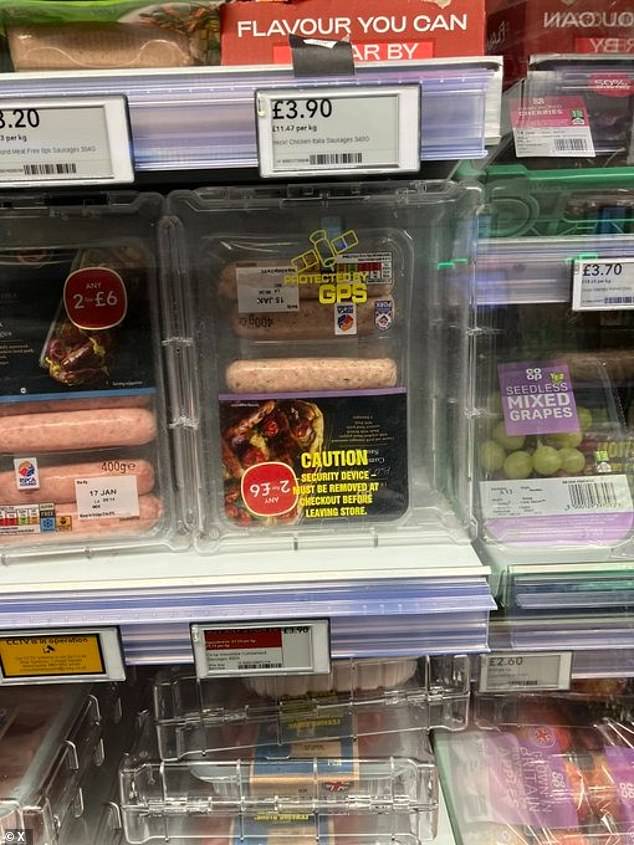
GPS trackers are being fitted to grocery items, including sausages, steak, and beef, in the latest bid from supermarkets to stop the shoplifting epidemic plaguing Britain’s high streets.
The trackers allow the location of the products to be followed once they leave the store and have been spotted at a number of Co-Op stores across the UK.
In another attempt to deter shoplifters, the items are also placed in locked plastic boxes.
Co-op Cumberland sausages, which cost £3.90, have been pictured in the boxes with a label reading ‘protected by GPS’.
While other Co-op meat products, including £7 British sirloin steaks and Angus beef roasting joints, costing £20.90, were also locked in the GPS-tagged boxes at a store in Old Street in central London.
It’s the latest effort in a long list of security measures being brought in by supermarkets to deter shoplifters, as new figures revealed Britain’s shoplifting epidemic has hit a record high of more than 500,000 cases in a year.
Police recorded 530,000 offences in England and Wales last year – a 48 per cent increase on pre-pandemic levels.
And retailers estimate the true figure is far higher, as shoplifting has become increasingly organised on ‘Britain’s broken high streets’.

Co-op Cumberland sausages, which cost £3.90, have been pictured in the boxes with a label reading ‘protected by GPS’
A spokesperson for Co-op said: ‘We know the tide of criminality can be turned. Local shops are an anchor in communities, and we continue to invest significantly in wide-ranging safety and security measures, including the latest CCTV, body-worn cameras, fortified kiosks, security cases and covert and non-covert guarding.
‘This, along with forging successful partnerships with local policing and the increase in police attendance, has contributed to a drop in retail crime levels at Co-op of more than 20 per cent last year – a trend we are seeing continue into 2026.’
Earlier this month, it was reported that Waitrose will begin locking bottles of champagne in new ‘smart cabinets’
A spokesperson for the supermarket said it is ‘currently investing in a range of advanced technology, including smart technology, to deter theft’.
As part of this new tech-based anti-theft investment, the retailer is ‘planning pilot lockable smart cabinets for areas such as spirits and champagne soon’.
‘We already use smart shelf technology in our health, beauty and spirits aisles, which are able to sense unusual customer behaviour, so this would provide an additional layer of security,’ the spokesperson added.
It is also trialling ‘meat nets’ with security tags on certain joints of meat in some stores, similarly to how security tags are already put on other items, such as spirits and razors.
Waitrose have not yet specified exactly how their smart cabinets will work, but self-locking cabinets used by other supermarkets usually require customers to use a touchpad screen to open them.
Smart cabinets tested by Sainsbury’s required customers to progress through four different steps to unlock the doors and grab the item they want to buy.
Other retailers have tested smart cabinets which can be opened by scanning their loyalty cards or inputting their phone numbers.
The technology can track how long doors have been opened and whether any products have been removed, alerting staff to any suspicious activity, such as people emptying the cabinets.
The number of reoffending shoplifters has also spiralled, with 67 per cent of shoplifters going on to commit another offence within the year, compared to just 55 per cent before the pandemic.
In fact, the average shoplifter commits 9.1 offences, which has nearly doubled in the past five years, according to analysis by the Centre for Social Justice (CSJ).
However, just one in five shoplifting offences resulted in a charge or court summons, meaning the vast majority of thieves faced no formal consequences.
The figures, spanning from April 2024 to March 2025, were released following a parliamentary question by CSJ chairman Sir Iain Duncan Smith, with the organisation launching an inquiry seeking to repair Britain’s broken high streets.
CSJ researchers have identified a growing link between shoplifting levels and the spread of ‘dodgy vape shops and mini-marts’ operating as fronts for illegal activity.
Meanwhile, one in four independent retailers have reported seeing goods stolen from their shops being resold in their area.
Sir Iain, the MP for Chingford and Woodford Green, said Britain is suffering from a ‘high street crime wave’.
He added: ‘Set against years of economic difficulties, there is a risk that some of our town and city centres are left permanently hollowed out.
‘In my own constituency, rising levels of shoplifting point to a broader social breakdown that is fuelling crime.
‘Shoplifting is not a victimless crime. There must be zero tolerance for criminals who target shopkeepers and undermine our local communities.’
High-profile shoplifting cases have seen some perpetrators jailed for stealing up to £300,000 of goods.
In October, Daniel Cleveland, 33, was jailed for three years after stealing £16,000 worth of taps from B&Q in Bromley, south London.
Another thief, Liam Hutchinson, was jailed for a year after CCTV footage showed him swiping whole shelves of Boots products into his bag, totalling £100,000.
It comes after former Met detective David McKelvey warned that a ‘nonsense’ ban on supermarket staff confronting shoplifters leaves stores ‘wide open’ to criminal gangs.
Union bosses instructed their members to ‘watch, report and be an expert witness for police’, but not to put themselves at risk for the benefit of ‘those who may not support you afterwards’.
Daniel Garnham, general secretary of the union Security Industry Federation (SIF), said he was clarifying advice in the face of ‘the growing level of shoplifting and violence’, and increased ‘confusion’ over how staff are expected to act.
He said that security workers were confronted by ‘different rules in different places’, blaming the lack of a ‘joined-up approach’ between the regulator, employers and clients.
The intervention comes in the wake of several high-profile cases of shopworkers being dismissed over their responses to shoplifting.
Waitrose sparked fury last month after it sacked a veteran employee of 17 years for tackling an Easter egg thief due to its strict ‘non-intervention’ policy.
Walker Smith, 54, confronted the ‘repeat offender’ at the chain’s Clapham Junction branch and got into a tug-of-war, causing a £13 bag of Lindt eggs to spill across the floor.
Morrisons manager Sean Egan, 46, also made national headlines last month when he was sacked from the branch in Aldridge, near Walsall, where he had worked for 29 years.
He was let go because he intervened with a prolific shoplifter, continuing to engage even after the thief became aggressive and began spitting, which the company said contravened their deter-and-not-detain policy.

Supermarket workers have been sacked for tackling shoplifters in breach of their employers’ rules including Sean Egan, 46, who tried to stop a serial thief at Morrisons

Waitrose worker Walker Smith (pictured) was also dismissed after he tried to stop a thief from stealing Easter chocolate
Meanwhile, Gavin Ramsay, 49, was sacked from Asda after 25 years’ loyal service for trying to prevent a young person from getting away with a stolen bottle of alcohol.
Some supermarket bosses have publicly called for security guards to be armed with batons and pepper spray to better equip them to tackle shoplifters – but the SIF insisted this would be ‘reckless’ without proper preparation.
It argued this would create ‘even more risk in an already confused and inconsistent system’.
Members were implored to avoid intervening with troublemakers, even if that rails against their ‘instincts’.
Mr Garnham said: ‘Someone else’s stock is not more important than your safety, your career or your licence.
‘We need clear national guidance on lawful intervention, better and more realistic training, proper support for workers who act in good faith, and an end to policies that leave officers exposed to violence while punishing them for trying to do their job.
‘Security workers deserve clarity. They deserve consistency. Most of all, they deserve support.’
The retail union Usdaw, which has 360,000 members, is also telling its members ‘not to intervene against potentially dangerous criminals and to keep themselves safe’.
GMB, one of Britain’s largest unions representing thousands of security guards, said that ‘retailers cannot expect security guards to put themselves at physical risk just to protect their bottom lines’.