

4/5
- Brand
-
Aurzen
- Native Resolution
-
1080p
- ANSI Lumens
-
300
- Connectivity
-
HDMI, Wi-Fi, USB, Bluetooth
The Aurzen EAZZE D1R air is the world’s first portable Roku Smart TV projector, giving you access to all your favorite streaming services.
- Easy setup
- Great sound
- Impressive visuals
- Loud fan
- No built-in battery
Price, availability, and specs
Indoor or outdoor viewing
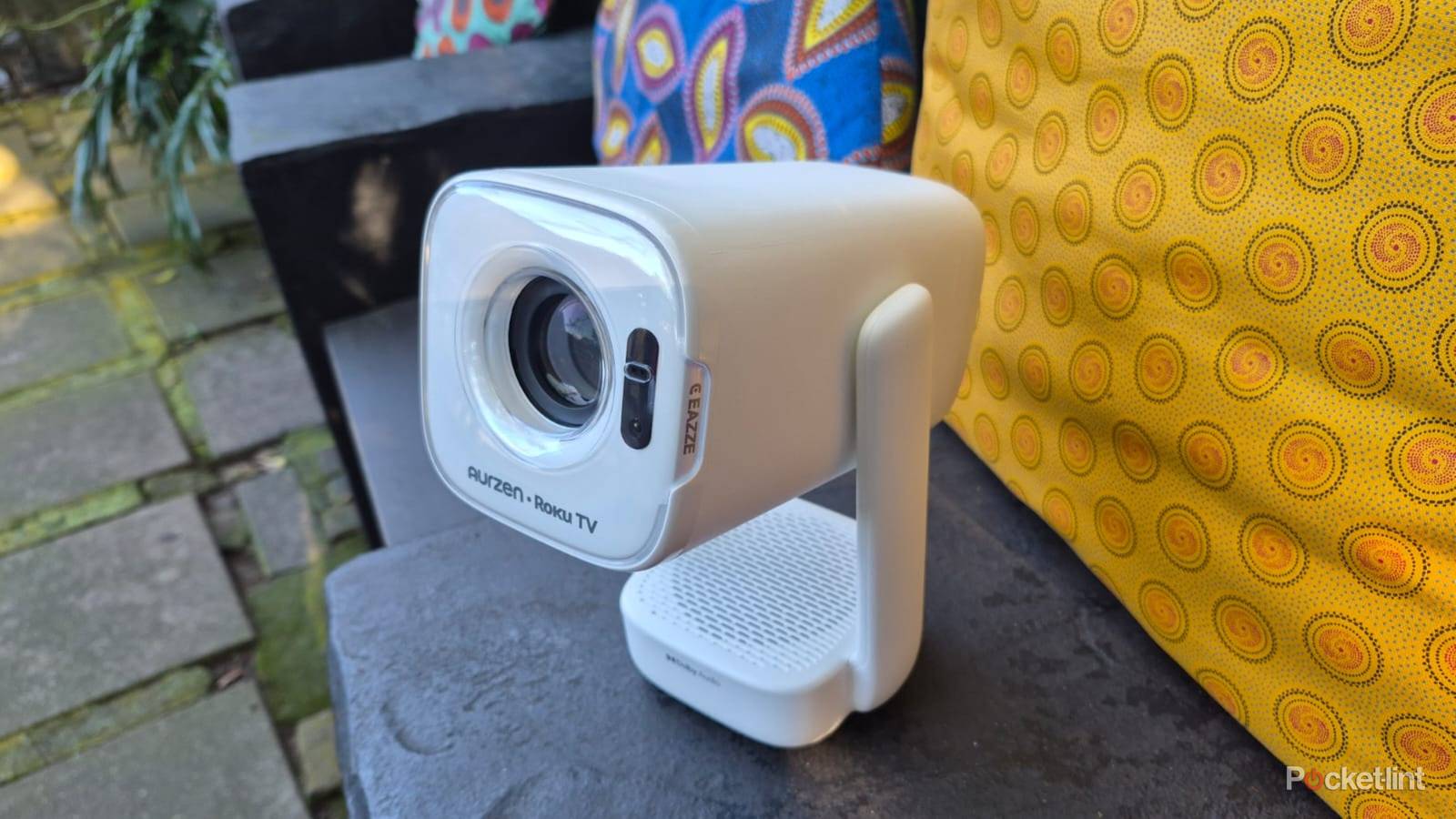
The EAZZE D1R Air is a portable projector with an integrated gimbal stand. It has a minimalist all-white aesthetic, with an HDMI eARC, USB-A, 3.5mm audio, and an integrated power button hidden behind a protective rubber strap on the back. A pair of Dolby Audio-compatible 5W speakers is built into the base, which also houses the Figure-8 power port and threads for attaching a stand. You can use the USB-C port to run the projector from a phone charger or power bank.
Performance-wise, this projector offers a native 1080p resolution and 300 ANSI lumens of SGS-certified brightness. It has 1GB of RAM and 512GB of storage space for apps. The screen size ranges between 40 and 150 inches. Aurzen recommends 80 inches as the sweet spot, which requires a viewing distance of 7.26 ft.
Setting up the EAZZE D1R Air was a breeze thanks to its compact 5.35 x 4.33 x 10.12-inch size and 42.3-ounce weight. After setting the 180-degree stand to my preferred viewing position, the autofocus and auto-keystone features took over and perfectly aligned and focused the screen without requiring user input.
The autofocus and auto-keystone features took over and perfectly aligned the screen without me doing anything.
Then it was as simple as connecting the projector to my Wi-Fi and setting up my Roku account. I downloaded Netflix, Spotify, and some free Roku apps, and I was ready to go. This projector uses a standard Roku remote control, which should be familiar to many users. I found it just as convenient to use the remote feature in the Roku mobile app.
The EAZZE D1R Air goes on sale this week and retails for $240 on Amazon and the official Aurzen site. You can get it for $150 with the limited-time launch offer.
- Brand
-
Aurzen
- Native Resolution
-
1080p
- ANSI Lumens
-
300
- Connectivity
-
HDMI, Wi-Fi, USB, Bluetooth
- Audio
-
Dual speakers
- OS
-
Roku TV
What I liked about the Aurzen EAZZE D1R Air
Great sound and image quality
The simplicity of the Aurzen EAZZE D1R Air is its best feature. It works as a standalone device, and you can access hundreds of streaming services via the user-friendly interface. There are countless free apps to choose from, and you can watch movies, shows, and live news for free without any subscriptions. It’s all about convenience and works like a Roku smart TV with added mobility benefits.
Portable projectors fall into a specific niche and cater to buyers who want a projector they can take anywhere. The Aurzen EAZZE D1R Air impressed me with its all-in-one folding design, which is easy to store and carry anywhere. The little details matter, and I appreciated that it takes a second to get it into the perfect viewing angle and requires no manual calibration or configuration to focus it.
I think the EAZZE D1R Air offers excellent visuals for its size. It’s brighter than many similarly sized projectors I’ve tried, and all the content I watched was sharp and vivid, without any washed-out colors or graininess.
It’s brighter than many similarly sized projectors I’ve tried, and all the content I watched was sharp and vivid, without any washed-out colors or graininess.
I watched movies and shows on the EAZZE D1R Air, and it exceeded my expectations. The underwater scenes and sea creatures came to life, feeling natural and realistic in Our Oceans. Spider-Man: Into the Spider-Verse is known for its bright color palette, and the EAZZE D1R Air showcased them in all their glory while keeping up with the fast-paced visuals. It also displayed the intricate details and metallic finish of the robots in Transformers: One. The performance was equally impressive in live-action movies and shows, like Furiosa: A Mad Max Saga and One Piece, and the frenetic action scenes were enhanced by the huge display.
The EAZZE D1R Air offers decent gaming performance for casual players. I tested it with Horizon: Forbidden West while battling robotic beasts in the jungle and in the snow. It offered excellent color accuracy and contrast for every environment, with no motion blur. Injustice 2 is sometimes too dark for some projectors to handle well, but the EAZZE D1R Air passed with flying colors in stages like The Joker’s Playground. GTA V’s graphics might be outdated, but roaming the streets of Los Santos is still more fun on a massive display compared to a TV.
I also have to give this projector credit for its audio capability. The pair of 5W speakers provides respectable sound considering its size and price. Most portable projectors have a single speaker, and the EAZZE D1R Air’s dual setup offers a noticeable improvement with true stereo sound. To me, the vocals seemed clearer, and it reached a higher volume before distortion kicked in. It gets the job done for small to medium rooms, but you’ll probably want to attach a soundbar or surround sound system for a cinematic experience.
 Quiz
QuizRoku streaming devices
Trivia challenge
From its humble beginnings to your living room — how well do you really know Roku?
HistoryHardwareFeaturesStreamingFounders
In what year was Roku founded?
Correct! Roku was founded in 2008 by Anthony Wood, who had previously founded ReplayTV. The company launched its first streaming player the same year it was founded, making it a pivotal moment in streaming history.
Not quite. Roku was founded in 2008 by Anthony Wood. It launched its very first streaming device that same year, just months after the company was formed, which was remarkably fast for a hardware startup.
Who is the founder and CEO of Roku?
Correct! Anthony Wood founded Roku in 2008 and has served as its CEO ever since. Before Roku, he founded ReplayTV, one of the first digital video recorder companies, giving him deep roots in home entertainment technology.
Not quite. The answer is Anthony Wood. He founded Roku in 2008 after previously founding ReplayTV. Reed Hastings is associated with Netflix, while Tony Fadell is known as a key figure behind the iPod and Nest.
Roku was originally spun off from which major streaming company?
Correct! Roku started as an internal project at Netflix, which invested in the company and helped shape its early direction. Netflix ultimately decided to spin it off as a separate company to avoid competing with other device manufacturers who might not want to carry a Netflix-branded box.
Not quite. Roku was actually spun off from Netflix. Netflix funded and incubated the project before deciding it was better to keep the streaming device market open and neutral rather than launch a Netflix-branded player that might alienate other hardware partners.
What was the name of Roku’s very first streaming device, launched in 2008?
Correct! The Roku DVP N1000, also known as the Roku Digital Video Player, was the company’s debut product. It launched in May 2008 at a price of $99 and could stream Netflix content directly to your TV — a genuinely groundbreaking feature at the time.
Not quite. The first Roku device was the Roku DVP N1000, launched in May 2008. Priced at $99, it was primarily designed to stream Netflix and helped pioneer the idea of a dedicated, affordable streaming box for the living room.
What is the name of Roku’s free, ad-supported streaming channel built directly into its platform?
Correct! The Roku Channel launched in 2017 and offers thousands of free, ad-supported movies and TV shows. It has since become one of the most-watched channels on the Roku platform and is also available on other devices and the web.
Not quite. The correct answer is The Roku Channel, which launched in 2017. It provides free, ad-supported content and has grown into a major part of Roku’s business strategy, helping the company earn revenue beyond just hardware sales.
Roku’s business model relies heavily on which of the following revenue streams?
Correct! While Roku does sell hardware, its primary revenue engine is its platform business, which includes advertising, revenue sharing with streaming partners, and The Roku Channel. This platform-first approach is what makes Roku more than just a device maker.
Not quite. Roku makes the majority of its money from its platform business, which includes advertising and revenue-sharing arrangements with streaming services. Hardware sales are actually sold at low margins, with the real profit coming from keeping users engaged on the platform.
Which of the following form factors did Roku introduce to make streaming even more portable and discreet?
Correct! Roku introduced the Roku Streaming Stick, a compact dongle that plugs directly into a TV’s HDMI port. It was a game-changer for portability, making it easy to turn any modern TV into a smart TV without a bulky box sitting on your shelf.
Not quite. Roku launched the Roku Streaming Stick, a small dongle that plugs straight into an HDMI port. This compact form factor made Roku devices far more discreet and portable, competing directly with Amazon’s Fire TV Stick.
In which year did Roku go public on the Nasdaq stock exchange?
Correct! Roku went public on September 28, 2017, trading on the Nasdaq under the ticker symbol ROKU. Its IPO was considered a major success, and the stock surged significantly in the months that followed, reflecting strong investor confidence in the streaming market.
Not quite. Roku held its IPO on September 28, 2017, listing on the Nasdaq under the ticker ROKU. The offering was well-received by investors and marked a major milestone in the company’s journey from a Netflix spin-off to a publicly traded streaming powerhouse.
Your Score
/ 8
Thanks for playing!
What I didn’t like about the Aurzen EAZZE D1R Air
Permanent power connection required
Like with most portable projectors, the EAZZE D1R Air’s fan noise is noticeable. It’s about as loud as a gaming laptop, and you can banish it by increasing the volume if it’s bothering you. I usually prefer portable projectors with built-in batteries for camping trips and other outdoor adventures. The lack of a battery on the EAZZE D1R Air is a minor gripe for me, but it probably won’t be a deal-breaker for many buyers.
Should you buy the Aurzen EAZZE D1R Air?
Depends on what you need
The EAZZE D1R Air is a simple plug-and-play projector that you can get up and running in minutes. It also runs on the user-friendly Roku TV OS and provides access to thousands of free shows and movies.
For me, it was one of the brightest and loudest portable projectors I’ve tried, and it doesn’t sacrifice much in the way of image and sound quality for its size. Retailing at $240 before the launch discount, the EAZZE D1R Air sits in the middle of portable projector pricing. I think you get what you pay for, and it delivers an excellent all-around feature set for the price.
At the end of the day, EAZZE D1R Air isn’t meant to compete with the biggest and brightest home laser projectors. It’s for buyers looking for big-screen visuals in a compact and affordable package. I think the EAZZE D1R Air is an excellent choice in this category because of its Roku TV convenience, and it’s worth considering despite its considerable fan noise and lack of a built-in battery.
This device was provided to Pocket-lint by Aurzen
4/5
- Brand
-
Aurzen
- Native Resolution
-
1080p
- ANSI Lumens
-
300
- Connectivity
-
HDMI, Wi-Fi, USB, Bluetooth
The Aurzen EAZZE D1R air is the world’s first portable Roku Smart TV projector, giving you access to all your favorite streaming services.