Millions of mortgage holders have been thrown a temporary lifeline after the Reserve Bank hit pause on interest rates.
The central bank held the cash rate at 4.35 per cent on Tuesday, ending a bruising run of three consecutive hikes that have left households ‘absolutely crunched’.
Reserve Bank Governor Michelle Bullock confirmed the widely anticipated decision after two days of deliberations, as mounting evidence suggests Australians are increasingly struggling under the pressure of the cost-of-living crisis.
The board said inflation was still too high to give Aussie mortgage holders a rate cut.
‘Higher fuel prices have added directly to inflation and there are indications that this is passing through to the prices of other goods and services, so inflation is likely to remain high for some time,’ the board said.
‘But inflation is still too high and the board judged that it was appropriate to leave the cash rate target unchanged while it assesses the response to previous interest rate rises and the impact of the oil supply disruption.
‘There are signs that growth in consumer spending is slowing as expected and momentum in the housing market has shifted, with housing prices falling in some capital cities. The unemployment rate was higher than expected in April, but other measures of labour market conditions have been more resilient.’
The bank did not rule out further rate hikes.

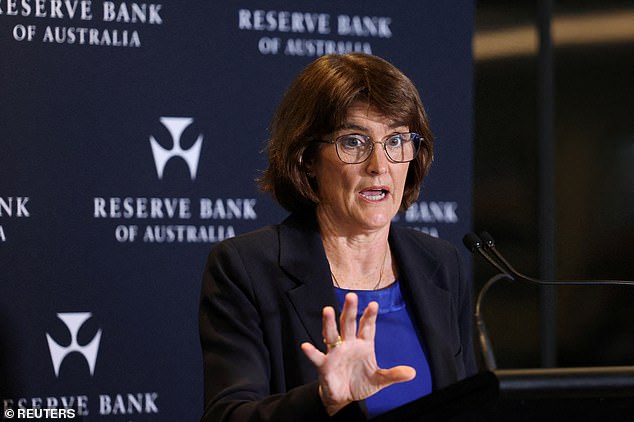
Reserve Bank Governor Michelle Bullock (pictured) confirmed the widely anticipated decision to leave rates on hold after two days of deliberations with her board

REA Group senior economist Angus Moore said falling oil prices following Sunday’s Middle East peace deal are providing some relief on inflation
‘The board is focused on its mandate to deliver price stability and full employment. It will do what it considers necessary to achieve that outcome, including increasing the cash rate target further if required,’ the board’s statement said.
REA Group senior economist Angus Moore pointed to falling oil prices following Sunday’s Middle East peace deal as providing some relief on inflation.
‘While there is still a lot of uncertainty, the fall in oil prices will have given the RBA a little more comfort in holding this month,’ he said.
Despite inflation remaining stubbornly above target, Mr Moore said the RBA is now prepared to step back and assess the damage already inflicted.
‘While the RBA remains focused on inflation, and underlying inflation remains above the RBA’s target band, they are comfortable to wait and see how the effects of the interest rate hikes already in place flow through,’ he said.
The cracks are already showing for Australian households.
Household spending has slowed sharply after a surprisingly strong end to 2025, while Australia’s once red-hot housing market is cooling, with prices flat nationally in May and falling in Sydney and Melbourne.
Mr Moore warned the property downturn is far from over, with higher rates continuing to crush borrowing power and drag on prices throughout the rest of 2026.

Australia’s once red-hot housing market is cooling, with prices flat nationally in May and falling in Sydney and Melbourne
The impacts of the Albanese government’s budget are also being felt in the market, with negative gearing now limited to new-build properties.
Domain’s chief residential economist, Dr Nicola Powell, said Tuesday’s decision was less about the pause and more about what happens next.
‘The RBA has already delivered a sharp adjustment, lifting rates three times in five months and returning policy to restrictive settings,’ she said.
Those aggressive moves are now biting, slashing borrowing capacity and weakening demand, particularly in rate-sensitive markets like Sydney and Melbourne.
At the same time, cracks are emerging in the labour market, with rising unemployment and falling employment signalling a broader slowdown.
Dr Powell said the central bank now faces a delicate balancing act.
‘Inflation is still too high, but the economy is clearly losing momentum,’ she said.
‘How the Bank balances these competing pressures will be critical, not just for monetary policy, but for housing market confidence and activity over the next six to twelve months.’

Domain’s chief residential economist Dr Nicola Powell said the RBA now faces a delicate balancing act, with inflation still too high but an economy clearly losing momentum.
She warned the RBA has not ruled out further pain for borrowers.
‘The Bank is keeping the option open to move again if needed,’ she said.
‘A significant amount of tightening is still flowing through the economy – what happens next will depend on how the balance between inflation and growth evolves.’
Westpac has cautioned borrowers not to mistake Tuesday’s pause as the end of the hiking cycle, with the bank tipping another rate rise as early as August.
That would heap fresh pressure on already stretched households.
Canstar data shows a homeowner with a $600,000 mortgage and 25 years remaining would see monthly repayments jump by $92 from a single 0.25 percentage point hike.
Across four hikes this year – in February, March, May and potentially August – that’s an extra $364 a month.
Canstar data insights director Sally Tindall said the outlook remains highly uncertain.
‘It is highly uncertain which direction the cash rate will go next and when,’ she said.
‘With inflation sitting at 4.2 per cent, the RBA is likely to keep the country on notice that more hikes could still be necessary.’

Westpac has cautioned millions of borrowers not to mistake Tuesday’s pause as the end of the hiking cycle, with the bank tipping another rate rise as early as August
Compare the Market economic director David Koch said the RBA needed to ‘take a breather’, warning the last hike may have already pushed households too far.
‘I just don’t think the Reserve Bank understands how tough it is for Australian households at the moment,’ he said.
‘They’re being crunched, absolutely crunched, by the last three interest rate increases, rising petrol prices, and the uncertainty around tax changes, particularly for small business owners. It is essentially forcing everyone into hibernation.’
Mr Koch warned the real danger is still to come – a spike in unemployment.
‘The latest figures showed a slight increase, but as we know, unemployment is often the last piece of economic data to deteriorate in a downturn and, when it does, it comes with a ‘bang’ out of nowhere and it’s really hard to stop.’
While millions of borrowers are already paying hundreds more each month, NAB economist Josh Copeland believes the next move could ultimately be down.
‘Inflation risks remain elevated… but we expect with restrictive policy and slow growth momentum, the next move from the RBA is likely to be down,’ he said.
Most economists tip no more rate hikes this year, with 16 of 25 forecasting the cash rate will stay at 4.35 per cent.