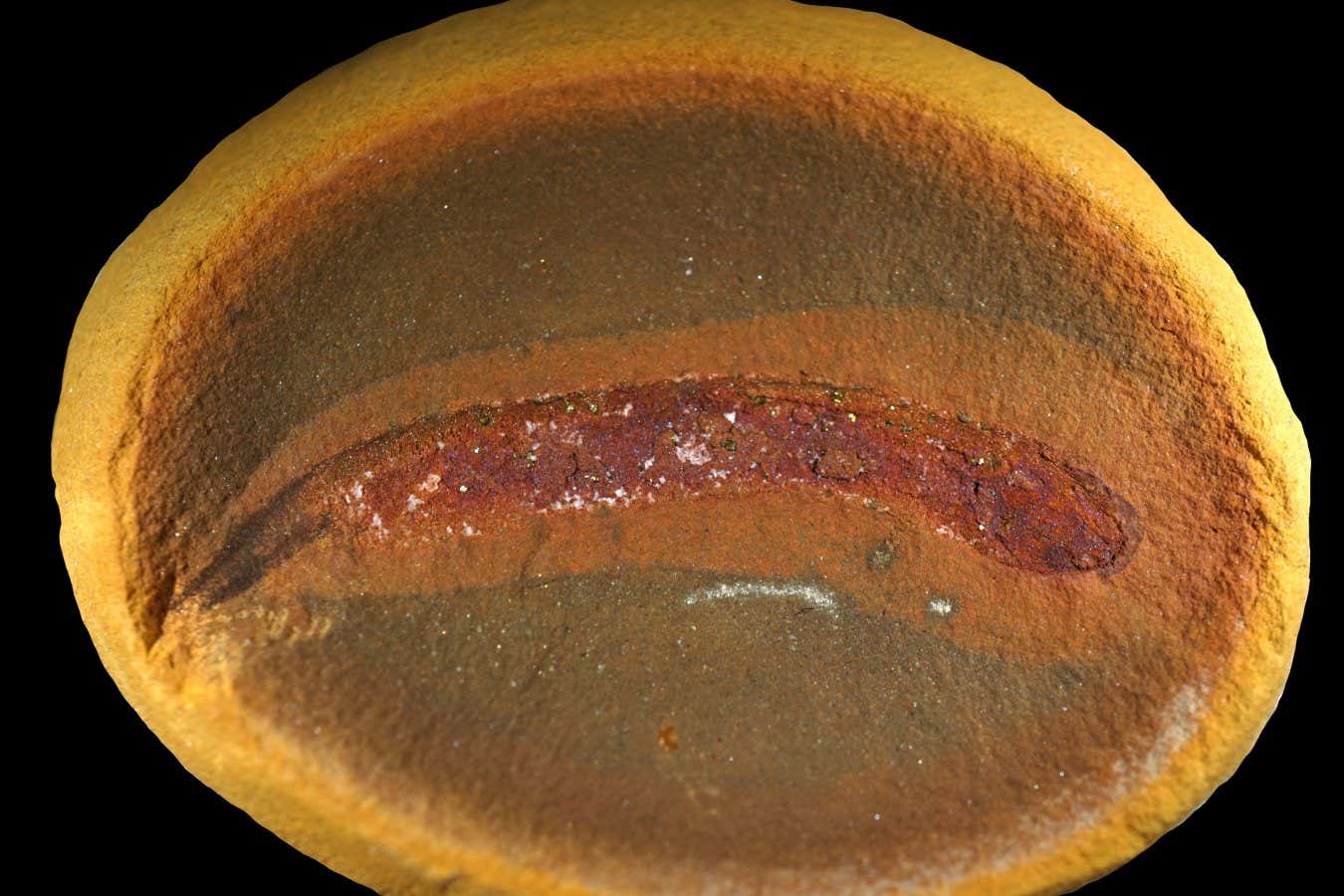

A fossil baby embolomere from Mazon Creek, Illinois
Arjan Mann
A set of exquisitely preserved 300-million-year-old fossils suggests that early four-limbed vertebrates did not undergo a metamorphosis between their juvenile and adult stages, challenging conventional ideas about the evolution of life on land.
“We have for a very long time assumed that these animals were broadly amphibian-like, and that this life cycle would have bridged the gap between life in the water and life on land,” says Jason Pardo at the Field Museum of Natural History in Chicago.
Today’s reptiles, birds, mammals and amphibians belong to a group called tetrapods, which evolved from lobe-finned fish around 390 million years ago. But almost nothing was known about the early developmental stages of these ancestral lobe-finned fish, says John Long at Flinders University in Adelaide, Australia.
Pardo and his colleague Arjan Mann, also at the Field Museum, examined a collection of fossils that were unearthed between the 1960s and 1990s at the Mazon Creek fossil site, south-west of Chicago. The preserved animals lived 307 million to 309 million years ago, during the Carboniferous Period.
Embolomeres, which had a body around 2 metres long in adulthood, were the largest tetrapods in the Carboniferous and one of the top predators. They spent most of their time in water, but had small legs with which they could have clambered onto the land.
The fossils included two 2-centimetre-long baby embolomeres, which were so well preserved that the scientists could see soft tissues and even egg yolk.
In tadpoles, the yolk sac remains inside the body for a few days after hatching as a store of energy. But the young embolomeres had a yolk sac outside the body, similar to the case for some young fish such as lungfish.
Amphibian larvae, such as tadpoles, have external gills that enable them to breathe underwater, but the young embolomeres did not. “The absence of external gills across early development in these animals is the smoking gun,” says Pardo.

Illustration of young embolomeres
Berit Godring
The skull and skeleton have “all the important parts seen in an adult embolomere”, says Pardo. The fossils show that embolomeres remained more or less the same from the time they hatched from their eggs until they reached adulthood.
“Human bodies basically work the same way from birth through adulthood, but we get bigger and our proportions change, but we don’t undergo the sort of fast, rapid change you see in a frog or salamander,” says Pardo. “Our fossils show that this sort of life cycle was the norm for our earliest terrestrial ancestors, too.”
Although embolomeres were aquatic, Pardo argues that the evidence available suggests our earliest terrestrial ancestors did not have a tadpole-like stage either. The team also studied the fossil remains of two other early tetrapod species that were alive at the same time and in the same place as the embolomeres.
“None of these show any evidence of a tadpole-like stage,” says Pardo. “Neither do other fishy tetrapod relatives such as early lungfishes and coelacanths. So is it impossible that a tadpole stage showed up somewhere and was subsequently lost? Maybe, but it seems vanishingly unlikely with the data we have.”
This study fills in a much-needed knowledge gap, says Long. “It shows how early tetrapod-like fishes living about 308 million years ago did not need to develop a tadpole phase in order to invade land, as was previously thought by some scientists.”
Join this extraordinary adventure through the heart of Australia’s fossil frontier. Once a shallow inland sea millions of years ago, eastern Australia is now a hotspot for fossils. Over 13 unforgettable days, you’ll travel deep into the outback, tracing the footsteps of prehistoric giants and uncovering the secrets of Earth’s ancient history. Topics:
Fossil hunting in the Australian outback