



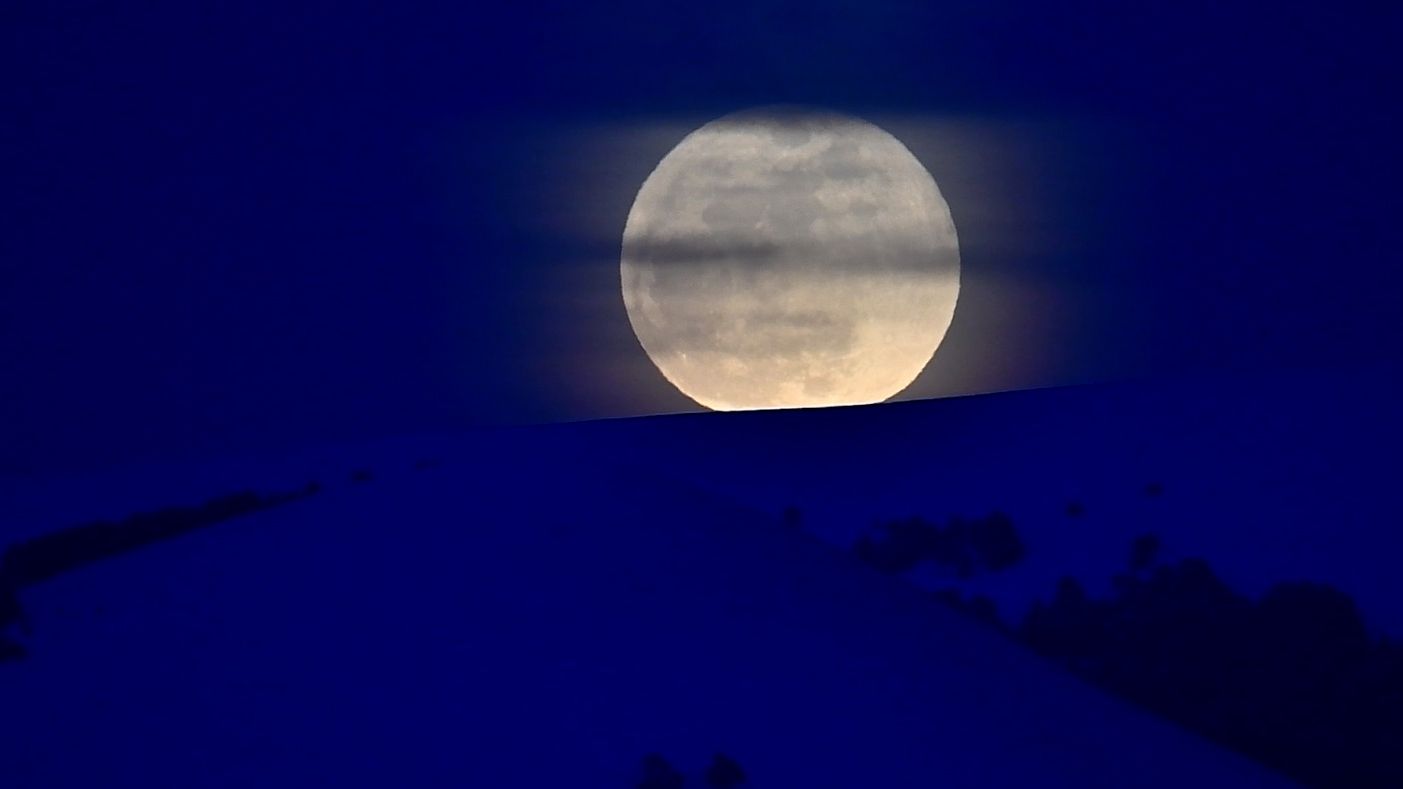
Some lucky southern hemisphere stargazers will catch an incredible sight this weekend, as the “Blue Moon” slips in front of the red star Antares in the heart of the constellation Scorpius, briefly hiding its light mere hours before the second full moon of the month reaches peak illumination.
Fujinon Techno-Stabi 1640

With 16x magnification and some of the strongest image stabilization available, these binoculars deliver detailed views of the moon without needing a tripod by completely eliminating hand-shake. They are also great for observing star clusters, galaxies and constellations.
_
Fujinon Techno-Stabi 1640 review
A Blue Moon is the name given to the second full moon in a calendar month — an event that occurs roughly once every 2.5 years thanks to a quirk related to the length of the Gregorian calendar and the moon’s orbital period. It’s also the name given to the third full moon in a season of four full moons, though sadly, neither name marks a sudden and dramatic change in the color of Earth’s natural satellite.
Stargazers in southwestern Australia, New Zealand, Fiji, Argentina, Chile, and a handful of other southern hemisphere nations will see the next Blue Moon rise above the eastern horizon at sunset on May 31, with the red light of Antares shining close to the lower right of the lunar disk. Over the following hours, the moon will pass directly in front of the red supergiant star, briefly blocking its light in an event that astronomers refer to as an occultation, according to the astronomy website In-the-Sky.
For North American observers on the evening of May 30, the Blue Moon rises in the east as the sun dips below the horizon, with Antares glowing roughly 3 degrees to the lower left of Earth’s satellite — less than the width of your three middle fingers held at arm’s length against the night sky.
The lunar disk will appear to draw closer to the red light of Antares as the pair track a low arc over the southern horizon, before finally setting at sunrise on May 31, with the red star having transitioned to the top of the silver moon.
You may like: What is a Blue Moon and when can you see the next one in 2026?
Want to get a closer look at the moon and dazzling stars like Antares? Then be sure to read our picks of the best telescopes and binoculars for exploring the night sky, along with our beginner’s guide to observing the moon!
Editor’s Note: If you would like to share your moon photos with Space.com’s readers, then please send your image(s), along with your comments, name and location to spacephotos@space.com.