by Samantha Harrington, Yale Climate Connections
June 18, 2026
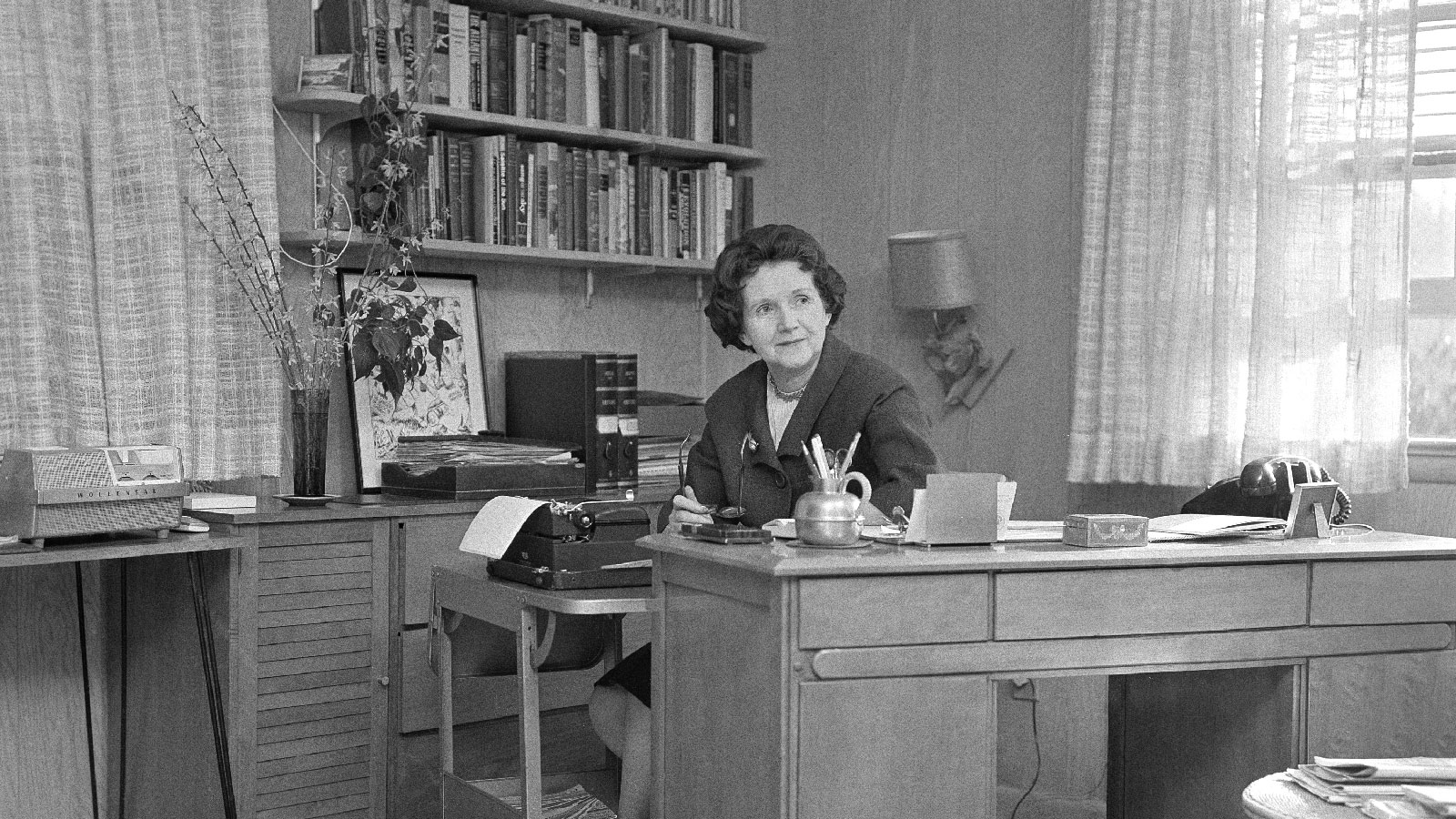
In seaside Maine in 1953, science writer Rachel Carson met Dorothy Freeman and quickly fell in love. Lida Maxwell, author of the 2025 book “Rachel Carson and the Power of Queer Love,” says this moment was a turning point for Carson. As the two women explored Maine summers and spent offseasons writing longing letters, Carson grew more committed and public in her environmental advocacy.
Almost a decade after she met Freeman, Carson published her most famous work, “Silent Spring,” which explored the deadly effects of pesticides. “Silent Spring” was met with a massive disinformation campaign by chemical companies, but ultimately changed public opinion so much that it led to a nationwide ban on agricultural uses of the synthetic pesticide DDT and helped spur the environmental movement that led to the creation of the Environmental Protection Agency.
In her book, Maxwell argues that these victories are inseparable from the love between Carson and Freeman, and that in breaking from traditional models of love and taking time to experience wonder in our intimate relationships, we may all begin to build a healthier, happier world.
This interview has been edited and condensed.
Sam Harrington, Yale Climate Connections: What is the story of Rachel Carson and Dorothy Freeman?
Lida Maxwell: When Rachel Carson met Dorothy Freeman, she had just published “The Sea Around Us,” and that was the book that really established Carson as a major writer. It was a huge bestseller, and with the money, she bought a piece of land on Southport Island in Maine. It turned out to be very close to a cottage that had been in Dorothy Freeman’s family for a couple of generations. Dorothy and her husband Stanley heard that Carson was building a house that was just like a five or 10-minute walk through the woods. And they were both big fans of the book.
Carson found them at the end of the summer of 1952, and she introduced herself, and they had one day-long outing, the three of them, Dorothy, Stan, and Rachel. They went tide pooling, and Rachel showed them things under the microscope. And apparently, Carson and Freeman really hit it off. Carson was leaving the next day to go back to Maryland, and she walked back over that night and left Freeman with a kiss, and they started writing letters to each other, and very quickly, the letters became love letters.
This became a hugely important relationship in Carson’s life, probably the most important relationship, maybe next to her relationship with her mother. And they understood the beauty of their love as analogous to and intertwined with their love of nature. The early 1950s was a hugely homophobic time in American history, and whatever they understood about their feelings for each other, if they had understood them as “Oh, this is homosexuality,” there would certainly be shame, guilt, and social stigma. And they did not understand it that way. Instead, what happened is they called it this beautiful wonder that they could not fully understand. Just like nature was this beautiful wonder that they could not fully understand.
Harrington: How did their relationship change Carson’s work?
Maxwell: As Carson and Freeman’s love accelerated and grew, I think that Carson’s sense of the value of nature both expanded and changed. She always thought it was incredibly valuable, and she was loosely involved with conservationist organizations, but I think her sense of the need to sustain it and live in a sustainable relationship with nature became more urgent for her, and she began to feel more empowered and interested in acting on that in public.
The first way she did that was by trying to conserve this space of land in between their houses, which they called the Lost Woods. And this ultimately failed. She could not afford it. But I think the idea that they both had, Carson and Freeman, was to conserve this piece of land where their love had developed so that others could experience the same kind of pleasure and meaning as well. After that failed, Carson came to see that conservation was really limited in its capacity to do what she wanted. And this is when she started writing her essay, “Help your child to wonder.” And then from there, she started working on “Silent Spring.” And for the first time in her career, she became willing to take on this big political topic.
Harrington: You wrote, “When queer pleasure begins to feel real and possible in one’s own life, it also feels more possible and even more urgent to act in the world on behalf of the life one wants.” How do you see this story of these two women as a story about how intimate relationships can change our political lives?
Maxwell: I think whether we all realize it or not, our political lives are already shaped by our intimate lives. In our intimate lives, we take in this story of what a good life is, what happiness is. For many of us who are born female, we learn, I mean, everybody does, but women learn a particular way that marriage, house, creating this happy domestic space, is the road to happiness. And it’s very much tied in with buying and consuming. So we learn this story in our intimate lives of what a good life is, and I think that really structures, in many ways, most of our understandings of what we want from politics. If this is a good life, my heterosexual marriage with children, in a single-family home where I get to consume and buy all this stuff to make my life easy, then that’s what I want my politics to do for me.
Their intimate experiences opened up a different horizon of what a good life is and therefore opened up a different political horizon. I found that incredibly meaningful in their letters and in Carson’s work, because in climate change politics today, I don’t think we see enough of people imagining or helping each other experience what other kinds of good living are, so that we can actually create motivation for a different kind of political horizon.
Harrington: I want you to talk a little bit more about how you have defined queer love and straight love in the book, because I think it’s so interesting.
Maxwell: I oppose them in the book, straight love and queer love, but straight love is not anybody’s actual experience. It’s like an ideology: The best life is a particular kind of intimate life where it’s heterosexual, and queer people can imbibe this too, you know.
Harrington: Totally, yeah.
Maxwell: But [straight love is] pictured as a kind of heterosexual life with kids with the single family home, with the yard, and especially consumption. And part of what I say in the book is that most of us who have tried to achieve this find that we never actually achieve it. But it leads you to just keep consuming in the hope that you finally achieve it. And I don’t just mean goods. [Feminist scholar] Jane Ward talks about the heterosexual repair industry, with all the self-help books and therapy saying “You guys are the problem. It’s not this whole way of life that’s the problem; it’s you guys. You just need to fix yourself and keep spending money.”
And queer love is not an ideology, it’s a set of experiences that I think that we all have the invitation to enjoy, whether we are in a relationship with someone of the same gender, or a trans person, or if you’re in relationship with someone of a different gender, I think these experiences are out there for all of us: experiences of meaning and joy and pleasure with other people and nature that just do not fit into this dominant story of what a good life is, experiences of pleasure that are not about consumption, that might suggest that, actually, consuming less can lead to a happier and better life. I think there are so many possible good feelings between people that we tend to try to compartmentalize, and allowing things to not fit, to enjoy pleasures of nature and people, [allows us] to find what kind of intimate life actually would make us happy.
Harrington: In the book you write, “We need to start thinking about heteronormativity as a climate issue.” I’m hearing that is related to this consumption-driven life, but I wonder if you could talk a little bit more about it.
Maxwell: That was a big realization for me as I was writing the book. I do feminist theory and queer theory, so I’m a critic of heteronormativity, by which I mean this kind of culture that leads us to want straight love. And I’d always been critical of it, but what I realized is how much it contributes to our passivity, or a sense of powerlessness about climate change. And I mean that in two ways. One is the way it actually feeds the kinds of behaviors and practices that contribute to climate change. Like, if the only kind of happy life I can have is a heteronormative happy life, then I’m going to keep buying all this stuff, burning the fossil fuels to make it happen, living in this unsustainable way. It also narrows our worldview. So we get habituated out of the experience, the way of living, and the way of experiencing the world that would allow us to find other kinds of pleasures.
Harrington: One can read a lot of parallels into the time in which Rachel Carson and Dorothy Freeman were falling in love — peak McCarthyism — and today. People are fighting for the EPA to be able to regulate pollution, and we’re seeing a ton of discriminatory laws against trans people. How has exploring their relationship changed how you think about the power of queer love in the U.S. in 2026?
Maxwell: This is a really depressing time in many ways, right? The EPA, it’s there in name, but it’s essentially eviscerated right now. Whatever was built out of Carson’s book [Silent Spring], and the other parts of the environmental movement is really gone. And as you’re saying, we’re seeing a huge attack on trans rights and queer rights overall to a degree.
But I think Carson and Freeman teach me two things. One is that we should see these struggles as connected: The struggles for queer rights and trans rights is part of an environmental struggle, not only because we believe all creatures, human and otherwise, deserve dignity and rights, but also because making trans and queer lives possible is part of fighting climate change.
And the second way that I find them teaching me is that things are possible. Things seem bleak, but even the experiences we have in our intimate lives can give us courage to build something new. The power of queer love, they teach me, is real for all of us, and that there are real resources in our intimate lives for politics. We’re often taught to look away from those, but our intimate lives are where we are creating connections and power to bring to [policy] arenas.
And actually, the third thing is, they have torn so much down, but Carson shows you can build it back up. With so many other people working on these issues, maybe we see this as an opportunity to build something better back from what they’ve done. We don’t hear stories about queer love having this kind of power every day. So it’s a very meaningful story for our moment.
This <a target=”_blank” href=”https://yaleclimateconnections.org/2026/06/rachel-carson-and-the-power-of-queer-love-explores-how-intimate-relationships-can-spur-political-action/”>article</a> first appeared on <a target=”_blank” href=”https://yaleclimateconnections.org”>Yale Climate Connections</a> and is republished here under a <a target=”_blank” href=”https://creativecommons.org/licenses/by-nc-nd/4.0/”>Creative Commons Attribution-NonCommercial-NoDerivatives 4.0 International License</a>.<img src=”https://i0.wp.com/yaleclimateconnections.org/wp-content/uploads/2020/10/ycc-favicon.png?resize=100%2C100&ssl=1″ style=”width:1em;height:1em;margin-left:10px;”>
<img id=”republication-tracker-tool-source” src=”https://yaleclimateconnections.org/?republication-pixel=true&post=139218&ga4=1401ERFF5Q” style=”width:1px;height:1px;”><script> PARSELY = { autotrack: false, onload: function() { PARSELY.beacon.trackPageView({ url: “https://yaleclimateconnections.org/2026/06/rachel-carson-and-the-power-of-queer-love-explores-how-intimate-relationships-can-spur-political-action/”, urlref: window.location.href }); } } </script> <script id=”parsely-cfg” src=”//cdn.parsely.com/keys/yaleclimateconnections.org/p.js”></script>