Russia’s decision to strip tanks and heavy military hardware from its Victory Day parade suggests Ukraine may now hold the upper hand in the war, according to experts.
The scaled back May 9 event in Red Square marks a significant departure from the traditional display of military strength, coming more than four years into a conflict that has killed hundreds of thousands and drained economic resources.
In recent months, Kyiv has intensified long range strikes on energy and military infrastructure far behind the front lines, with waves of drones regularly launched towards Moscow.
Kremlin spokesman Dmitry Peskov said the changes were driven by security concerns, telling reporters: ‘Against the backdrop of this terrorist threat, every measure is being taken to minimise the danger.’
However, analysts believe the real reason goes beyond safety fears, reflecting a deeper strain on Russia’s military as Ukraine steps up its offensive.
Speaking to the Daily Mail, Keir Giles of Chatham House said the move is likely linked to difficulties on the battlefield.
‘Putin hasn’t described the real reason for a decision like that, but we can guess that this is due to any one of a number of reasons all to do with the pressure that Russia is under trying to prosecute its war against Ukraine.’
He added that heavy losses may be limiting Russia’s ability to stage a full scale display.

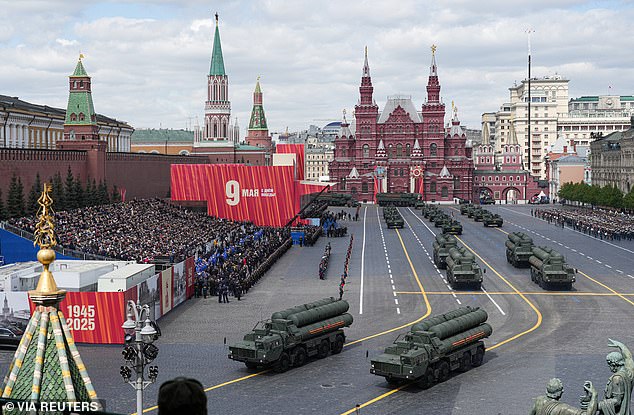
A view shows Red Square during a military parade on Victory Day

Vladimir Putin has axed tanks and military hardware from Russia’s annual WW2 parade through Red Square over fears that Ukraine could launch an attack
‘That could mean simply the shortage of military units that some commentators have suggested is a result of the massive casualty toll that the meat grinder has taken on Russia’s forces. Entailing a lack of ability to mount a parade at all.’
‘There are no explanations for what Putin has done that do not one way or another come down to Russia’s inability to defeat Ukraine.’
Ukrainian strikes are now reaching deep into Russian territory at distances of up to 932 miles, targeting critical infrastructure.
There are reports of significant damage to oil production and air defence systems, while Moscow appears increasingly unable to prevent such attacks, with economic consequences beginning to take hold.
Writing for the Telegraph, former British Army officer Hamish de Bretton Gordon said the war is turning against Russia, with its forces losing ground and suffering unsustainable casualties.
He said that replacements are poorly trained and reportedly include ethnic Russian conscripts who are not meant to be deployed beyond Russia’s borders, adding little to combat effectiveness while increasing losses.
He said awareness of these setbacks is spreading دthrough Russia and fuelling discontent.
‘The reduced parade becomes more than symbolism; it is an admission of decline,’ Gordon wrote.
‘Even after redeploying advanced air defence assets like the S-400 missile system away from the front lines, the Kremlin cannot guarantee the security of its own capital.’
Giles agreed that this reveals major Russian weakness, shattering the Kremlin’s carefully curated image of superior military power.
‘This is a direct admission of the fact that Ukraine can, in theory, strike directly into the heart of Moscow and threaten a flagship event like this that is a major fixture in the Russian national calendar,’ he said.
‘If that is being presented as the reason for making the 9th of May parade a less attractive target for Ukraine, then it’s a major admission of weakness and incapacity by the Russian state.’
‘It does not fit with the pretence that Russian air defence is working well and is able to mitigate the threat from Ukraine’s long range munitions.’
Several military schools, cadet corps, ‘as well as the military hardware column, will not be participating in this year’s military parade due to the current operational situation’, the Russian defence ministry had said Tuesday night on Telegram.
Last year, Ukraine sought to disrupt the flagship event by launching swarms of drones at Moscow, causing travel chaos with thousands of flights cancelled or delayed.
Russian pro-war blogger Alexander Sladkov said the decision was ‘logical, given the circumstances.’

Russian T-80 BVM tanks roll in Red Square during the Victory Day military parade in Moscow, Russia, Friday, May 9, 2025

Troops march during a rehearsal for the Victory Day military parade at the Dvortsovaya (Palace) Square in St. Petersburg, Russia
The May 9 parade commemorates the Soviet victory over Nazi Germany and has become a huge set-piece event under Putin.
World War II, known in Russia as the Great Patriotic War, is the central historical narrative of Putin’s quarter-century rule.
The former KGB spy repeatedly invokes Soviet victory over Nazi Germany to justify his offensive against Ukraine, a claim dismissed by Kyiv as propaganda.
Last year, more than two dozen world leaders, including Chinese President Xi Jinping, were in Moscow to watch a procession of thousands of troops – some of whom fought in Ukraine.
It comes as Putin is more unpopular than he has been in years, with a poll by the Kremlin-affiliated FOM polling institute showing only 71 percent of Russians trust their president – the worst result in seven years.
Meanwhile, dissent in Russia is being crushed. Those speaking out against Putin and the war in Ukraine are facing imprisonment in penal colonies, while public opposition, including protests against internet censorship, is severely stifled.
‘Putin and Russian leaders in general are always concerned about the prospects for threats, not from the victims abroad, but from their own population,’ Giles explained.
However, he added: ‘There are no indications that are discernible from outside Russia that any kind of popular discontent within the country is getting anywhere close to presenting a threat to Putin’s leadership.’
Putin, in power as either president or prime minister since the end of 1999, has repeatedly promised stability and spoken of the destructive nature of revolutions.
But the leader himself recently admitted Russia’s economy was performing below his expectations.
While the country has seen a jump in oil revenue as a result of the conflict in the Middle East, the president has since admitted that it would be short-lived.
Putin recently said that Russia’s GDP fell by 1.8 per cent in January and February, while Russian central bank governor Elvira Nabiullina recently said ‘external conditions are now getting worse on an almost constant basis — for both exports and imports’.
Russia was forced to reduce its oil output in April due to Ukrainian drone attacks on ports and refineries, as well as a halt to crude supplies via the only remaining Russian oil pipeline to Europe.
In what could be the sharpest monthly decline in Russian output in the six years since the Covid-19 pandemic, Russia may have cut production by about 300,000 to 400,000 barrels per day in April, from the average level seen in the first months of the year.