

A strategic Arctic sea route could become Vladimir Putin’s latest weapon against the West, with experts warning Russian control of the potential ‘chokehold’ would leave Britain vulnerable to hypersonic nuclear strikes.
Known as the Bear Gap, the roughly 400-mile-wide gateway serves as Russia’s access route from the Arctic into the North Atlantic.
It lies on the western flank of the Kola Peninsula, where much of Russia’s nuclear arsenal is based and where the Kremlin’s Northern Fleet is concentrated.
Norwegian defence minister Tore Sandvik said the area has become increasingly significant as Russia expands its military capabilities in the Arctic and deploys submarines more frequently near Nato waters.
Speaking to The Times, Sandvik warned that Moscow could seek to dominate the region as part of a strategy to shield its nuclear forces while improving naval access to the Atlantic.
‘It’s homeland defence for the UK,’ he said. ‘If Putin gets control of the northern part of Scandinavia, if he can control the Bear Gap, this is a direct threat against the UK.
‘If you cannot track the submarines, if you cannot hold the northern part of Nato, then we all are under threat from Russia. This is the same for the Americans. It’s homeland defence.’
The warning comes as Britain is increasing its military footprint in northern Norway.
Earlier this year, the UK announced plans to double its troop presence in the region to 2,000 personnel, making it the country’s largest overseas deployment despite ongoing manpower pressures within the armed forces.
According to Sandvik, securing the High North is not only important for Arctic stability but also for Britain’s own security.
‘We see what kind of weapon systems Russia is developing, and we know that if they can control the Bear Gap, they can also use hypersonic missiles against Nato… against London, against Norway, against Denmark,’ he said.
‘They are developing weapon systems, which tells us that we cannot let them control the Bear Gap.’
Among the weapons cited by Norwegian officials are the Zircon hypersonic cruise missile, which can reportedly travel more than 600 miles and carry nuclear warheads, and Poseidon, a nuclear-powered underwater drone designed to deliver atomic payloads.
The Poseidon is said to be 20 metres long and nearly two metres wide. Reports indicate that it weighs 100 tons.
It is capable of travelling up to 6,200 miles with a speed of 115mph deep underwater.
The Kremlin’s propaganda machine has repeatedly claimed that the Poseidon could ‘sink’ Britain under ‘radioactive tidal waves’.
Sandvik argued that the Bear Gap now occupies a role similar to that played by the Greenland-Iceland-UK Gap during the Cold War.
Nato already controls two other major maritime chokepoints that affect Russian naval movements: the Bosphorus Strait, which provides access from the Black Sea, and the Danish straits connecting the Baltic Sea to the wider Atlantic.
That leaves the Arctic corridor as one of Moscow’s most viable routes for projecting naval power beyond its immediate coastline.
‘Russia views this maritime area as integral to its so‑called “Bastion Defence” strategy,’ Kristian Atland, a senior research fellow at the Norwegian Defence Research Establishment, told Al Jazeera.
He added: ‘In order to ensure the safe operation of the Northern Fleet’s ballistic missile submarines in the inner part of the bastion, that is, in the Barents Sea, Russia wants to be able to control the Bear Island gap.’
Although the corridor lies within an area dominated by Nato members Norway, Canada and other allied states, Russia maintains significant military capabilities close by.
Atland warned that because of this, control over this pass could enable Russia to ‘limit Nato’s ability to deploy anti‑submarine warfare assets into the Barents Sea to detect, locate, and track Russian strategic submarines’.

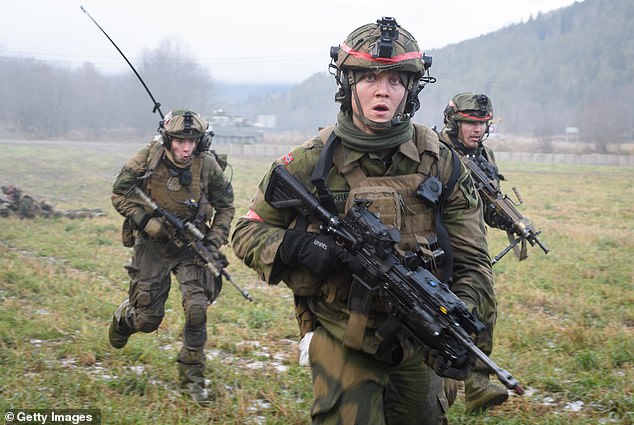
Norwegian soldiers run for cover during a live exercise which saw them attempt to storm an opposing British Army position

Defence Secretary John Healey meets soldiers deploying an 81mm mortar near Bardufoss, Norway, in February
Norway has responded by strengthening its military presence in the far north. It is creating its first new army brigade since the Cold War and expanding both artillery and air defence systems in Finnmark, the northernmost county in the country.
The region’s geography also gives Nato an advantage. The seabed drops sharply from the relatively shallow Barents Sea into deeper Atlantic waters, creating favourable conditions for monitoring submarine traffic.
‘[The Bear Gap] is the easiest place we can control and monitor and keep track of the submarines because of shallow waters,’ Sandvik said. ‘There, we can see them and we can also do the early warnings and follow them.’
Western concern over Russian underwater activity has grown in recent years.
In April, UK Defence Secretary John Healey revealed that three Russian submarines, including an Akula-class attack vessel, had been detected attempting to gather intelligence on undersea communications infrastructure near British waters.
Sonar buoys – which track underwater movements using acoustic signals – were dropped into the water to deter the Russians from targeting the cables, which carry vast amounts of valuable data.
Addressing Putin, Healey said: ‘We see your activity over our cables and our pipelines, and you should know that any attempt to damage them will not be tolerated and will have serious consequences.’
Aided by allies including Norway, Britain deployed 500 personnel onboard a warship and a Royal Air Force P8 aircraft, which flew for more than 450 hours before the Russian subs retreated.
Healey said Putin had sought to capitalise on the world being ‘distracted’ by the Iran war and said his actions showed it was ‘not in Britain’s national interest’ to deploy large parts of the Royal Navy to the Middle East.
He told a press conference that he wanted to expose Russia’s targeting of Britain’s underwater infrastructure and vowed to ‘step up’ efforts to protect it.
The Ministry of Defence has also reported a 30 per cent rise in Russian maritime activity considered threatening around the UK over the past two years.
Attacks on undersea infrastructure could cause major disruption to the financial and communications systems Britons rely on.
To improve surveillance and protect critical infrastructure, Britain and Norway signed a defence agreement last year.
Under the arrangement, the two navies will operate a combined force of at least 13 vessels tasked with tracking Russian submarines in the North Atlantic, with Britain providing at least five ships as part of a £10billion programme.
Attention is also focused on Svalbard, where Russia maintains a population of about 350 people connected to a shrinking coal-mining operation in Barentsburg on Spitsbergen, the archipelago’s largest island.

The Ministry of Defence has also reported a 30 per cent rise in Russian maritime activity considered threatening around the UK over the past two years

The Poseidon is said to be 20 metres long and nearly two metres wide. Reports indicate that it weighs 100 tons
Norwegian intelligence recently assessed that Russia is likely to seek greater freedom of action in the territory.
Nato’s hybrid threats monitoring centre has separately accused Moscow of applying pressure through information operations and maritime signalling.
The alliance has reportedly conducted exercises based on the possibility of a Russian amphibious craft landing on the islands.
The Atlantic Council has identified Svalbard as one of the five locations most vulnerable to potential future Russian aggression beyond Ukraine.
Despite those concerns, Sandvik said Norway has not observed signs of an immediate threat.
‘The Kola peninsula and the Arctic [are] important for the Russians, and they use a lot of resources to develop that,’ he said.
‘But they don’t want to increase the tension in the north, because they are occupied down in Ukraine, and because they are struggling with their own economy, which is really, really bad.’
China’s growing interest in the Arctic is also being watched closely. Beijing declared itself a ‘near-Arctic’ state in 2018 and has invested heavily in polar infrastructure, including icebreakers.
The Northeast Passage, which runs along the Russian and Norwegian coasts and offers a significantly shorter shipping route between Europe and Asia than the Suez Canal, remains a particular focus.
However, Sandvik said Norway has not witnessed a major increase in Chinese activity in the region and rejected suggestions that Chinese vessels are operating extensively around Greenland.
Even so, Oslo’s domestic intelligence service has identified China as a country seeking intelligence on Norwegian territory.
In recent weeks, authorities arrested two Chinese nationals in northern Norway in separate espionage investigations.
Although Russia and China continue to cooperate on Arctic shipping, energy projects and scientific research, Sandvik suggested there are limits to that partnership.
‘There’s a kind of ambiguity from the Russians about China up there,’ he said. ‘They are closely co-operating, but Russia … they want to be the hegemon in the Arctic. They don’t want them [the Chinese] to be too active up there.’