


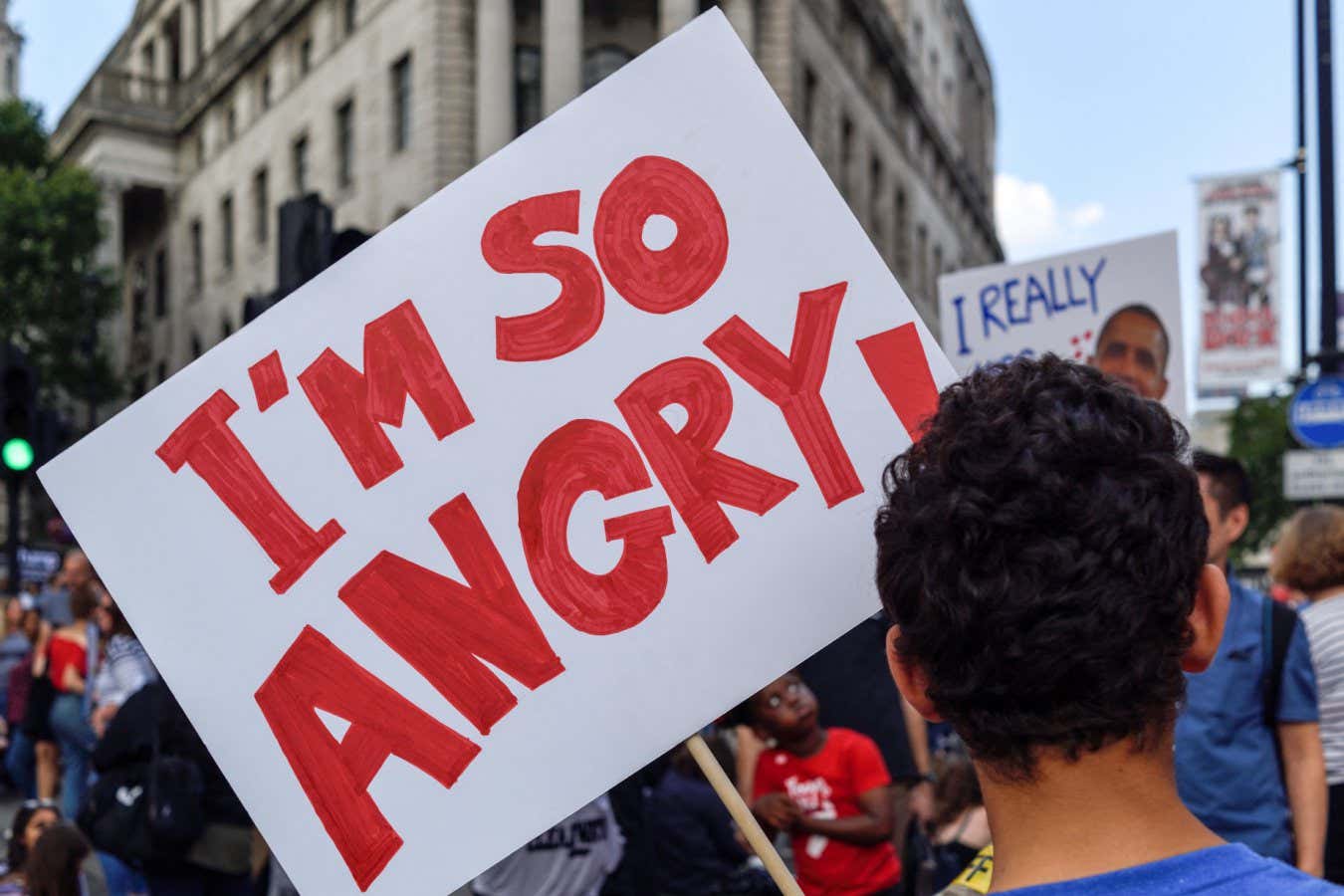

The intensity of politically induced anger and disgust may be what spurs people to protest
Ian Francis/Alamy
If the emotional rollercoaster of global politics feels overwhelming, the findings of a new study might help to explain why. Emotions evoked by political issues seem to be felt differently in the body than when the same emotions are experienced in everyday life. Understanding how and why this happens may offer clues to how we can stay calm while remaining informed and engaged citizens.
“Feeling more is probably a good thing for democracy,” says Manos Tsakiris at Royal Holloway, University of London. “Feeling better is about first figuring out what you feel, and then the challenge is learning how to respond rather than react.”
Tsakiris and his colleagues asked nearly 1000 people to mark on a body-outline diagram where, and how intensely, they felt emotions including anger, disgust and hope. Then, they were asked to do the same, but while reading words associated with emotionally laden political issues, such as terrorism and crime.
Their responses were used to create a digital heat map, which covered where in the body each emotion was felt, how intensely, and whether the sensation was linked to feeling spurred into action or demotivated and detached.
Previous research suggests that many emotions are experienced similarly in the body in different people, and the patterns of activation or demotivation seem to be universal across cultures. Depression, for instance, almost universally shows widespread deactivation across the body, reflecting a lack of energy and motivation, while anger is felt as a high energy, activating sensation in the chest, head and arms.
The new study largely reflected these past findings, except when some emotions were evoked by politics. “People usually feel that their whole body is deactivated when they’re depressed, but politically linked depression is more mobilising”, says Tsakiris, with more intense sensations experienced throughout the torso and limbs.
Political disgust was also felt as a higher-energy sensation across the upper body, compared to non-political disgust which clusters around the gut. When compared with non-political emotions, “political disgust more closely resembles anger”, says Tsakiris.
Why this occurs isn’t clear, but Tsakiris speculates it might be because political issues feel too big to tackle on our own, so we might feel motivated to join a wider cause to effect change. “The sense of agency that we have in politics is quite different,” he says. “We cannot probably effect a change on our own. It will be a collective effort.”
By getting better acquainted with our emotions, we may be able to avoid getting trapped in a cycle of doom scrolling and despair, says Lisa Quadt at the Brighton and Sussex Medical School, UK. “We like to think of ourselves as rational beings, but that doesn’t consider how the body influences our decisions, behaviours and responses.”
Quadt and her colleagues have previously shown that training people to listen to their heartbeat and other bodily sensations associated with strong emotions reduced overwhelm in autistic people with anxiety. Getting more in tune with how we feel, “might indeed help to become less overwhelmed by negative emotions and perhaps then enable action, rather than avoidance”, she says.
Topics: