


If you’re looking to book your summer holiday soon, no doubt you’ll check the reviews on a site such as Tripadvisor, where previous guests upload photos alongside their evaluations.
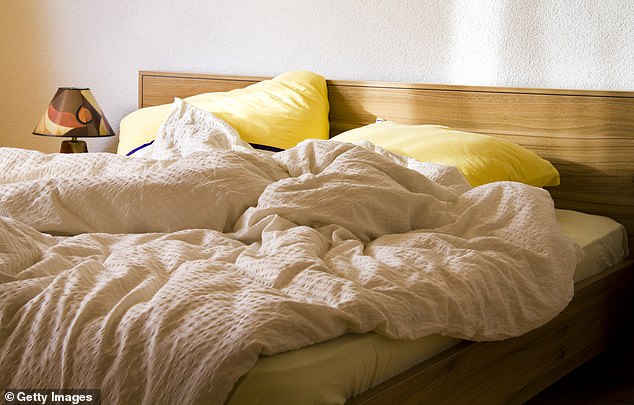
But even the most glowing appraisal may fail to win us over – if accompanied by a picture of the bedroom the happy holidaymaker spent their week in.
We find being shown a reminder that someone has been in the room off-putting – even though we already know people stay in hotels and that rooms are cleaned before we set foot in them.
And, the study showed, people are less keen to book hotels when the reviews include these types of photos.
‘There is a difference between knowing in the abstract that a hotel room has been used by previous guests and being visually confronted with a particular moment when the room appears to have just been lived in,’ said the study’s co-author, Rubing Bai, from Shandong University of Science and Technology in China.
‘Visible traces of another guest’s prior use [in their online review] can make the previous occupancy feel more concrete, immediate, and personally relevant.
‘In our study, we describe this reaction as virtual contamination.’
These bedroom photos are so-called ‘cues’ that break our expectation of a ‘a private space’ free from others, the researchers explained in their paper, published in the International Journal of Hospitality Management.

Holidaymakers were found to be less likely to book a hotel room if they saw pictures of it in use
Cathrine Jansson-Boyd, professor of consumer psychology at Anglia Ruskin University, who was not involved in the study said: ‘Consumers don’t want to see how others are using the rooms.
‘We like to think about how we will “fit” in the room, rather than by what others do in there.’
Over four separate experiments the researchers showed 785 people hotel reviews with photos showing two versions of the same room: in one version the room was clean but had evidence someone had been in there, while in the other half the room was clean but no one had entered.
They then asked the participants to rate on a scale how likely they were to book; booking intention dropped by 15.9 per cent when they saw the occupied room.
The study also found that photos of occupied public areas, such as hotel restaurants, did not put people off.
Unlike bedrooms which are viewed as ‘temporarily exclusive private domains’, public areas are understood to be communal by design, so evidence of people being there aligns with our expectations.
‘Consumers naturally recognize these spaces are for multi-person use, so they do not expect “no traces of others’ occupancy”,’ the academics wrote in their research paper.
‘When seeing photos of occupied public areas, consumers do not associate others’ occupancy with virtual contamination, and they may even view it as a sign of normal operation or popularity.’