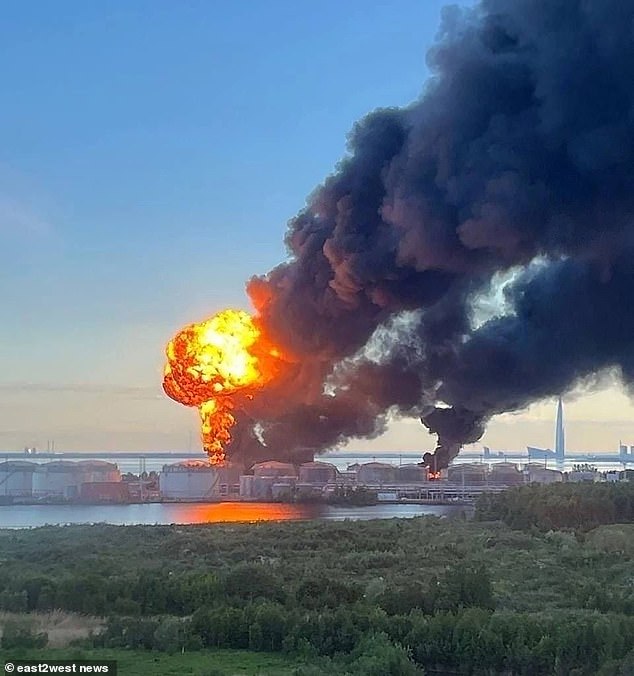
In more than four years of war, one may think many Russians have become immune to the devastation caused by drone strikes such as the one that hit St Petersburg in the early hours of Wednesday.
Ukrainians are forced to suffer it daily, as are residents of some of the Russian regions that border the country it invaded.
But Vladimir Putin’s birthplace has seldom heard the ominous buzzing – like a flying lawnmower or a large swarm of bees – before the deafening and often deadly explosions.
On Wednesday, Ukraine was sending the war home to Russia while Putin staged his own grandiose version of the Davos World Economic Forum (the St Petersburg International Economic Forum) amid the spires of the historic city where he grew up.
The city’s oil terminal went up in flames and a £120million naval corvette vessel (the Boykiy) was ripped apart in the nearby Kronstadt military base, which headquarters Russia’s Baltic Fleet. Across the city, fires broke out as infrastructure targets were hit.
The irony of the forum’s slogan, ‘the pathway to a stable future’, was not lost on its 20,000 delegates from more than 130 countries, as a huge column of smoke from the blazing St Petersburg oil refinery – supplier of energy to Putin’s war machine – hung over the city.
It was a shocking humiliation for the president, who was due to speak at the conference, and terrifying for residents.
‘We’ve been bombed for the last two hours,’ Vika, 45 and a friend of mine, messaged me during the onslaught from Ukraine’s long-range ‘Liutyi’ (‘fierce’) drones. ‘Luckily my parents are further away, so they didn’t hear much.’

St Petersburg’s oil terminal went up in flames and a £120million naval corvette vessel was ripped apart in the nearby Kronstadt military base on Wednesday following drone strikes
‘I can’t sleep. I found my son with a pillow covering his head to make it go away. What can I say? This is the taste of our own medicine.’
Russians – even those who opposed Putin’s war – are now reaping what he has sowed.
One woman cowering in her bathroom was cut by splinters of glass from an explosion hundreds of yards away. ‘Panic, terror,’ summed up a male resident regarding this week’s events. ‘We thought we were safe, being some 600 miles away from Ukraine.’
Yet they were, in a sense, fortunate. Yes, they choked on the noxious fumes from the smoke shrouding Russia’s former tsarist capital.
But no one was killed, and Ukraine chose military targets – unlike Putin, who cold-bloodedly seeks out Ukrainian civilians in such attacks.
The truth is that after months of grinding and bloody attrition in the war, the tide appears to be turning in Ukraine’s favour.
Massive drone attacks are reaching deeper into Russia to hit vital infrastructure targets, following dramatic improvements in technology and support from the West.
What Putin declared would be a ‘three-day special operation’ in February 2022 has become a crisis from which the Russian President seems unable to escape.

The drone strikes were a ‘humiliation’ for President Putin, who was due to speak at a conference, and terrifying for residents
The success of these attacks is becoming increasingly evident to a despairing Russian people despite state-enforced internet and broadcast crackdowns.
A month ago, drones were launched at Moscow for three successive days in the run-up to the Victory Day parade celebrating the defeat of the Nazis in the Second World War.
What should have been a showcase of military might was scaled down to a shadow of the great parades of the past.
Also in the past month, Ukraine has used its new domestically produced missile and drone capability to wreak havoc on Russian oil refineries (one has been destroyed or badly savaged every two days), with catastrophic consequences for the economy.
One recent hit was a big facility in Feodosia, in Russian-occupied Crimea, deepening a rapidly growing crisis in this tourist mecca, caused by constant attacks.
Meanwhile, a hit on another port, Tuapse, triggered pollution that has contaminated vast stretches of coastline, making the Black Sea a more literal name.
Bathers emerge from the water with their bodies smeared in oil. ‘My children’s skin is patched in black from playing on the beach,’ says Tatiana, 37, who is holidaying there. ‘Yet they tell us it’s safe as the summer begins.’
The pollution has even reached the beaches around Putin’s £1billion clifftop palace at Gelendzhik, with multiple underground floors, including a bunker, and likened to the lair of a James Bond villain. It was originally designed with a striptease stage and pole-dancing hookah hall.

One month ago, drones were launched at Moscow for three successive days in the run-up to the Victory Day parade
His secret children with the 43-year-old Olympic gymnast, Alina Kabaeva – Vladimir, seven, and Ivan, 11, who are educated by governesses from Britain and other Nato states despite the war – may find the oil a serious hazard if they spend their summer holidays there.
For ordinary Russians, hotels in the holiday hotspot of Sochi – which is far from immune to drone strikes – are offering discounts of 15 per cent. So far only a quarter of the resort’s rooms have sold for the season.
‘We booked Sochi because we can’t afford to go abroad due to Western sanctions over the war, but I’ve just cancelled due to safety concerns,’ said Igor, 42, a bank analyst.
‘Last month the drones came to our district in Moscow and my wife freaked out about keeping the kids safe.
‘She fears for us in Sochi, which is targeted much more by Ukraine’s armed forces.’
One online tour guide warned would-be vacationers to stay away from the Black Sea due to the threat of drones, explaining: ‘You’ll soon understand why a room with a panoramic sea view suddenly became cheaper than one on the ground floor with a view of a stone wall.’
Fuel shortages have hit the tourist spots of Crimea, where Olga, 29, is holidaying with her young children after driving from blitzed St Petersburg.
She fears they will not get back home because of Soviet-style petrol rationing following months of relentless Ukrainian strikes on oil refineries, pipelines and depots, as well as supply routes.

The success of drone attacks is becoming increasingly evident to the Russian people despite state-enforced internet and broadcast crackdowns
‘This damned war,’ she said. ‘Why are we fighting? What for? I just want a normal life.’
A Red Army colonel’s daughter, her private view of Putin is unprintable – but she, like many Russians, is scared to voice it publicly. ‘Just end it,’ she pleaded.
‘My favourite beach, which I’ve known since childhood, is full of dragon’s teeth [military barricades to deter a feared Ukrainian invasion]. How long must this madness go on?’
Astonishingly, Sevastopol – headquarters of the Russian Black Sea Fleet – is itself out of fuel. And experts say Crimean-style petrol shortages over vast swathes of Russia’s 11 time zones are now almost inevitable.
Indeed, last week there were signs of rationing in Moscow, St Petersburg and several of the regions.
One major reason for the acute shortage in Crimea is instructive: Ukraine is bombarding the key land route to the tourist hotspot with precision drone strikes, day and night.
This road, a vital supply artery for the Kremlin’s military machine across its annexed territory, has become a terrifying game of Russian roulette for truck drivers, many of whom have died on their journeys.
The 390-mile route is called the ‘Novorossiya’ (‘New Russia’) trunk road, but it’s become known as ‘Hell’s Highway’ as it’s littered with hundreds of burnt-out and exploded lorries.
Russian military figures admit that Kyiv’s medium-range drone pilots now have ‘fire control’ over the road even though it is far from any Ukrainian-held territory.
The alternative route – the Crimean Bridge, Putin’s £3billion pride and joy constructed in 2018 – is already badly weakened by earlier Ukrainian strikes and cannot carry heavy loads.
It is just another example of Ukraine taking the war to Russia with a vengeance. As President Zelensky said of the conflict: ‘We’re sending it home. This is absolutely fair.
In addition to justice, it is also very effective.’ Everywhere, there are indications of Ukraine’s strikes causing real damage; this week, for the first time since the start of the war, the Russian government banned aviation fuel exports until the end of November.
Another weathervane is the soaring prices in supermarkets, despite blithe Kremlin assurances that they are under control.
‘They have risen sharply, and life has become much harder,’ said Vera, 40, from Moscow. The cost of bread jumped 15 per cent in a year, eggs 25 per cent, beef 13 per cent and vodka 17 per cent.
‘Soon the selection in stores will be limited to just two items – common cabbage and standard potatoes,’ moaned fellow Muscovite Alex.
‘My diet is changing in accordance with the shrinkflation, I’m trying to eat less,’ acknowledged Boba. ‘We’ll only see real, juicy vegetables on TV, in shows about the good life. On holidays, we’ll splurge and cut up a single, rare tomato into a salad.’
Food shortages remind one of a joke in Soviet times about a man walking into a shop and asking: ‘Do you have any meat?’
He is told: ‘No, this is the shop that has no fish. The shop that has no meat is across the street.’
More and more people are privately voicing anti-war sentiments, said Boba.
‘I’ve seen them in shops, in the street, in hospitals, or at clubs and classes. It’s the only thing that still gives me the strength to carry on at all.’
As another young Russian, Sasha, said: ‘I used to be quite a patriot and among people who supported the war and displayed the ‘Z’ symbol [expressing solidarity with Russia’s military] – something I am deeply ashamed of today.’
Meanwhile, as the war is coming home to roost, its cost to Russia’s economy is becoming intolerable.
This week, Putin’s ministry of finance and the Central Bank of Russia directly warned the Kremlin leader that his current levels of military spending were unaffordable for the state and carry critical risks for the economy, according to Bloomberg.
He risks a ‘dangerous expansion’ of the state budget deficit, and cuts to his ballooning war budget are now essential, Putin has been told – at the very moment he is losing territory on the frontline and suffering truly grievous blows inside Russia for the first time during the conflict.
When the war in Ukraine started four years ago, then-prime minister Boris Johnson vowed to ‘hobble the Russian economy’ with Western sanctions.
It’s been a slow process, as Russian resilience and its capacity for evading sanctions has surprised Nato capitals, but by combining the sanctions with targeted Ukrainian strikes, there is good reason to think we may be reaching a tipping point.
The question is how Putin reacts. He looks ever more tired and weary and some see signs of dementia.
‘He repeats words, stammers, gets confused, and struggles to pronounce names,’ said independent media outlet We Can Explain.
Political commentator Andrey Okun added: ‘Our perception of Putin has changed beyond recognition. He probably never felt like a democratic president, but he certainly exuded a far stronger aura of power… Now he feels, perhaps, first and foremost, stuck.
‘Stuck in his own lies, which have accumulated so much deception that, I think, he’s even lost the thread of logic.’
And yet, as Artyom, a 56-year-old opposition activist says: ‘While the mood is turning against Putin and the war, there is no readiness or ability to get out on the streets and protest. People are too cowed by the law enforcement apparatus, which beats and tortures anyone who steps out of line.
‘There is hardly any political opposition, and no sign of it emerging.’
For a while there were flickerings of mass opposition to internet crackdowns led by popular social media icon and former TV reality show star Victoria Bonya, yet this failed to gain momentum and has now been stifled.
Time will tell as the pressure continues to mount on Putin. But even if he does make concessions to Ukraine, it does not necessarily mean an end to his belligerence.
‘Two things keep Putin and his circle in power – the war and repression,’ explained a Moscow academic.
‘Yes, he might be forced to freeze the war in Ukraine, which has cost almost half a million Russian lives, compared to less than 15,000 in the ten-year Soviet war in Afghanistan.
‘But then he would need to go to war elsewhere, perhaps after a short pause, and there are indications from his propagandists of where this will be.
‘Nato is the enemy and he could seek to grab a city or two in Estonia, Latvia or Lithuania – all Nato members – claiming they are really Russian, or strategic islands belonging to other
Nato members such as Sweden or Denmark.
‘And if you see this as a recipe for a Third World War, I don’t disagree.’