



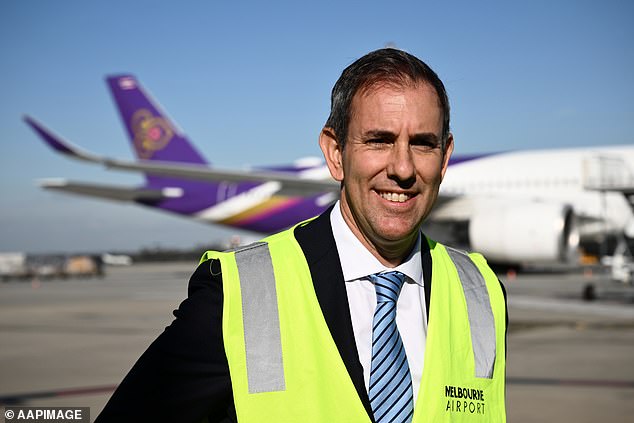
Treasurer Jim Chalmers has been warned not to dole out broad-based cost-of-living handouts in the upcoming federal budget over fears it could fuel inflation.
On Tuesday, International Monetary Fund chief economist Pierre‑Olivier Gourinchas urged governments to avoid policies such as energy price caps and subsidies that are intended to ease pressure on households and businesses.
‘While such measures are popular, evidence suggests they are often both poorly designed and very costly for the public purse,’ he said.
‘Moreover, avoiding fiscal stimulus at a time of rising inflation is another critical component so as not to complicate the task of central banks.’
The warning comes as Chalmers prepares to travel to Washington on Wednesday for the IMF‑World Bank Spring Meetings, amid fresh concerns about a worsening global outlook driven by the Middle East conflict.
Speaking in Brisbane ahead of his departure, the Treasurer said the world economy faced a ‘really dangerous time’ after the IMF flagged severe downside risks in its latest World Economic Outlook.
‘The IMF is sounding the alarm on some pretty severe scenarios published overnight,’ Chalmers said.
‘Australia is better placed and better prepared than a number of other countries. We won’t be spared the fallout from this very substantial economic shock.’

Jim Chalmers (pictured) will jet off to the United States for an IMF-World Bank meeting
The IMF has slightly downgraded its near‑term growth outlook for Australia, revising expected GDP growth to two per cent in 2026, down from 2.1 per cent forecast in January.
Growth in 2027 is now expected to slow to 1.7 per cent, down from 2.2 per cent.
However, Australia’s inflation outlook has worsened sharply. The country’s headline inflation rate currently sits at 3.7 per cent.
The IMF now expects consumer price inflation to reach four per cent in 2026, higher than most advanced economies, including the United States, Britain and New Zealand.
The IMF had been preparing to upgrade its global growth forecasts earlier this year, before the outbreak of war and the closure of the Strait of Hormuz derailed that momentum.
Attacks on oil and gas facilities have raised fears of a prolonged energy crisis, increasing the risk of a global recession.
‘From an economic point of view, the end of the war can’t come soon enough,’ Chalmers said.
‘But even when the strait is properly reopened, and even when the hostilities formally end in an enduring way, we still expect the consequences of this war in the Middle East to be felt for some time.’
Join the discussion
Should the government risk higher inflation to ease Aussies’ cost-of-living struggles right now?

The IMF has warned against Australia offering stimulus that would add inflation pressure
Under a severe IMF scenario, where conflict persists and further damage is done to energy infrastructure, global growth would fall to just two per cent in 2026, perilously close to recession.
Against that backdrop, the IMF has urged governments to think carefully before intervening to lower prices, arguing that artificially suppressing costs can undermine economic adjustment.
Economists have echoed those concerns at home, warning that the Albanese government’s cuts to the fuel excise could keep inflation higher for longer.
Mr Gourinchas said preserving price signals was critical during periods of scarcity.
‘High prices signal scarcity, encouraging demand restraint and supply expansion,’ he said.
‘Preserving price signals is important.’
He also urged central banks to ‘look through’ temporary energy price spikes, provided inflation expectations remain well anchored and policy settings are already appropriately calibrated.
On that front, Reserve Bank deputy governor Andrew Hauser noted at a speaking event in New York that short‑term inflation expectations were rising, though long‑term expectations remained stable.

The IMF has warned that a prolonged war in the Middle East could push the world to recession.
Even so, he acknowledged uncertainty around current interest rate settings, saying he was not yet confident policy was ‘at the right level’.
Despite the IMF’s warnings, Chalmers said the upcoming federal budget would aim to strike a careful balance between immediate cost pressures and the need to maintain fiscal discipline.
‘I’m confident that this budget, which will be focused on fuel security, supply chains, resilience and economic reform, will balance those key considerations,’ he said.
Looking beyond the immediate crisis, the IMF said advances in artificial intelligence offered hope for stronger productivity, faster growth and rising living standards over the long term, though it warned the economic scars from war and instability would be felt long after the fighting stops.