



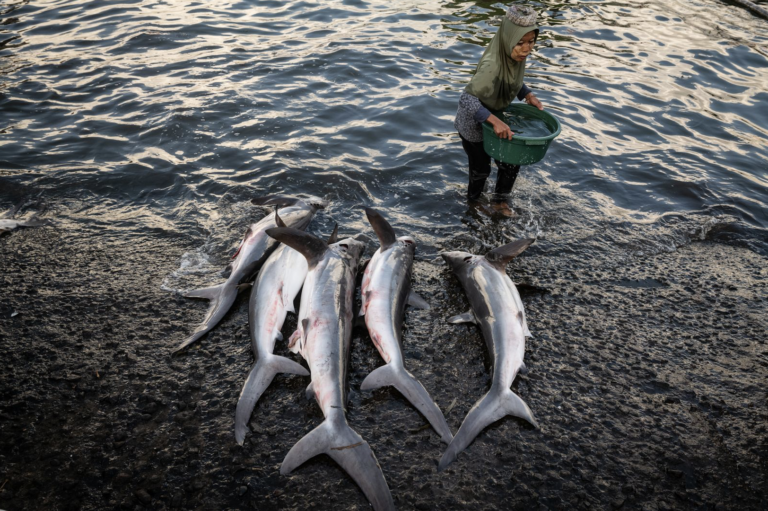

Overfishing in Southeast Asia, on view until April 26, 2026, at the Bronx Documentary Center, is a powerful and layered exhibition by photojournalist Nicole Tung, laureate of the 15th Carmignac Photojournalism Award. Developed over nine months of in-depth reporting supported by the Fondation Carmignac, the project produced across Thailand, the Philippines, and Indonesia traces the far-reaching consequences of industrial fishing. It reveals an industry that largely operates beyond public scrutiny, exposing collapsing marine ecosystems, accelerating biodiversity loss, the exploitation of migrant labor, and the pressures faced by coastal communities.
At the heart of the work is a stark reality shared across the region: for many small-scale operations, there “just weren’t any fish of value to be caught near the shore anymore,” leaving them unable to compete with industrial-scale fishing fleets.

There are a few layers to this project: the exploitation of workers on fishing boats, as well as the obvious issues of overfishing and environmental impact. Did you plan to cover both angles when you started the project? And was there another layer to the story that came up that you didn’t expect?
“Yes, in the proposal I submitted when I applied for the award, I wanted to explore the intersectional nature of overfishing. That included the exploitation of workers on commercial fishing vessels, the environmental impacts, the geopolitical aspects, and fishing traditions threatened by plummeting fish stocks.
“I think one of the unexpected things that came up was really about how every single fishing community I visited, they faced a multitude of concerns, the prime one being that there just weren’t any fish of value to be caught near the shore anymore, and that they could not compete with industrial-scale fishing boats. This was across the board in all three countries I visited.”

In one of your interviews, you mentioned that each country has its own rules and regulations (or lack thereof) regarding fishing. What do you think the major issues are in each country you photographed?
“Thailand last year was facing the potential for regulations that were put into place after 2015 to be rolled back. Parliament was under pressure to relax laws designed to curb labor abuses, especially overfishing.
“In Indonesia, the major issue was that the condition for fishermen on commercial vessels has become similar to what Thailand was before 2015, where the industry is rife with abuses of fishermen aboard mainly Chinese fishing boats (and to some degree Korean and Taiwanese ones as well).
“In the Philippines, overfishing is linked to the geopolitical issues with China, where China’s claim to territories of its’ Nine-Dash Line’ means Filipino fishermen have faced intimidation and also been chased at sea by Chinese militias.”

Thailand has passed major fishing reforms within the last decade. Did you see major differences in how they operated in comparison to Indonesia and the Philippines?
“I could see that Thailand had implemented what’s called Port In Port Out (PIPO) that were checks by authorities on what crew was going out and coming back in, there were also a lot of fishing vessels that were left at their docks over the past decade because the restrictions made it impossible for some owners to continue covering costs of operating, so there were indeed some major differences – Indonesia has something similar but from the fishermen I spoke to who had been out on commercial vessels, it was not strictly enforced and the system was corrupt.
“In terms of protecting their own fisheries, Thailand was doing much better after 2015, and it allowed some areas to make a comeback as well – a point that environmentalists and small-scale fisherfolk argued was the reason why these areas should remain protected rather than open again to commercial fishing interests. Indonesia has signed treaties to comply with provisions such as the CITES II appendix, but enforcing bans on the types of sharks caught and sold is much more difficult to enforce.
“The Philippines cannot compete with powers like China, Taiwan, and Vietnam, all seeking to exploit its waters, so enforcement of any laws preventing illegal fishing is near impossible there.”

I know access can be a major issue for photojournalists covering animal stories in Asia. Did you have any issues with that?
“Yes, access to get onto a commercial ship or onto a supply ship going out to sea was very difficult, and I did not manage to get access to that during the time I spent reporting. It would have taken many more months to negotiate that access, as many captains and boat owners are very wary of journalists.”


Aside from buying local and, of course, abstaining from eating fish, what can the average person do in response to this situation?
“I think the average person can just be more conscious of where their seafood comes from, including looking at resources like the Monterey Bay Aquarium that tracks which species are more suitable for seafood. I think consumers can also avoid species they know are overfished and look for species that are generally more sustainably caught. That also comes down to asking restaurants and fishmongers questions and supporting policies that align with sustainable fishing regulations.

The media response has been very positive to this project and exhibition. What do you hope will come of this?
“I really hope that it will bring some more awareness to this topic that is often so invisible to us as consumers. Overfishing is a very complex issue and understandably seems very far away from us because we don’t see what occurs at sea, and under the ocean too, with the destruction of the sea floor, but it is a very real and present problem as this also feeds into issues of climate change, and loss of biodiversity, which ultimately hurts us all.”