

The NHS could become flooded with thousands of discrimination claims from female staff after a tribunal found it has wrongly been allowing trans women to use single-sex toilets.
An NHS employee in Leeds successfully sued health bosses this week, saying she suffered discrimination and harassment because transgender colleagues were told they could use single-sex facilities, including lavatories and showers.
Her case centred on policies adopted by NHS England in 2017, which stated that transgender colleagues could use facilities according to the gender they identified as.
While she did not encounter transgender women (biological males) in the facilities she used, Leeds Employment Tribunal upheld her complaint that the policy itself created a hostile environment, and was therefore harassment based on her biological sex.
But NHS England, which advises trusts, is yet to update its guidance since a landmark court ruling last year. Many trusts say they are waiting until this happens.
While some trusts have ‘withdrawn’ their guidance since last year’s Supreme Court ruling that ‘woman’ in the Equality Act refers to biological sex, critics point out they have not been replaced.
It means the practice of allowing people to self-identify and use whichever facilities they like effectively remains unchanged and that thousands more female NHS workers are potentially being discriminated against.

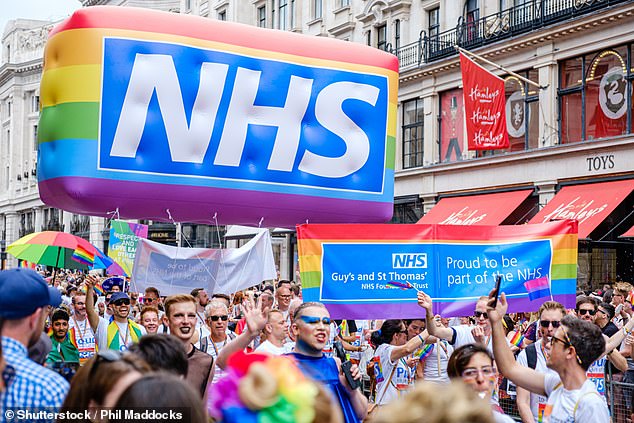
The NHS has previously been accused of focusing too much on issues around Pride and transgender rights

Women and Equality Bridget Philipson has been sitting on Equality and Human Rights Commission guidance around how to enforce last year’s Supreme Court ruling for months

Maya Forstater, CEO of sex-based rights charity Sex Matters, said it was ‘shameful’ that the NHS is yet to update its policies around use of single-sex spaces
Last month a Daily Mail audit revealed how hundreds of public bodies – including a staggering 97 per cent of 190 NHS trusts in England with inpatient facilities – have outdated policies allowing trans-identifying biological males to use women-only spaces such as wards, changing rooms and toilets.
This is despite last year’s Supreme Court ruling.
Ministers have been sitting on guidance from the Equality and Human Rights Commission (EHRC), on how to enforce the ruling, since September.
Many public organisations have claimed they were effectively in limbo due to the delay.
Elizabeth McGlone, managing partner of Didlaw, the law firm acting for the Leeds NHS employee, said this week’s tribunal ruling meant thousands of health service workers have potentially been discriminated against and could launch claims.
She told the Mail: ‘You could now have massive group claims.
‘On the premise of the facts of this case, that gives women who are in this position in local authority or public body employers the grounds to bring a claim.
‘We’re talking about every council in the country that flies its Progress flag, its trans-inclusion flag and then actually has facilities that don’t protect biological women in a safe space.’
Of the failure to publish the EHRC guidance, she added: ‘Everybody is excusing themselves on the basis that we’re just waiting on the EHRC guidance.
‘Well that’s BS (b******), because again, the Supreme Court ruling is entirely clear. The guidance is no more important. It’s less important than a Supreme Court judgment that came out over a year ago.
‘It’s just fear. And it is just procrastination to the highest level. This is not personal. This is not about people disliking other people. This is about facts. It’s about what has been upheld in law.’
Maya Forstater, CEO of sex-based rights charity Sex Matters, added: ‘This is a highly significant judgment which shows that the NHS could face successful claims from any female employee who takes issue with NHS England’s policy of allowing trans-identifying male staff to access women’s toilets and changing rooms.
‘NHS England and trusts across the UK have been warned repeatedly over several years to bring their policies in line with the law, and this verdict makes any further delays untenable.
‘It’s shameful that it has taken the bravery of individual women such as the claimant in this case to pressure the NHS to take women’s right to privacy, dignity and safety seriously.’
The NHS employee who brought the case, a Muslim who cannot be named because of reporting restrictions, received an email about the transition of a colleague.
She was asked to attend a ‘trans awareness session’, which prompted her to complain.
She said the policy indirectly discriminated against women generally, Muslim women specifically, as well as women with post-traumatic stress disorder caused by male sexual violence.
The tribunal ruled NHS England failed to show its policy was a proportionate means of achieving a legitimate aim of making trans people feel included.
The woman could now receive up to £25,000 in compensation. It means NHS trusts could face legal bills of hundreds of thousands of pounds if more claims are launched.
Ministers have pledged to publish the EHRC guidance this month.
An NHS England spokesman said: ‘While we cannot comment on individual employment matters, we recognise the need for revised guidance on same sex spaces, and we will consider today’s findings as we develop a new policy.’