
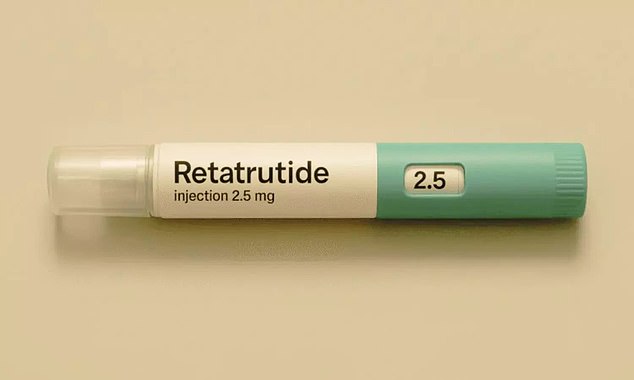
A new drug that curbs appetite and helps users burn more calories is the most powerful weight-loss treatment ever, a major trial reveals.
The study suggests retatrutide – which has been likened to ‘exercise in a jab’ – outperforms Wegovy and Mounjaro and is ‘as good as surgery’.
Patients taking a 12mg dose typically lost more than a quarter of their body weight (28.3 per cent) in just 18 months – the equivalent of 31.9kg or 5 stones.
The breakthrough drug also trimmed an average of 9.5inches (24.1cm) off patients’ waistlines, according to newly published trial results.
Meanwhile, 45.3 per cent of participants achieved at least 30 per cent weight loss over the course of the 80-week study, a level long associated with bariatric surgery.
Currently, the most powerful licensed weight loss drug, Mounjaro, helps users lose around 20.9 per cent of their body weight when taken for 72 weeks.
Both are made by the US pharmaceutical firm Eli Lilly and Company, which is likely to apply for permission to sell retatrutide in the UK within months.
Retatrutide – also known by the nicknames ‘Godzilla’, ‘reta’ and ‘triple G’ – is a triple agonist, meaning it acts on three different hormone receptors to help users slim down.

The study suggests retatrutide – which has been likened to ‘exercise in a jab’ – outperforms Wegovy and Mounjaro and is ‘as good as surgery’
This is two more than Wegovy and one more than Mounjaro, which is already available on the NHS to those with the greatest need.
The drugs work by mimicking hormones that regulate appetite and slow gastric emptying.
Retatrutide goes further by also acting on glucagon, which appears to increase energy expenditure – essentially helping the body burn more calories.
The latest findings come from TRIUMPH-1, a Phase 3 clinical trial evaluating the effectiveness and safety of retatrutide in 2,339 obese and overweight adults with at least one weight-related illness excluding diabetes.
In addition to the weight loss, participants also showed significant improvements across certain cardiovascular risk factors, including bad cholesterol, blood fats, blood pressure and inflammation.
Eli Lilly were forced to issue warnings when promising results from early-stage trials led to a surge in people trying to obtain the drug through social media.
The firm said anyone using fake drugs from unauthorised sources is putting their health at ‘serious risk’ as it threatened to take action against the sellers.
Trial users taking 4mg of retatrutide once a week lost an average of 19 per cent of body weight over 80 weeks and those taking 9mg lost an average of 25.9 per cent.

Eli Lilly were forced to issue warnings when promising results from early stage trials led to a surge in people trying to obtain the drug through social media
Dr Kenneth Custer, Lilly’s executive vice president, said: ‘The 12mg dose delivered a level of weight loss long associated with bariatric surgery.’
Professor Ania Jastreboff, lead investigator on the trial at Yale School of Medicine, said: ‘Obesity is a chronic disease, and people living with obesity deserve treatment options that match the complex biology of their neurometabolic disease.
‘It was impressive to see that every dose of retatrutide resulted in clinically meaningful weight reduction for nearly all participants, and people with severe obesity on the highest dose lost on average 30 per cent of their body weight over two years.
‘Importantly, treatment with retatrutide not only resulted in robust weight reduction, but also in clear improvements in assessed cardiometabolic health measures.
‘For patients I see in clinic, retatrutide may potentially be a highly impactful future tool to treat their obesity and transform their health trajectory.’
The types of adverse events seen were generally consistent with trials of other weight-loss jabs, including nausea, diarrhoea, constipation and vomiting.
Individuals with an initial body mass index of 35 or more – meaning they were severely obese – lost an average of 30.3 per cent of their body weight in a study extension to 104 weeks.
Commenting on the findings, Dr Simon Cork, from Anglia Ruskin University, said: ‘These early results are incredibly promising in showing that we are now truly on the path to combating the obesity crisis.

Henry Dimbleby, co-founder of the Leon restaurant chain and author of the Government’s National Food Strategy, said he expects one in four Britons will soon be taking weight loss drugs
‘The results demonstrate Retatrutide’s superior weight loss effects over all currently available weight loss medications, with side effects similar to those seen with other GLP-1 based medications.
‘Obesity is a life-long, relapsing remitting disease that for many requires active medical treatment in order to control.
‘The rapid advancement of effective and safe drugs for the treatment of obesity should be welcomed, but will take time for health services to adapt to be able to offer these treatments to all who could benefit.’
The findings come as Henry Dimbleby, co-founder of the Leon restaurant chain and author of the Government’s National Food Strategy, said he expects one in four Britons will soon be taking weight loss drugs.
He told a British Nutrition Foundation conference: ‘We’re going to get a society where it is going to be possible to choose what weight you are and most people will choose not to be obese or overweight.
‘I actually think we’ll end up in a world where you get the pill, whether you like it or not.
‘You get given the pill at 40 as you begin to start spreading, like you do your statin at 50 or your aspirin, and that there’ll be a combination of that – society will be on these drugs forever.’