NASA’s James Webb Space Telescope is giving us new insight into the far-future of solar systems like our own, as the agency continues to reveal the secrets of the universe and our place in it. Billions of years ago, a Sun-like star nearing the end of its life swelled tremendously in size to become a red giant before ejecting its outer layers, leaving a hot, remnant core known as a white dwarf. As a red giant, the star should have engulfed and destroyed any nearby planets. Yet astronomers have found a Jupiter-sized exoplanet orbiting the white dwarf every 34 hours at a separation of less than 2 million miles (3 million kilometers).
To solve the mystery of how this exoplanet survived, an international team of astronomers used NASA’s James Webb Space Telescope to watch the Jupiter-sized exoplanet WD 1856 b transit its host star, measuring the planet’s temperature and detecting molecules in its atmosphere. They found the planet is significantly warmer than expected and determined how it most likely reached its very tight orbit around the white dwarf star. The results are a window into the future of planets like Jupiter after the death of the Sun, billions of years into the future.
The results published Wednesday in the journal Nature.
WD 1856 b was discovered in 2020 by scientists using NASA’s TESS (Transiting Exoplanet Survey Satellite) and the retired Spitzer Space Telescope. It orbits the white dwarf WD 1856+534, which is located about 80 light-years from Earth. “The planet is about the size of Jupiter, but the white dwarf it orbits is the size of Earth, so the planet is seven times larger than its star,” said lead author Ryan MacDonald of the University of St. Andrews in the United Kingdom.
WD 1856 b orbits extremely close to its host star, a distance 50 times closer than Earth orbits the Sun. If WD 1856 b had originally been orbiting at that distance, it would have been obliterated while the star was a red giant. How did it survive the death of its host star and end up in its current position?
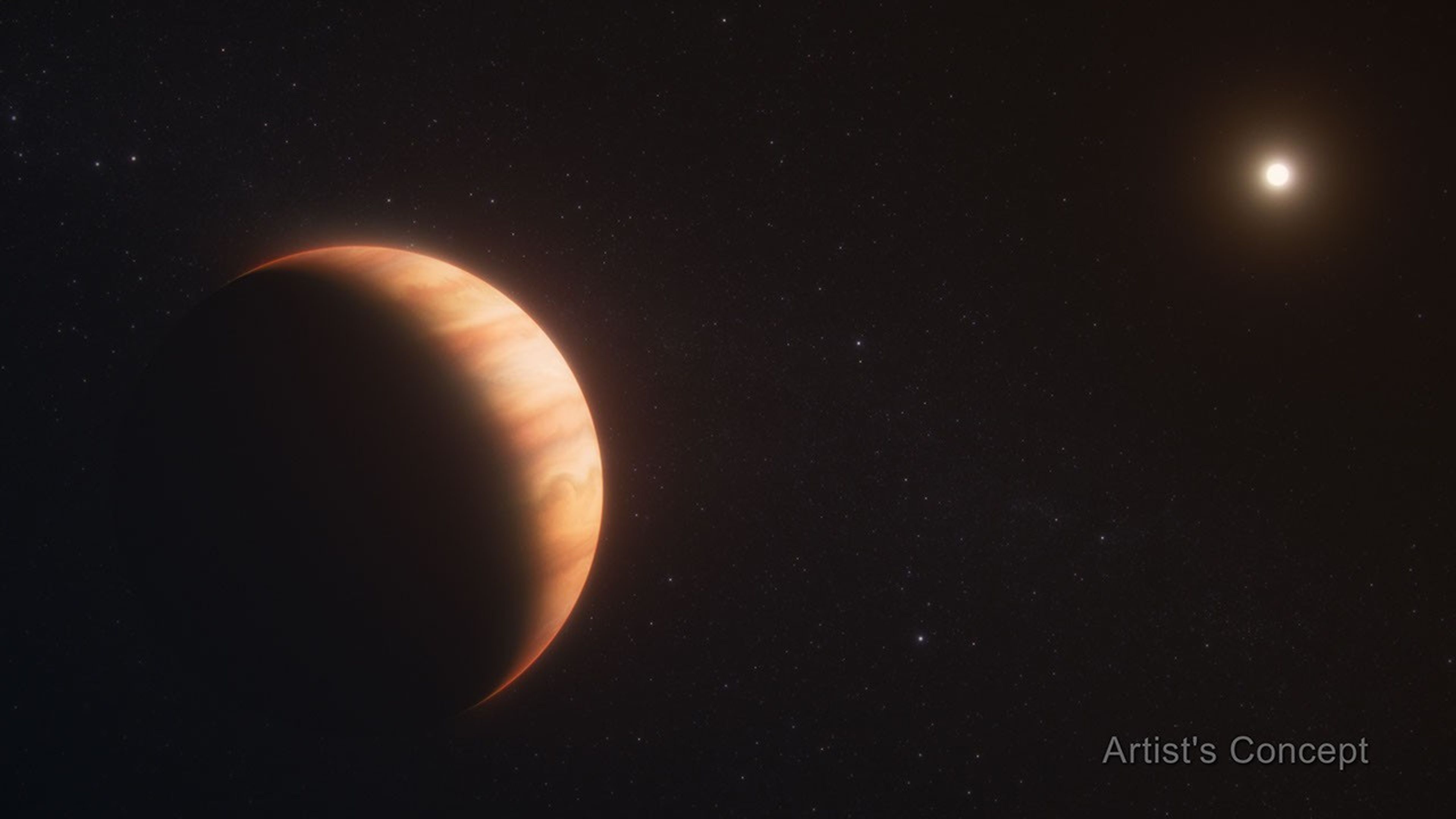
Exoplanet WD 1856 b, shown in this artist’s concept, is a gas giant that orbits its star at a distance 50 times closer than Earth orbits the Sun. Observations by NASA’s James Webb Space Telescope determined the planet’s temperature and detected molecules in its atmosphere.
Artwork: NASA, ESA, CSA, Ralf Crawford (STScI)
The new study used Webb to watch the planet passing in front of its star. This transit yielded unique information about the planet’s mass, which is between four and eleven times the mass of Jupiter.
The team also was able to determine the planet’s temperature. During the transit, light from the star was partly blocked, but infrared light was reduced less than other wavelengths. The difference was infrared light emitted by the planet from its own heat. The data indicated that the planet has a temperature of about 260 degrees Fahrenheit (126 degrees Celsius) — significantly hotter than it would be if its only source of heat was the light from the white dwarf. This puzzling discovery turned out to be the key fact that proved how the planet must have reached its current orbit.
Christopher O’Connor of Northwestern University in Illinois, a co-author on the paper, was responsible for tracing the temperature of the planet back in time. O’Connor said, “The big question is how WD 1856 b ended up where it is today, and there are two theories. One is that the planet was swallowed by the host star as it was dying, and managed to survive on the inside. The other is that migration took place due to the gravitational effect of other objects in the system. The white dwarf is part of a triple star system, and the companion stars could have influenced WD 1856 b’s orbit.”
The researchers realized that there was no source of energy present to generate that heat today, so it must be residual energy from an earlier time when the planet was heated. Using models of how sub-stellar objects like WD 1856 b cool down over time, coupled with the new data from Webb, the team was able to project its temperature back in time and deduce how long ago the heating must have happened. The timing is key to determining whether the heating was from being engulfed by the red giant or occurred during an inward migration
They concluded that the heating most likely happened between 3 and 5.5 billion years after the star became a white dwarf. In this scenario, the planet was on a wide orbit that kept it safe from the star during its destructive red giant phase, and only migrated to its present location later on. “As the planet moved inward, its interactions with the strong gravity of the white dwarf will have caused it to warm up considerably, and it has been cooling ever since,” said O’Connor.
Light from the star passing through the planet’s atmosphere also picked up information about its chemical composition. “We saw the telltale signatures of small cloud particles and hydrocarbons, most likely methane, which is the first time we have seen an atmosphere on a planet transiting a dead star,” said co-author Victoria Boehm of Cornell University. “We recently observed four more transits of WD 1856 b with Webb to take a deeper look into its atmospheric chemistry and can’t wait to see the results.”
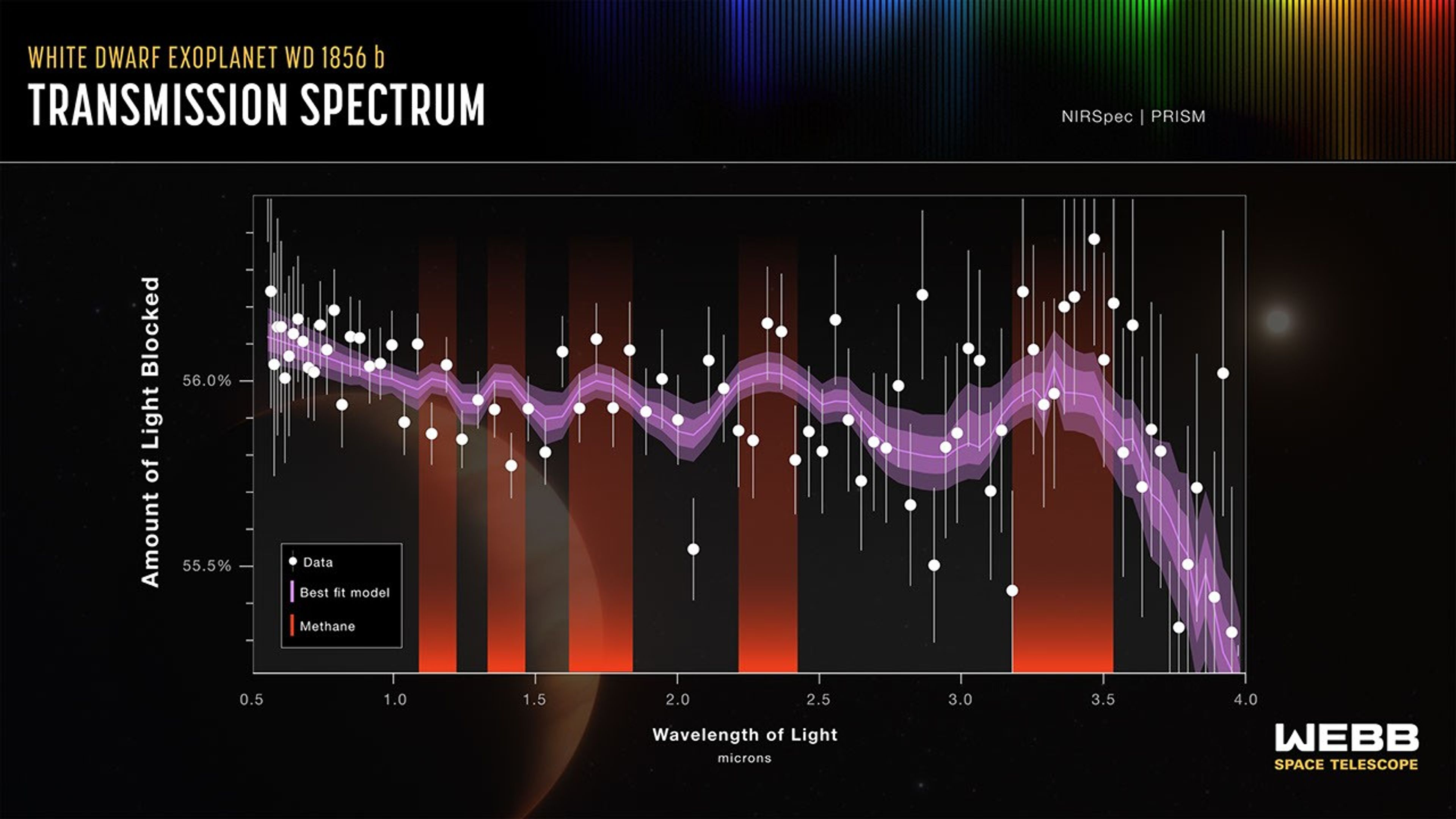
NASA’s James Webb Space Telescope measured the constituents of exoplanet WD 1856 b as it passed in front of its star, finding signs of methane. WD 1856 b orbits a white dwarf star the size of Earth. As a result, the planet blocks more than half of the star’s light.
Illustration: NASA, ESA, CSA, Joseph Olmsted (STScI)
In approximately five billion years, the Sun will run out of hydrogen fuel in its core and swell up more than 100 times larger than it is now into a red giant star. It will then shed its outer layers and end its life as a white dwarf star. Mercury, Venus, and possibly the Earth will be destroyed by the red giant. However, the fate of the more distant planets, particularly the gas giants, is unclear. Finding and studying planets in orbit around the remnants of Sun-like stars after their death is a means of learning what might happen in our own solar system in the far future.
“We’re used to looking back in time when we use telescopes, but this is the first time we have been able to look forward to what might happen to the outer planets around the remnant of a Sun-like star,” said MacDonald. “It’s like using a time machine to peer into the distant future of our solar system.”
The James Webb Space Telescope is the world’s premier space science observatory. Webb is solving mysteries in our solar system, looking beyond to distant worlds around other stars, and probing the mysterious structures and origins of our universe and our place in it. Webb is an international program led by NASA with its partners, ESA (European Space Agency) and CSA (Canadian Space Agency).
To learn more about Webb, visit:
https://science.nasa.gov/webb
The following sections contain links to download this article’s images and videos in all available resolutions followed by related information links, media contacts, and if available, research paper and Spanish translation links.