



May 20, 2026
2 min read

NASA’s Psyche captures gorgeous Mars crescent photo on way to asteroid
NASA’s Psyche snapped images as it flew by Mars last week. The spacecraft used the planet’s gravity to give itself a boost on its journey toward its target asteroid
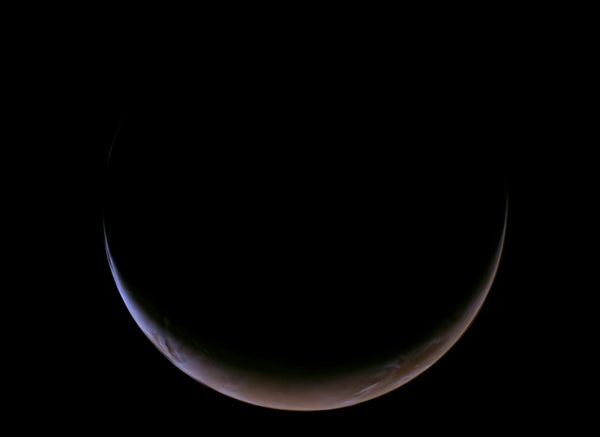
NASA’s Psyche mission to study an asteroid beyond Mars played tourist last week, with the spacecraft flying by the Red Planet and snapping photographs as it went. Coming within 2,864 miles of the planet’s surface at its closest approach, Psyche used the planet’s gravity to boost its speed and adjust its course toward its ultimate destination: a metal-rich asteroid called 16 Psyche, which lies between Mars and Jupiter.
Among the new photos are a high-resolution snap of Mars’ south pole, which is home to a 430-mile-wide ice cap.

On supporting science journalism
If you’re enjoying this article, consider supporting our award-winning journalism by subscribing. By purchasing a subscription you are helping to ensure the future of impactful stories about the discoveries and ideas shaping our world today.
The Psyche mission began its six-year long, 2.2-billion-mile trek into the solar system on October 13, 2023. After the probe reaches the asteroid in July 2029, it will begin orbiting it while snapping photos, mapping the surface and, using its onboard science instruments—a magnetometer, gamma-ray and neutron spectrometer and multispectral imager—will try to determine 16 Psyche’s chemical composition.
The Mars flyby not only allowed the Psyche team to test out the spacecraft’s cameras, but also to try out NASA’s Deep Space Network Doppler system, which uses the effects of relative motion on radio signals to better track and communicate with spacecraft in deep space. NASA has a digital reconstruction of the flyby that can be viewed here.

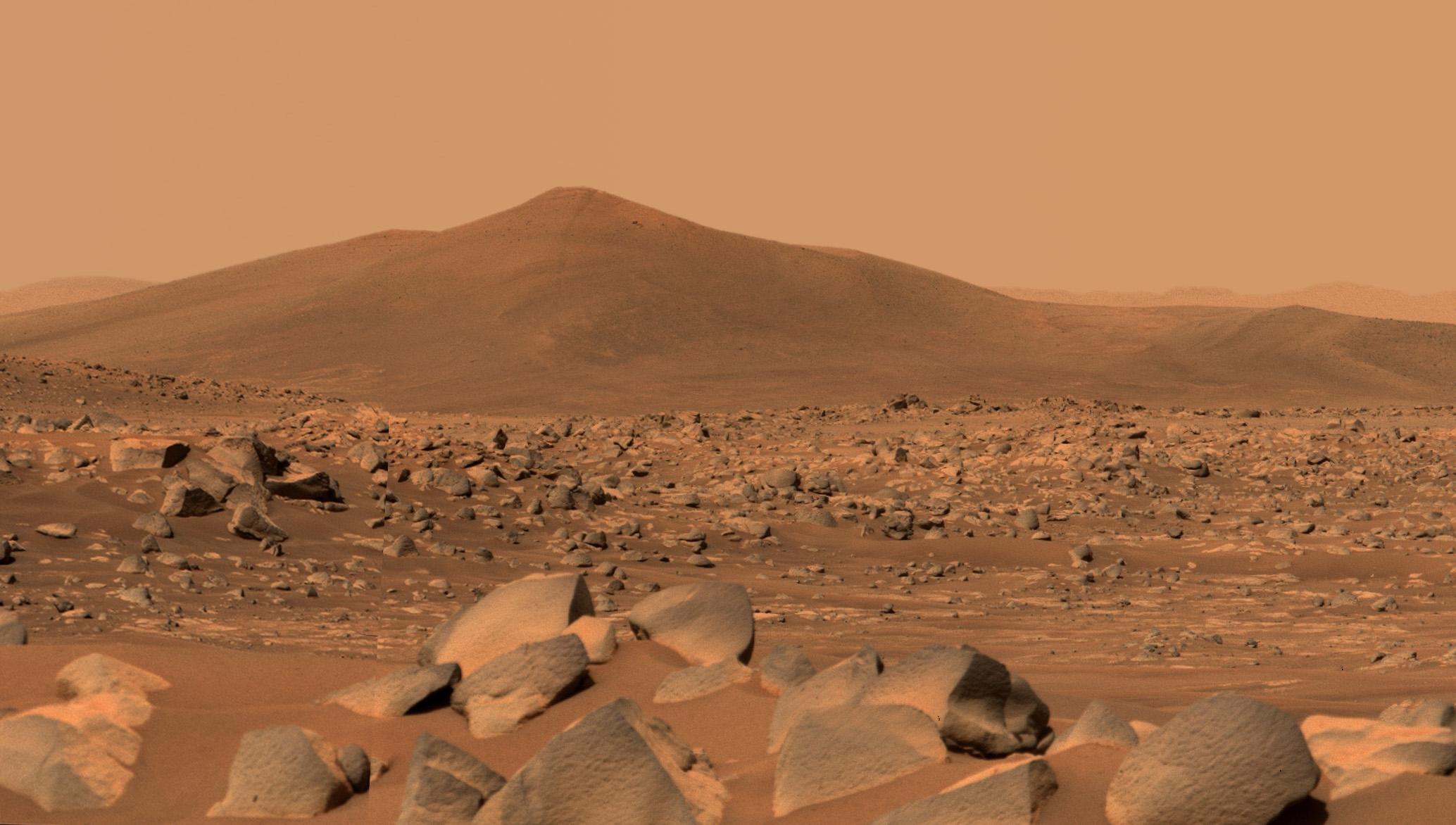
This view of the Martian surface shows streaks that have formed due to wind blowing over impact craters in the Syrtis Major region.
“We’ve confirmed that Mars gave the spacecraft a 1,000 mile‑per‑hour boost and shifted its orbital plane by about 1 degree relative to the Sun,” said Psyche navigation lead Don Han in a statement. “We are now on course for arrival at the asteroid Psyche in summer 2029.”
16 Psyche is a large asteroid, measuring around 1438 miles across. Some scientists theorize that the rock is actually a planetesimal—these are large, solid space objects that act as the building blocks of planets. And because it is currently impossible to bore a hole into the Earth’s core to better understand how our planet first formed, studying objects like 16 Psyche could be the next best thing.
It’s Time to Stand Up for Science
If you enjoyed this article, I’d like to ask for your support. Scientific American has served as an advocate for science and industry for 180 years, and right now may be the most critical moment in that two-century history.
I’ve been a Scientific American subscriber since I was 12 years old, and it helped shape the way I look at the world. SciAm always educates and delights me, and inspires a sense of awe for our vast, beautiful universe. I hope it does that for you, too.
If you subscribe to Scientific American, you help ensure that our coverage is centered on meaningful research and discovery; that we have the resources to report on the decisions that threaten labs across the U.S.; and that we support both budding and working scientists at a time when the value of science itself too often goes unrecognized.
In return, you get essential news, captivating podcasts, brilliant infographics, can’t-miss newsletters, must-watch videos, challenging games, and the science world’s best writing and reporting. You can even gift someone a subscription.
There has never been a more important time for us to stand up and show why science matters. I hope you’ll support us in that mission.