


Conny Waters – AncientPages.com – Knowledge of ancient Maya mythology has expanded as archaeologists have identified what is believed to be one of the oldest known depictions of the mythical Maya hero Juun Ajaw.
Credit: CINAH Campeche
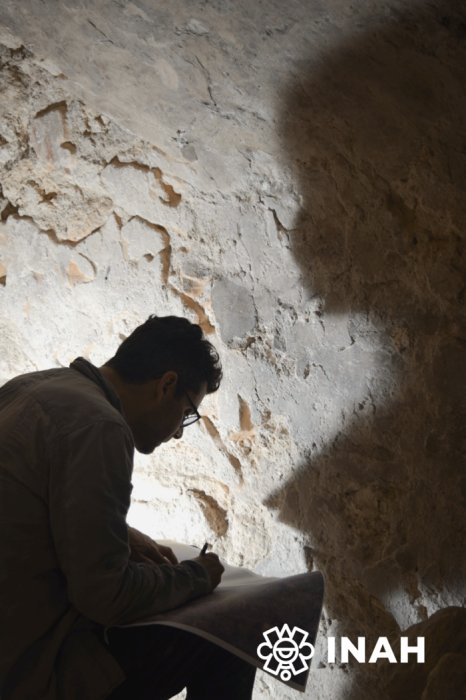
INAH reports that over the past three years, researchers have investigated a mural inside Structure II at the ancient city of Calakmul in Campeche, Mexico. The study’s findings, considered the oldest pictorial vestige found in Calakmul to date, will be presented at the conference Hunting in the Water, Fishing in the Cave: Juun Ajaw, a Mythical Hero in a Preclassic Mural of Calakmul, by archaeologist Daniel Salazar Lama.
The lecture, organized by the Ministry of Culture of the Government of Mexico, through the National Institute of Anthropology and History (INAH) and the INAH Campeche Center, will be given on July 17, 2026, at 5:00 p.m., at the Museum of Mayan Architecture, Baluarte de la Soledad, with free admission.
Researchers used digital recording techniques, including photogrammetry, digital drawing, and virtual architectural modeling, to create a detailed graphic reconstruction of the mural and its architectural context. This process enabled the identification of the mythological figure Juun Ajaw, depicted in a water hunting scene.
The research also revealed that the architectural space housing the painting recreates the interior of a cave, which holds deep significance in the Mayan worldview. Additionally, the scene features a symbol that may represent a 365-day calendrical cycle, offering new insights into the connections between myth, architecture, and ritual time.
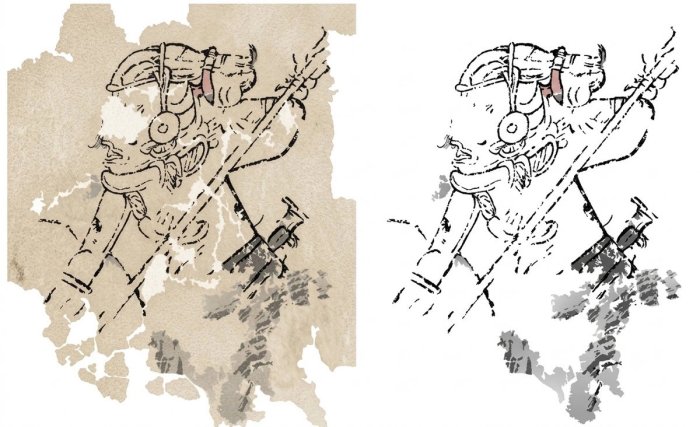
Fragment of the oldest pictorial vestige reported in the Mayan city of Calakmul, depicting the hero Juun Ajaw. Photo by Daniel Salazar. CEMCA-Archaïos, France
This mural is an early example of how the ancient Maya linked mythical events to specific calendar dates, a practice also documented in other Preclassic contexts. In Calakmul, this association offers new evidence for understanding how mythical narratives were anchored in time and space from early periods.
Since 2011, Salazar Lama has focused on Mayan and Mesoamerican art and iconography. She currently leads a project to document and analyze Substructure II C at Calakmul, which began in 2020 during her postdoctoral research in France. She now directs the project in partnership with French (Archaïos, Cemca) and Mexican (INAH) institutions, with specialists from Mexico, Spain, France, and Italy also participating.
See also: More Archaeology News
His research has been published in international scientific journals and books published in Mexico, France, Spain, Guatemala, Poland, and the United States. Among her recent works is a volume on the Balamkú frieze, published in the Paris Monographs in American Archaeology series. The Mayan area, including Balamkú, Becán, Chicaná, Hormiguero, Río Bec, El Tigre, and Calakmul.
Source: INAH
Written by Conny Waters – AncientPages.com Staff Writer

