Conny Waters – AncientPages.com – Scientists are investigating mysterious giant stone circles visible only from the air. This complex structure is located over 3,000 meters above sea level near the Tigre mountain range in Argentina. Initially detected through satellite imagery, the discovery is considered unprecedented in regional archaeology and has astonished the scientific community because of its unique aerial design.
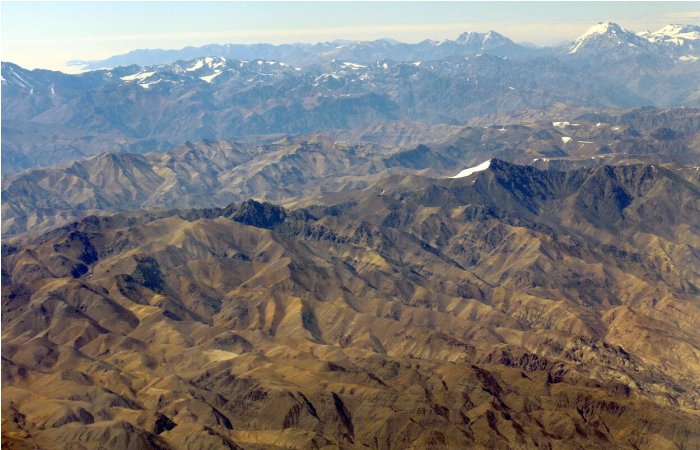
The front range of the Andes in Argentina: In the foreground, the Cordillera del Tigre with the glaciated Cerro del Tambillo. Credit: WeHaKa – CC BY-SA 4.0
Mountaineer Carlos Gobbi discovered the site after noticing its shapes in satellite images on Google Earth a year ago. When he reached the remote location in early 2026, following nearly three days of climbing, he found a structure that has raised more questions than answers.
Argentine and Spanish specialists are studying these previously unknown stone circles and passageways in Mendoza’s high mountains. They are assessing whether the site served as a pre-Hispanic ceremonial center. The location, over 3,000 meters above sea level, is difficult to access and marked by water scarcity and limited communication.
At ground level, the complex features stone walls, passageways, and excavated areas. Large circular stone structures, each 27 to 35 meters in diameter, connect via corridors. The site also includes ditches and walls, with partially buried stones integrated into ditches resembling canals or irrigation channels, alongside surface walls.
The site is being formally studied as part of ArqueoAndes, a binational project involving researchers from Argentina and Spain, including specialists from Ianigla (Conicet) and the University of Jaén. The project focuses on analyzing changes in the high mountain landscape and historical human occupations.
Could Be A Glyph?
Although the aerial design invites comparisons to the Nazca Lines of Peru, researchers remain cautious: “There are no records or publications of this. It is an unprecedented find for archaeology. It is not an ordinary archaeological site; there is no other like it in Mendoza,” the researchers said.
The inevitable comparison is to the famous Nazca Lines in Peru. But researchers are still cautious, so they cannot yet say for sure what function the structure served or when it was built.
The structure looks very different from above. Satellite images reveal large circular formations, corridors, and rectangular sections arranged in a distinct pattern.
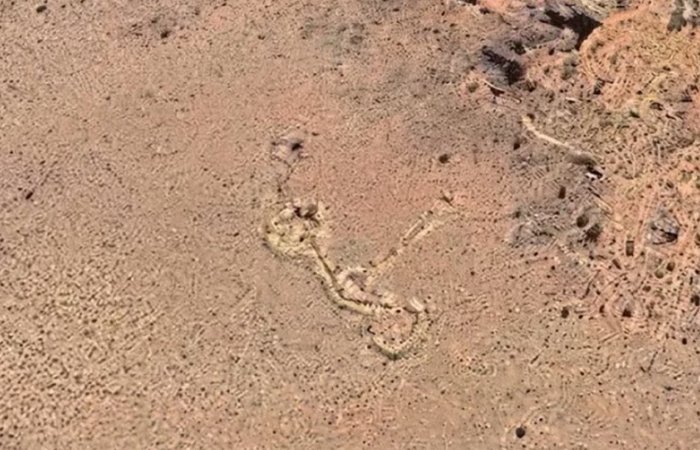
The giant stone circle complex. Credit: Carlos Gobbi
Researchers, in the early stages of study, believe the structure may be a geoglyph. They emphasize that its features make it an unprecedented discovery for Mendoza archaeology. “There are no records or publications about it. It’s an unprecedented find for archaeology. It’s not a typical archaeological site; there’s nothing else like it in Mendoza,” explain archaeologist Cristina Prieto-Olavarría, director of the project at IANIGLA (CONICET), and co-director Horacio Chiavazza.
Chiavazza and Prieto-Olavarría, together with Spanish researchers from the University of Jaén, will visit the site in December, guided by Gobbi. This fieldwork will help them date and interpret the structure.
Was It Once A Sacred Place?
Researchers are considering the possibility that the structure is linked to the Inca period, though they do not rule out an earlier origin.
Several factors support this hypothesis. The site is remote, lacks water, and shows no evidence of permanent occupation.
“We interpret this as not being a place for permanent habitation,” the Chiavazza specialists state. During the initial survey, no surface archaeological materials were found apart from the architecture. No ceramics or food remains were discovered to suggest residential use.
For this reason, researchers suggest the site may have served a ritual or symbolic function. If it is Inca, it could be connected to their sacred view of the landscape, where mountains, roads, and other landmarks (apus) were interconnected within a meaningful territory.
For this reason, researchers suggest the site may have served a ritual or symbolic function. If it is Inca, it could be connected to their sacred view of the landscape, where mountains, roads, and other landmarks (apus) were interconnected within a meaningful territory.
The research will be conducted in collaboration with specialists from the University Institute of Iberian Archaeology at the University of Jaén, Spain. The institute’s director, Juan Pedro Bellón, described the discovery as “of the highest order” and highlighted the partnership’s importance.
See also: More Archaeology News
Researcher Mario Gutiérrez, also from Spain, explained that the Spanish team will use advanced methods to analyze sediments and botanical remains at a microscopic scale. This will help reconstruct the landscape’s evolution and past human activities.
A Discovery That Must Be Protected
The project has received authorization from the Provincial Heritage Directorate to proceed. The project director and co-director stress that all archaeological work must follow best practices to protect the heritage site.
There is a strong interest in including the perspective of the native communities of Uspallata, recognizing that these remains are connected to their ongoing cultural heritage and worldview.
This research will help us understand how past societies shaped, traversed, and interpreted the Mendoza mountain landscape.
Written by Conny Waters – AncientPages.com Staff Writer