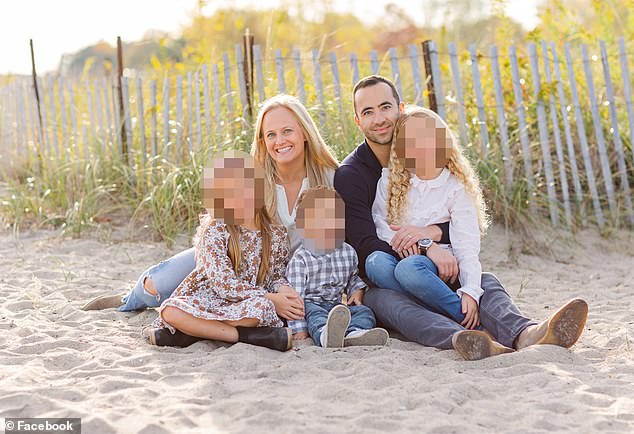
After a career spent scaling the lofty peaks of the investment banking industry, Slava Leykind had a life most can only dream of.
A loving wife, three adorable children aged six, 10, and 13, and a stunning $6.3 million mansion in Westport, Connecticut, where they all lived.
But it was his attempt to scale a different kind of peak that caused his death – and now his widow, Amy Leykind, has filed a lawsuit making shocking claims about his demise.
Leykind, 43, who worked nearly 20 years at Wall Street investment bank CG Sawaya Partners, knew he couldn’t climb Mount Everest, so he paid $6,000 to repeatedly trudge up a much smaller peak.
The ‘Everesting’ event in Jackson Hole, Wyoming, had participants ascend the A-List resort’s Snow King Mountain 19 times in 36 hours – equivalent to climbing to the 29,029ft summit of the world’s highest peak.
Leykind’s June 2025 attempt went horribly wrong after his sixth climb up the winding path, when he felt too unwell to continue.
This spiraled into a medical emergency that cost Leykind’s family their husband and father after he died of a swollen brain, Amy’s lawsuit alleged.
Leykind was feeling dizzy, lightheaded and had persistent brain fog, according to the lawsuit.

Slava Leykind (pictured with his family) died on July 2 last year days after participating in an ‘Everesting’ endurance challenge on Snow King Mountain in Jackson Hole, Wyoming
He went to a medical tent set up by 29029 – the events firm that set up the Everesting event, its name a nod to the Nepalese mountain’s height.
Twelve hours later, after two more visits to on-site medics, Leykind was found in his hotel room without a pulse at about 11.20pm on June 27, 2025.
The father-of-three never woke up, and was declared dead on July 2. Doctors said his brain was so swollen it cut off its own blood supply and he stopped breathing.
Amy insists in her lawsuit that he would still be alive today had organizers not missed classic signs of a common endurance sport condition.
The grieving widow is suing 29029 LLC, its co-founders Jesse Itzler and Mark Hodulich, and medical contractor Heed Health for wrongful death.
‘Slava’s death was not a random, tragic accident,’ the lawsuit filed in Fulton County State Court in Georgia, where 29029 is based, claimed.
‘His death directly, foreseeably, and preventably resulted from a catastrophic breakdown in planning and care, born of the organizers’ gross indifference to participant safety and the profound medical negligence of the healthcare providers they hired.’
Setting off at 6am, the fitness fanatic banker was almost a third of the way through the challenge by noon.
That was when he first headed to the medical tent with fatigue, brain fog, dizziness, lightheadedness and gastrointestinal complaints, according to the lawsuit.
Heed Health staff advised him to take a break and drink water until he felt better, but by 3.30pm he hadn’t improved despite lying down in his hotel room.

Leykind traveled from his $6.3 million mansion in Westport, Connecticut

A photo shows another man attempting the same ‘Everesting’ challenge on Snow King Mountain near where Slava Leykind died
The lawsuit claimed medics again merely told him to ‘drink fluids and rest’ without checking his vital signs or sodium levels.
Text messages showed he asked staff to come to his hotel room, but was told they were only allowed to treat him in the medical tent, the suit claimed.
So he went back to the event about 7.30pm, where staff gave him water and put a 500ml saline drip into his arm.
The lawsuit claimed Heed Health ‘falsely allege that Slava ‘refuse[d]’ to go to the emergency room,’ but there was no record of him doing so.
‘In fact, Heed Health’s own after-the-fact records admit that there was no signed refusal, as there was for other participants who refused treatment,’ it claimed.
Leykind’s hotel roommate found him not breathing with no pulse and called 911.
Paramedics arrived at 11.35pm and restarted his heart with CPR, then rushed him to St John’s Hospital – only a mile away.
A CT scan of his head revealed his brain swelled so much that it cut off its own blood supply, and his blood sodium levels were dangerously low.
Leykind was suffering from hyponatremia, a condition common in endurance sports caused by an electrolyte imbalance.
Emergency medicine doctor Anwar Osborne, an associate professor at the Emory University School of Medicine who reviewed Leykind’s case, explained the condition in an appendix to the lawsuit.

Leykind, 43, traveled from his home in Westport, Connecticut, to complete the ‘Everesting’ challenge
When endurance athletes – especially amateur ones like Leykind – do sustained exercise, their bodies secrete antidiuretic hormone (ADH) to cope with the pain, stress, heat or nausea it causes.
ADH suppresses the kidneys’ ability to rid the body of excess water, which decreases the level of sodium in the body relative to its fluids.
When Leykind was repeatedly told to drink water and later injected with it, the sodium levels were even more diluted, causing the hyponatremia, Dr Osborne wrote.
‘In layman’s terms, as a result of hyponatremia, Slava’s brain had swelled so much that it cut off its own oxygen supply, irrevocably damaging the areas of the brain responsible for controlling his breathing,’ the lawsuit claimed.
The complaint also claimed ‘organizers, trainers, or medical staff encouraged excessive drinking’ and positioned water stations irresponsibly.
Amy’s lawyers claimed in the court paper that Itzler and Hodulich should have known about the risks of hyponatremia due to their experience.
Hodulich was a runner at Auburn University and has completed multiple 100-mile trail runs, ultramarathons and Ironmans, and ran many events like the one Leykind died participating in.
He was so aware of hyponatremia that he once described ‘either over hydrating or not having enough electrolyte’ as one of his ‘big fears’ while running.
‘You have to be mindful of having the right balance between sodium and water… Things can go wrong in the body if you’re really not watching what you’re doing,’ he said.
Itzler, whom the lawsuit described as a ‘serial entrepreneur and professional promoter’ markets his book Living with a SEAL to his millions of Instagram followers.

A panoramic view of Jackson, Wyoming, near Snow King Mountain where the event was held
Itzler claims he has run over 50 marathons, finished several 100-mile running races, and, in 2022, completed ‘the hardest triathlon in the world,’ which included a 6.2-mile open water swim, 261.4-mile bike ride, and 52.4-mile run ‘in the desert heat.’
Among his many gigs is ‘chief hydration officer’ for Redmond Life, the parent company of Real Salt and the Re-Lyte hydration.
Redmond’s website warns ‘drinking more than your kidneys can handle can trigger a condition called hyponatremia, where your sodium levels get dangerously low.’
‘People with hyponatremia can develop muscle cramps, muscle weakness, nausea, vomiting, lethargy, headaches, confusion, seizures, and even die.’
Hodulich made a statement on behalf of 29029 without directly commenting on the lawsuit. None of the defendants have responded through the court.
‘Anytime something happens to one of our own, our 29029 community is there to support each other,’ he said.
‘Our condolences will continue to be with the Leykind family and as always, our focus and commitment remains on the health and safety of our participants through coaching programs, preparation resources, frontline safety protocols, onsite medical services, and more.’
Heed Health was contacted by the Daily Mail but is yet to comment on the lawsuit.

A group hikes underneath one of the Snow King gondolas, which take participants back down the mountain once they complete an ascent
The lawsuit claimed that 29029’s website assured runners that it ‘staff[s] each event with trained medical staff and experienced coaches to support [participants] before, during, and after the climb.’
However, the complaint quoted Heed Health chief executive Brian Stern saying the contractor was ‘brought in very late to supplement some coverage.’
Medics were not required to screen symptomatic runners for hyponatremia and didn’t recognize Leykind’s ‘red flag’ symptoms, the lawsuit claimed.
Dr Osborne wrote in his testimony that ‘providers at the event grossly deviated from the applicable standard of care’ in numerous ways.
This allegedly included not assessing Leykind for hyponatremia despite his well-known symptoms, and exacerbating it with more water.
He instead should have been sent to hospital where he could have been treated.
‘These deviations were a proximate cause of Slava’s catastrophic injury and death,’ Dr Osborne wrote.
‘Had the standard of care been met, it is more likely than not that Slava would have had a materially improved outcome, including the prevention of the hypoxic-ischemic brain injury that ultimately proved fatal.’
He argued that in his medical opinion, this ‘constitutes negligence and gross negligence.’
The lawsuit added: ‘Rather than receive a competent medical assessment and treatment, Slava encountered a cascade of failures.
‘Poor or nonexistent planning and training, persistent and worsening symptoms that went ignored, fatally flawed advice, and contraindicated treatment.’

Leykind hiked Snow King (pictured) six times before experiencing medical complications from an electrolyte imbalance
At Leykind’s funeral on July 8 last year, his family, colleagues, neighbors and friends all gathered to remember him.
He was born in 1982 in Belarus, while it was still under the Soviet Union’s control. He emigrated to the US in 1988.
He went on to get a degree in business administration from the University of Michigan before embarking on a long career in finance. Although he had a demanding job, his first priority was his family.
‘Despite his significant professional success at a young age, Slava’s role as a husband and father was his greatest achievement, passion and pride,’ his obituary read.
‘He fervently supported his children, bringing love and a sense of calm to the wonderful chaos of a full house.’
Amy told stories at his funeral about how devoted he was to their three kids, while his brother-in-law Alan Isenberg remembered his ‘playful energy.’
Leykind’s close friend Robbie Salter eulogized him and talked about how he cherished the time he got to spend with him.
‘In thinking about this moment, the only comfort I can offer, and the central theme I come back to is this: appreciation for the quality, not the quantity, of time we shared with Slava,’ he said.
‘Because when someone like Slava leaves us far too early – and let’s be clear, this is unfair – you begin to understand that relationships aren’t measured in years but in depth.’