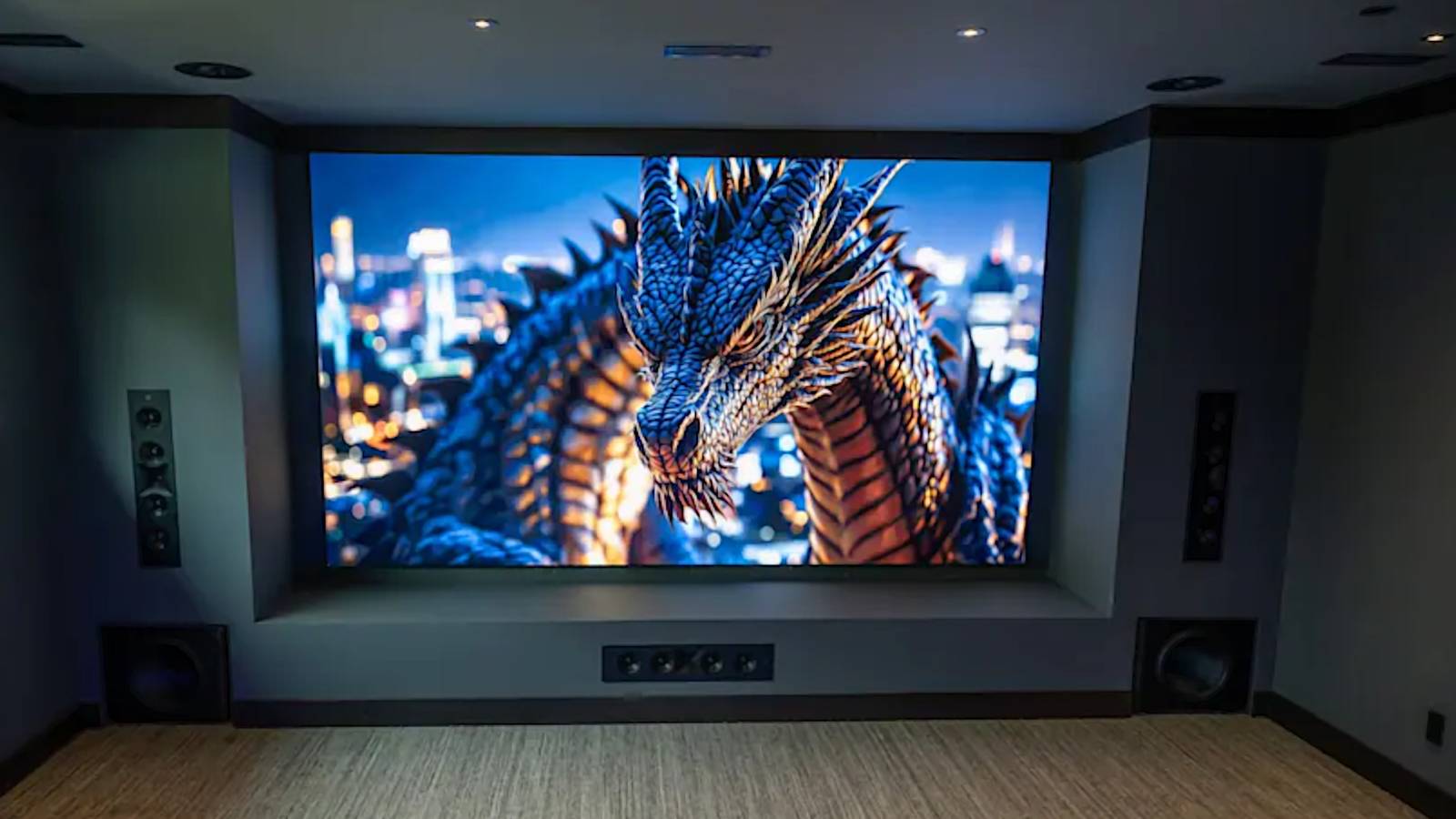
If you’re watching as a casual observer, it can be hard to keep up with the pace of TV tech, and it’s not much easier when you’re immersed in it every day, either. I still tend to think of things like QLED and mini-LED as being recent, even though they’ve been around for several years at this point. Truthfully, there have been significant innovations since then, and another wave of them is hitting us right now. Soon enough, you’re going to be demanding Dolby Vision 2 and HDR10+ Advanced on any TV you buy.
The peak of that wave could be MicroLED. There’s been a lot of progress, and on paper, it blows away any other display technology. But a confluence of factors means that it could miss its opportunity to seize the market, if it ever reaches the mainstream at all. You’ll see what I mean in a minute.
What is MicroLED, and what makes it so special?
Not just a rehash of your QLED TV

You’re used to seeing the term “LED” in every panel technology these days. Indeed, some people refer to all LCDs as “LED TVs” these days, presumably because they’re so used to seeing the QLED and mini-LED acronyms in association with them. There’s also OLED, which operates very differently from LCDs, but still shares some relation.
Let’s take a step back here. All LCDs rely on LEDs (light-emitting diodes) for backlighting — there simply wouldn’t be a visible image without some sort of external light source. QLED enhances this with quantum dot technology, making things brighter and more color-accurate, while mini-LED ramps up the number of LEDs from hundreds to thousands, or the tens of thousands. Mini-LED TVs tend to be the brightest available, and offer more contrast than other LCD types, to the extent that it can (sometimes) be hard to tell the difference via OLED.
Better contrast still leaves room for improvement, however. Short of OLED, LED-lit panels have always been unable to achieve perfect contrast, for the simple reason that those lights cover zones rather than individual pixels. There’s always bound to be some light bleed, and those zones can’t be shut off completely, only dimmed to near-black levels.
OLED can achieve perfect contrast, since it uses self-illuminating pixels, but this comes with a couple of major tradeoffs. The first is brightness, since most OLED panels are dimmer than any QLED or mini-LED equivalent. The biggest issue, though, is burn-in. The organic materials in OLED TVs are prone to degrading faster than synthetic ones, which inevitably leads to issues like ghost patterns, tinted color, and decreasing brightness. TV manufacturers have come up with a variety of clever ways to prolong lifespan — possibly even topping some LCDs — but it’s an uphill battle.
MicroLED is meant to be the best of both worlds. It uses synthetic LEDs for each individual pixel, enabling the perfect contrast of OLED with the brightness and longevity of mini-LED. It can even beat OLED in color accuracy, potentially achieving 90 to 100% of the BT.2020 color gamut. While your brain probably won’t register many of those shades, the benefit is seeing colors exactly as they were intended when watching HDR content.
The triumph of practical value?

The immediate problem is cost. MicroLED TVs are still extremely expensive, regularly costing five or six digits. Needless to say, most people aren’t prepared to drop as much on a TV as they would on a premium EV. Heck, if you gave me $10,000, I could build an amazing home theater system with a relatively high-end OLED or mini-LED TV at its core.
New panel technologies are always expensive at first. The problem here is that there’s no sign (yet) of the usual “bridge” product that takes a category from a plaything for the rich to something your upper-middle class neighbor might own. That’s despite Samsung having been in the MicroLED market since 2018, and making a more serious push in 2024, albeit still charging over $100,000.
At the root of this is the complexity of manufacturing a MicroLED screen. The LEDs used are microscopic, and need to be placed with extreme precision. That’s doable, but bringing costs down means being able to manufacture panels quickly and with high usable yields. That threshold doesn’t seem to have been achieved yet. On top of that, you can’t churn out MicroLED displays on the same assembly lines you’d use for LCD or OLED panels. It’s a Catch-22 — there isn’t enough demand to justify more manufacturing capacity, but demand can’t grow without increased production forcing prices down.
The problem here is that there’s no sign (yet) of the usual bridge product that takes a category from a plaything for the rich to something your upper-middle class neighbor might own.
Even this wouldn’t be such a threat if it weren’t for the existence of RGB mini-LED. That’s an evolution of mini-LED that substitutes single-color filtered backlights for separate red, green, and blue LEDs, hence the name. RGB TVs are exceptionally bright, and just as color-accurate as MicroLED. Perfect contrast is still missing — yet with some models already under the $2,000 mark, they’re poised to gain serious traction, and the contrast gap is small enough that only purists with money to burn may complain.
In fact, MicroLED picture quality can be rough around the edges. Manufacturing deviations can lead to some pixels being dimmer or less accurate than others, and if there are enough of those, you’ll see visible “splotches” onscreen. There are also complaints about reduced color consistency at off angles. That’s disappointing when the alternative might be buying a decked-out Rivian R1T, say, or putting a payment down on a new house.
Does MicroLED have any hope?
Talking timescales

Quite possibly. While the production issues I’ve mentioned are challenging, they shouldn’t be insurmountable, and there’s incentive to get things right. It’s not just about TVs, either. Since MicroLED screens can be cut to any dimension, they might represent the future of phones, smartwatches, and many other products. Apple was at one point looking to add MicroLED to the Apple Watch, but decided to stick with OLED for reasons that are probably clear by now.
For perspective, consider that plasma TVs once carried a lot of prestige, only to vanish overnight once LCDs delivered similar specs with affordable prices.
That said, the clock is ticking. The longer MicroLED TVs remain outside the mainstream, the harder it’s going to be to compete with RGB mini-LED, owing to the latter’s headstart in pricing and technological refinement. The two could hypothetically exist side-by-side, as with OLED and mini-LED at your local big-box store, but my suspicion is that there isn’t enough of an advantage to MicroLED to let that happen.
Remember also that researchers are always working on new panel technologies. It’s possible that something even better than MicroLED is a few years away. I doubt it, but for perspective, consider that plasma TVs once carried a lot of prestige, only to vanish overnight once LCDs delivered similar specs with affordable prices.