


Jan Bartek – AncientPages.com – One of Dublin’s previously “lost” medieval castles has been identified within University College Dublin’s Roebuck Castle.
New research reveals that substantial remains of the Norman castle of Roebuck, an important fortress on one of the approach roads into medieval Dublin, are preserved within the modern-day building.
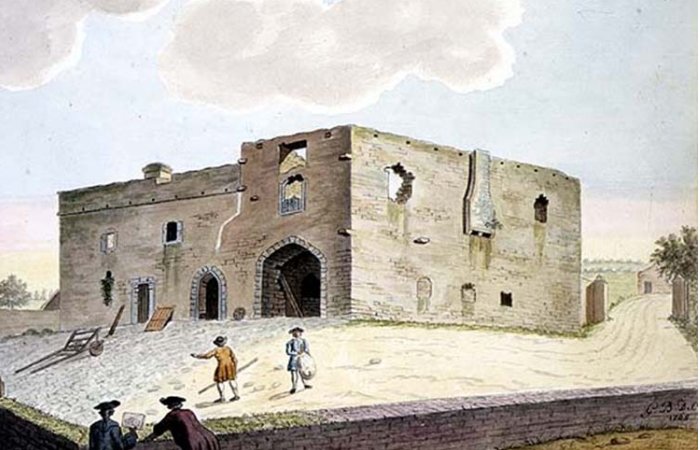
Beranger’s 1765 watercolor of Roebuck Castle, viewed from the north-west. Credit: Courtesy of the National Library of Ireland
Professor Tadhg O’Keeffe, a medieval architectural historian at UCD School of Archaeology, identified surviving walls and other medieval features from the castle, previously thought demolished, beneath the plaster of the current structure.
Published in Archaeology Ireland magazine, the research indicates that the oldest parts of the castle date to the early 13th century – this would likely make Roebuck Castle the oldest standing building on an Irish university campus.
“From the outside, the present building looks to be entirely Victorian. Inside, though, the walls of the old castle are preserved,” said Professor O’Keeffe.
“The medieval features remain. They are concealed under plaster but can still be identified. We are fortunate that the Georgian and Victorian renovators built around the medieval castle instead of demolishing it, and that little else was constructed on the site. The courtyard at the back of the house today is, in fact, the original medieval castle courtyard!”
Adding: “UCD can now claim to have the oldest standing building on any university campus in Ireland.”
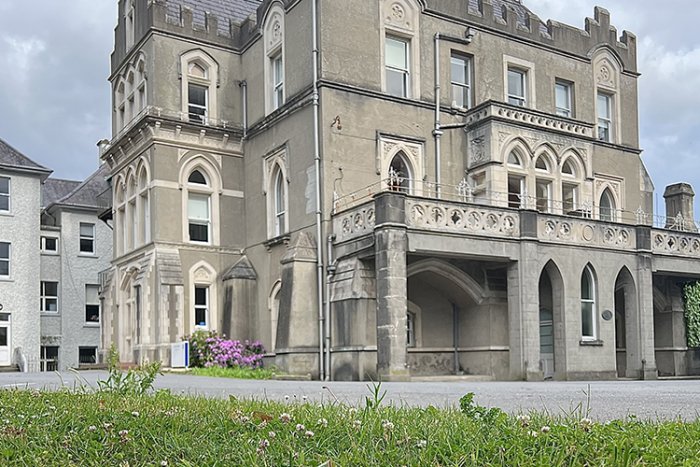
Present-day Roebuck Castle. Credit: University College Dublin
Historical sources indicate that the old castle was constructed shortly after the Norman invasion of Ireland in 1169 and underwent several alterations during the Middle Ages.
Notable occupants included a medieval Lord High Chancellor of Ireland. Tradition also holds that James II, the deposed King of England and Ireland (and Scotland as James VII), stayed there in 1689 after losing his throne.
By the 18th century, the castle had fallen into ruin and was believed to have been removed during subsequent redevelopment of the site.
However, artist Gabriel Beranger provided evidence of the castle’s survival when he visited the ruins around 1765 and created a series of watercolors.
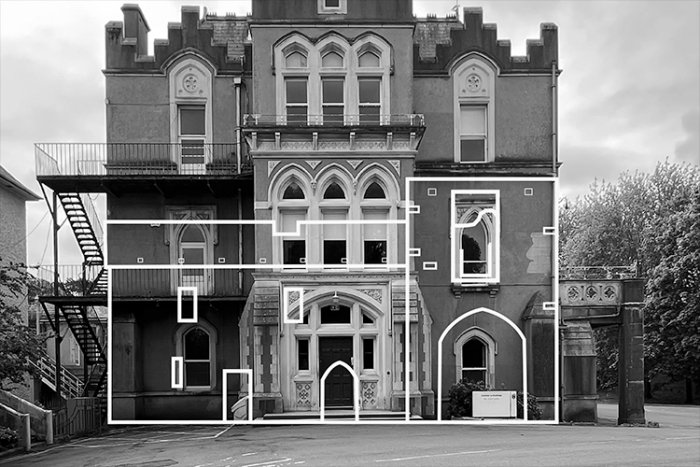
The facade of Roebuck Castle, with Beranger’s drawing of the castle superimposed in outline. Credit: University College Dublin
“Beranger’s depictions of the ruined castle are really fascinating,” said Professor O’Keeffe. “He captured the basic form of the building, as you would expect, but thankfully he also captured some of those small details which are the clues needed to work out the building’s structural history.”
See also: More Archaeology News
This discovery is significant because few medieval castles remain in south Dublin. Many were demolished in the 17th century, and their stonework was reused in more modern residences.
“The passage of time has been unkind to the castles which were built across south Dublin in the Middle Ages,” said Professor O’Keeffe. “Lost buildings are lost historical records. They leave gaps in our knowledge.
“It is wonderful to be able to welcome back Roebuck’s medieval castle, and to know that it won’t get lost again.”
Source: University College Dublin
Written by Jan Bartek – AncientPages.com Staff Writer
