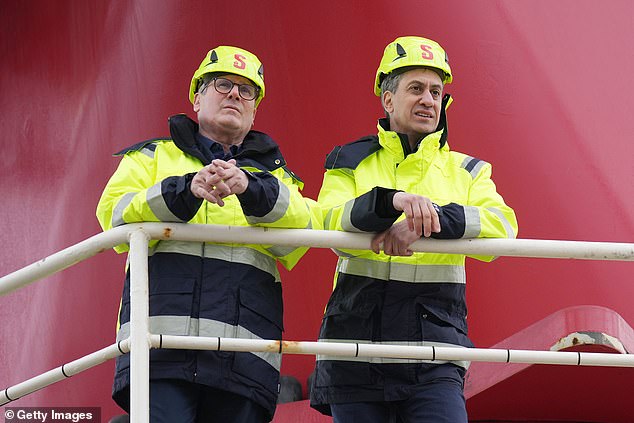
Sir Keir Starmer is set to dilute the UK’s electric vehicle sales targets, dealing a significant setback to Ed Miliband’s net-zero agenda.
The Prime Minister is understood to have overruled the Energy Secretary following sustained lobbying from industry leaders, the Unite union and Business Secretary Peter Kyle.
An announcement detailing the changes is expected within weeks, with the reforms likely to significantly slow the pace of the UK’s transition to electric vehicles, which typically carry higher upfront costs than petrol and diesel models.
Under the proposed changes, the Zero Emission Vehicle (ZEV) mandate’s requirement for 80 per cent of new car sales to be fully electric by 2030 would be cut to 50 per cent, according to reports.
The revisions will be subject to a formal consultation and will require the support of the devolved administrations before they can be implemented across the UK, raising the prospect of tensions between Westminster, Holyrood and the Senedd.
Motor industry leaders have warned that the existing mandate risks driving investment away from Britain, with concerns over large-scale job losses understood to have been a key factor in Starmer’s decision to intervene.
The move represents a notable U-turn on a flagship element of the green agenda championed by Miliband, who has come under increasing pressure in recent months to soften his position on issues such as oil and gas exploration in an effort to support economic growth.
Sharon Graham, the general secretary of Unite, which has been one of Labour’s biggest donors, said last week that the ZEV mandate ‘is significantly contributing to the loss of automotive jobs in Britain. This is a clear fact. The targets must be radically reduced.’ She warned that ‘if the government sits on its hands it will be responsible for the decimation of the automotive industry’.

Sir Keir Starmer and Ed Miliband tour a wind turbine site in Holyhead

Secretary of State for Business and Trade Peter Kyle MP during a visit to Jaguar Land Rover (JLR) supplier, Webasto, in Sutton Coldfield in the West Midlands
Liam Byrne, chair of the business select committee, told ministers in May: ‘Carmakers are being asked to carry a burden that is becoming impossible to sustain. Manufacturers are now spending billions discounting electric vehicles to stimulate demand.’
The UK’s Zero Emission Vehicle (ZEV) mandate, introduced by Boris Johnson in 2020 and implemented in 2024, requires car manufacturers to sell an increasing proportion of electric vehicles (EVs).
The target started at 22 per cent of sales in 2024, rose to 28 per cent in 2025, and was due to reach 33 per cent in 2026, eventually climbing to 80 per cent by 2030.
Under current plans, sales of new petrol and diesel cars will be banned from 2030, with hybrid vehicles allowed until 2035.
Supporters, including Ed Miliband, argue it helps consumers, supports UK manufacturing, and advances the transition to cleaner transport.
However, car manufacturers have criticised the mandate, saying they have had to offer large discounts to meet targets and avoid fines of £12,000 per non-compliant vehicle, reports the Sunday Times.
The industry estimates the policy has cost around £10 billion in its first two years, and some manufacturers have warned they may reduce or end their UK operations.
Meanwhile, the EU has moved away from a strict 2035 ban on petrol and diesel car sales, instead focusing on emissions-reduction targets.
This approach allows a limited share of hybrid and conventional vehicles beyond 2035 and imposes lower EV sales requirements than the UK.
February 2026 was the strongest February for new car sales since 2004, with 90,100 vehicles registered, an increase of 7.2 per cent on the previous year.

Sharon Graham (pictured), the general secretary of Unite, which has been one of Labour’s biggest donors, said last week that the ZEV mandate ‘is significantly contributing to the loss of automotive jobs in Britain’

UK Prime Minister Boris Johnson poses with electric cars outside 10 Downing Street
Much of this growth was driven by private buyers, whose purchases rose by 17.6 per cent.
Despite the overall strength of the market, demand for electric vehicles was weakening.
EV sales increased by only 2.8 per cent year-on-year, while their market share fell from 25.3 per cent to 24.2 per cent, marking the second consecutive month of decline.
This left EV sales well below the ZEV mandate’s 2026 target that 33 per cent of new car sales should be electric.
The Society of Motor Manufacturers and Traders (SMMT) used these figures to call for an urgent review of the ZEV mandate.
Its chief executive, Mike Hawes, warned that manufacturers were spending heavily to stimulate EV demand and argued that current targets did not reflect natural consumer demand.
Various factors may have discouraged EV buyers, including Labour’s decision to introduce Vehicle Excise Duty on electric cars from April 2025 and concerns over a proposed 3p-per-mile road pricing scheme from 2028.
There have also been calls for VAT on public charging to be reduced from 20 per cent to 5 per cent.
In 2023, exclusive polling for the Daily Mail found that only a quarter of the public agreed with the Government’s 2030 deadline.
More than half disagreed with the rush to switch to electric cars.
A major audit by this newspaper uncovered a series of concerns about the policy, including questions over the supposed financial and environmental benefits, as well as whether Britain’s infrastructure is ready.
As of 2023, each public charging point has an average of 36 drivers fighting over it.
There were also fears that the rush to ban new petrol and diesel cars could cost hundreds of thousands of jobs and leave households worse off. The poll, conducted by Survation across the UK, found:
– Only 28 per cent of the public think the ban of new petrol and diesel vehicle sales in 2030 is a good idea, compared with 53 per cent who think it is a bad idea.
– A similarly small proportion – 29 per cent – would feel confident buying an electric car to use as their only vehicle based on the current infrastructure; by contrast, 39 per cent would not be confident.
– Only 21 per cent feel confident Britain will have the necessary infrastructure to support electric cars ready in time for 2030, while 50 per cent do not feel confident.
– Nearly half of the public (42 per cent) are concerned about the economic consequences of the looming ban, compared with just 18 per cent who are not.