


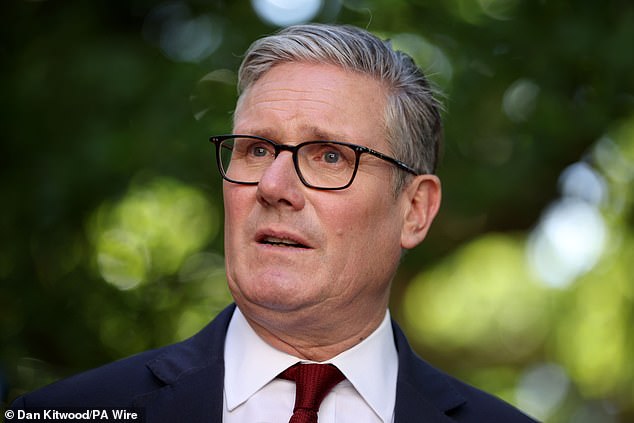
Labour’s defence plans were branded a ‘pantomime’ – as new figures revealed Russian jets are testing Nato’s defences an average once a day.
Keir Starmer will head for what looks set to be a bruising Nato summit in Turkey on Tuesday morning amid warnings that he has failed to protect Britain.
Downing Street is braced for a final blast from Donald Trump after US officials accused countries like the UK of ‘lagging behind’ Nato spending targets.
And, in an ominous development, it emerged that a Russian aircraft buzzed the British aircraft carrier HMS Prince of Wales last week.
The warship scrambled two F-35 fighter jets to shadow the Russian maritime patrol aircraft, which also dropped a number of sonic buoys near the British carrier in an apparent provocation.
Downing Street branded the manoeuvre, which took place in the Norwegian Sea, ‘unsafe and unprofessional’.
Government sources revealed it was one of 700 incursions that Nato jets have had to deal with in the last two years – an average of almost one a day.
Kemi Badenoch said the action by Vladimir Putin was a ‘test’ that the government is failing.

Humiliation: Officials fear Donald Trump could try to embarrass the PM over defence at this week’s Nato summit
In a speech on Tuesday, the Conservative leader will warn that Britain’s defence policy is becoming a ‘pantomime’ at the moment that the threat has grown to the most serious since the end of the Cold War.
Mrs Badenoch will urge Andy Burnham to take up her offer to help push through welfare cuts to help fund defence investment. But she will warn that the would-be prime minister has ‘said nothing’ about the growing threats facing the UK.
‘We are sending an outgoing Prime Minister who is now completely powerless to that Nato summit,’ she will say.
‘And he is taking with him a Defence Investment Plan which he knows is not fit for purpose. With barely half of the additional funding that our armed forces need.
‘So little that the former Defence Secretary quit the government because he thought the plans would put British troops in danger.’
Sir Keir will tell Nato allies this week that his controversial Defence Investment Plan (DIP) represents a major step on the way to hitting Nato’s target of spending 3.5 per cent on defence by 2035. But it only commits the UK to reaching 2.7 per cent by the end of the decade.
New Defence Secretary Dan Jarvis said Labour would ‘commit the resources to evidence the trajectory to 3.5 per cent’ at a spending review next year. But neither No 10 nor Mr Burnham have so far agreed to the timetable.
Nato chief Mark Rutte said he expected member states to produce ‘clear, concrete and credible’ plans to hit the 3.5 per cent target.
No 10 fears that Mr Trump may use this week’s summit to humiliate Sir Keir over defence spending.
Speaking at the weekend, he said ‘weak’ British leaders had allowed the country to become a ‘deindustrialised welfare zone unable to stop Third World men arriving on boats’.
The two leaders are not expected to hold a formal meeting this week, despite it being Sir Keir’s final appearance on the world stage before leaving office. But Downing Street said they would be seated next to each other at a summit meeting tomorrow and insisted that their relationship remains ‘constructive’.
Ahead of the summit, Putin sent a clear message to defence chiefs over Russia’s willingness to threaten its member states, including Britain.
It emerged how a Russian aircraft conducted a ‘danger close’ low pass of the HMS Prince of Wales while the £3.5billion carrier was operating in the Norwegian Sea.
After ignoring requests from the carrier’s control room, the Bear-F maritime patrol aircraft then dropped tens of sonobuoy projectiles in close proximity to HMS Prince of Wales which could have injured sailors or damaged the carrier.
British commanders scrambled two F-35 jets from HMS Prince of Wales to shadow the Russian aircraft in the carrier’s first ‘real-time’ engagement with enemy forces.
The Royal Navy has released information about the July 2nd incident for the first time.
At the time HMS Prince of Wales was sailing as part of the UK’s Carrier Strike Group which also consisted of the Type-45 destroyer HMS Duncan, the Royal Fleet Auxiliary ship Tidespring which were conducting freedom of navigation patrols in the High North.
The Arctic Sentry patrols are intended to reinforce security. The engagement came just weeks after the UK seized a Russian shadow fleet vessel in the English Channel for the first time and after a Russian fighter jet flew within feet of a Royal Air Force intelligence gathering aircraft conducting a patrol over the Black Sea.