
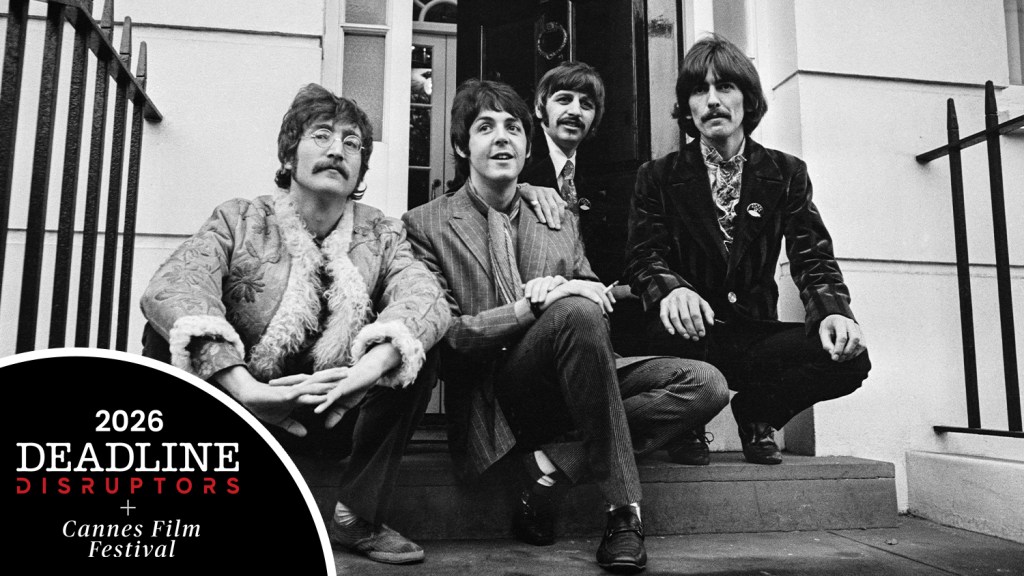
Picture yourself in a boat on the Riviera… Most rock superstars have been seduced by the glamor of the Cannes Film Festival at some point in their career. The Rolling Stones went twice, first with Gimme Shelter in 1971 and then with Stones in Exile in 2010. The Who closed the festival in 1975 with their rock opera Tommy; Pink Floyd took The Wall in 1982, and U2 played a short set on the steps of the Palais to promote 2007’s U2 3D. The Beatles were no exception; all four walked the Croisette at various points in their careers. Strangely, however, though they were quick to seize on the power of cinema, the Fab Four were never all in Cannes at the same time. Perhaps it’s fitting, then, that Sam Mendes’ upcoming quadrilogy, The Beatles – A Four-Film Cinematic Event, is set for release in April 2028, a matter of weeks before the festival.
The band’s first and best film, A Hard Day’s Night, was released in the summer of 1964, less than two years after their debut single, “Love Me Do”, launched the phenomenon known as Beatlemania that swept the world at the tail end of 1963. By that time, movies had become a key part of the marketing process, a trail blazed by Elvis Presley. For a time, it seemed that The Beatles might go down a similar path, entertaining an offer brought to them by manager Brian Epstein to play a pop group in a mild sexploitation film called The Yellow Teddy Bears (1963).
“We said to Brian, ‘Yeah, OK, great!’,” Paul McCartney recalled. “Then he came back to us after talking to the producers and told us they wanted to write the songs themselves.” Naturally, they passed.
In the summer of ’63 the band signed a three-picture deal with United Artists, which gave The Beatles a list of potential directors. The band immediately agreed on Richard Lester. Lester had recently directed the musical comedy It’s Trad, Dad! but McCartney and John Lennon remembered him from an 11-minute short they’d seen, called The Running Jumping & Standing Still Film (1959). The film that evolved was both a light comedy and a surprisingly perceptive study of the mechanics — and pressures — of pop culture, with a plot that covered 36 hours in the lives of the band as they prepare to perform for a TV variety show.
With a budget of just £180,000, filming began in March of 1964 and lasted less than two months. That left three weeks and four days to edit the film, dub it, and get a final print ready for its London premiere on July 6th. Against all expectations, the film was a massive hit, and Lester was tasked with coming up with a sequel. This he duly did — less than a year later — with Help!, a farcical romp in which drummer Ringo Starr is sent a ring by a fan, unaware that it is a religious item that must be worn by sacrificial victims of a pagan cult.
The Beatles only made three more films, largely to satisfy contractual obligations. Magical Mystery Tour (1967), ostensibly directed by the band themselves, was basically a whimsical 52-minute TV special that attempted (and mostly failed) to capture the offbeat vaudevillian comedy of A Hard Day’s Night. Yellow Submarine (1968), meanwhile, though a fantastic piece of psychedelic art in its right, had so little input from The Beatles that they didn’t even do their own voices. Their swansong was Let It Be (1970), a morose documentary that would have been the last word on the band had Peter Jackson not returned to the master tapes for his 2021 mini-series Get Back.

John Lennon and Yoko Ono in Cannes.
RAPH GATTI/AFP via Getty Images
JOHN
One of the founding Beatles returns to Cannes this year in Steven Soderbergh’s documentary John Lennon: The Last Interview, which uses a radio interview Lennon gave on 8th December 1980, the day he was shot and killed. Coincidentally, Lennon was the first to go to Cannes, spending four days there in May 1965, with Richard Lester, who was competing with his film The Knack… and How to Get It. Help! was in the can, awaiting a late summer release, and Lennon gave a brief, nonsensical interview to The Merv Griffin Show, which he mostly used to plug his upcoming book A Spaniard in the Works, on sale for “ten shillings and sixpence”. It was more of a social visit; Lennon took his then-wife Cynthia, and the pair hung out with Michael Caine, there to promote The Ipcress File.
Caine and Lennon attended a party thrown by the British Consul, where, astonishingly, none of the older Brits knew who they were.
“He introduced himself as Joe Lemon and I used my real name, Maurice Micklewhite,” Caine wrote in his autobiography, What’s It All About?. “As each group approached us we would introduce ourselves, and when they asked us what we did for a living, John would point at me and say, ‘I’m his assistant,’ and I in turn would point at John and say, ‘I’m in charge of him.’”
The same evening, they got drunk together at a party in a grand mansion overlooking the sea. Both went looking for a bathroom, but only Caine found one, in the hostess’s bedroom. John, meanwhile, relieved himself through the open window, splashing the drapes as he did so.
“John finally finished,” wrote Caine, “and as we left the bedroom I said to him, ‘You’ve ruined her bloody curtains.’ ‘They’re rich,’ he replied. ‘F*ck ’em.’”
It was a very different Lennon that returned to the festival in 1971. In 1965 he’d worn black tie; this time he wore double denim for the premiere in Directors’ Fortnight of a short film, Apotheosis, he’d conceived and co-directed with his new wife, performance artist Yoko Ono. Shot in the snow-covered town of Lavenham in Suffolk, it appeared to show the couple getting into an unseen hot air balloon and rise up into the clouds, disappearing into the cloud cover for 18 minutes before bursting through the other side. It appeared on a double bill with Ono’s Fly, a 25-minute piece starring actress Virginia Lust, about “a fly going from the toe to head of a lying naked body, crawling very slowly.”
The trip was arguably Lennon’s most visible public appearance since the disbanding of The Beatles, and there were no signs that he was looking back. In photographs taken at the festival, he can be seen brandishing a copy of his most recent album, John Lennon/Plastic Ono Band, as well as Yoko Ono’s book, Grapefruit. Subtitled A book of Instructions and Drawings and first published in 1964, it was a collection of epigrams that, variously, invited the reader to walk all over the city with an empty baby carriage, eat a tuna fish sandwich, and shoot a bullet through 100 panes of glass.
Paul McCartney on stage.
Keystone/Getty Images
PAUL
Despite being arguably the most artistic of the band — famously well-read, with a passion for painting inspired by Willem De Kooning — Paul McCartney has never really embraced cinema. Aside from a cameo as ‘Banquet Guest’ in the low-budget 1987 British comedy Eat the Rich, McCartney has mostly only ever played, or appeared as, himself. His first appearance at Cannes was with his wife Linda, who’d produced an animated short in 1980 for her reggae song “Seaside Woman” — released under the pseudonymous name Suzy and the Red Stripes — directed by Argentina’s Oscar Grillo.
The film won the short film Palme d’Or, which may have emboldened Mr. McCartney to come up with his own and — so far only — foray into feature films in 1982. Titled Give My Regards to Broad Street (1982), it was billed as “a day in the life of a famous rock star”, with McCartney, as himself, facing financial ruin when the master tapes of a recording session go missing. Roger Ebert, who half-heartedly praised the music, gave it one star, then twisted the knife. “It seems to be a throwback to pre-Beatles days,” wrote the critic, “back when pop musical films were simpleminded and shallow, back before A Hard Day’s Night and Help! seemed to create a new tradition of fresh irreverence.”
There’s three Beatles left, and it would be a real problem to be on stage and look over where John used to be and he wouldn’t be there. I don’t think we could do that.
Paul McCartney
Paul took it on the chin, while admitting that the bad reviews stung. “Nobody likes to have their wrists slapped,” he said later. “You don’t like it at school when you get exam results, and you haven’t done as well as you thought you had. And it’s the same [here]… It also happened with Magical Mystery Tour. Now, there’s a lot of people who like it. Whereas what happened was it actually came out on Boxing Day. It should have been, ‘Hello viewers, are we having a happy Christmas? Have you had your Christmas pud?’ It was in that slot, and it was just not what the majority of those 20 million viewers expected. So, it got slammed from that angle. But you won’t find any other footage of John Lennon singing ‘I Am the Walrus’.”
McCartney returned to Cannes in 2001 — three years after Linda’s death — to promote a Wings concert film called Wingspan. In a wide-ranging press conference, McCartney pontificated on the cause of foot and mouth disease, admitted to liking Coldplay, and claimed to have written a song inspired by one he heard The Rolling Stones play in a dream. He also emphatically denied that there would ever be a Beatles reunion. “Short answer, no,” he said. “I’ll tell you why, too, and why you won’t see Wings onstage either. I figured it out the other day. There’s three Beatles left, and it would be a real problem to be on stage and look over where John used to be and he wouldn’t be there. I don’t think we could do that. The same answer for Wings; no matter what lineup we had, I’d look over, and Linda wouldn’t be there. So, I think it’s definite that you won’t see any reunions of either of those groups.” Six months later, George Harrison passed away, aged 58.
George Harrison on his balcony at the Carlton Hotel overlooking the Croisette in Cannes.
Michael Putland/Getty Images
GEORGE
McCartney was the first Beatle to dabble in movie soundtracks, working with producer George Martin on an orchestral score for the 1966 comedy-drama The Family Way, but George Harrison was the first to release a standalone solo release, which comprised songs he’d written for a film called Wonderwall (1968). A curio even at the height of the Swinging ’60s, Wonderwall is best described as a psychedelic midlife crisis movie, in which a repressed scientist discovers hallucinatory portals that allow him to spy on the woman next door (Jane Birkin) and her Austin Powers-like photographer boyfriend.
Harrison’s fascination with the spiritual East was in full swing, and when Wonderwall director Joe Massot gave him carte blanche, the musician jetted over to EMI’s recording studios in Bombay. Wrote biographer Philip Norman, “His score brought together the classical Indian, on lesser-known instruments like the shehnai and the sarod, and Western idioms like country and ragtime, performed by guest musicians including Ringo and Eric Clapton. A few years later, such fusions would be dubbed World Music.”
The film premiered in Cannes, outside the official selection, just a few days after Lennon and McCartney had used their appearance on The Johnny Carson Show to distance themselves from their former guru, the Maharishi Mahesh Yogi. “We found out that we made a mistake there,” said Lennon. “We got all carried away,” added Paul. “We thought he was magic, floating around and flying.” Perhaps because of that, and the fact that the 1968 festival was cancelled the same day it screened, Wonderwall, in all its paisley-patterned, mystic splendor, was a flop.
It’s nice to let people have as much artistic freedom as possible, but I’m the one who has to pay back the bank.
George Harrison
Massot would later make a comeback, co-directing the Led Zeppelin concert film The Song Remains the Same (1976), and, by a strange twist of fate, Harrison would also return to film — as a producer.
In 1978, the Monty Python team were getting ready to shoot their religious satire Life of Brian, and after a smattering of bad publicity regarding the subject matter, its distributor, EMI, pulled out mere days before shooting was due to start. Python member Eric Idle approached Harrison and was amazed when the musician not only put up the cash but — together with manager Denis O’Brien — mortgaged his home to form HandMade Films and do so. “It was a bit risky, I guess,” Harrison said later, “totally stepping out of line for me, but as a big fan of Monty Python my main motive was to see the film get made.”
HandMade’s output tended towards the comedic, and thus, with the exception of 1986 gangster drama Mona Lisa, wasn’t exactly Cannes fare. But Harrison enjoyed the challenge. “When I was acting,” he said, “there was always the feeling that the artists were the clever ones who do everything — and then there were these horrible people who put the money up and don’t know anything. Everyone subscribed to that old Hollywood myth that executive producers hate everything and chop everything up after you’ve done it. So, it is sort of funny being a simple musician who’s now a producer or — inverted commas — ‘The Money’. I can see it from both sides. It’s nice to let people have as much artistic freedom as possible, but I’m the one who has to pay back the bank.”
Ringo Starr with director Roman Polanski at the Cannes Film Festival.
Keystone/Hulton Archive/Getty Images
RINGO
Ironically, of the four Beatles, it was initially assumed that Lennon would break into the seventh art, taking the joint lead in Richard Lester’s 1967 satirical anti-war movie How I Won the War. Instead, it was Starr that got the acting bug, and he was smitten even before the cameras rolled on A Hard Day’s Night. “I loved the movies as a kid,” he recalled. “I have great memories from Saturday morning picture shows. I’d be into whatever was showing; if it was a pirate movie, I would be a pirate, and if it was a Western, I would be a cowboy; or I’d come out as D’Artagnan and fence all the way home. It was a great fantasy land for me, the movies — and suddenly we were in one.”
Starr’s acting career got off to a slow start, with two adaptations of books by American writer Terry Southern that polarized reviewers. Candy, a raunchy update of Voltaire’s classic novel Candide was described by critic Pauline Kael as “a shambles of a sex spoof”, but fortunately for Starr there were plenty more famous faces — including Marlon Brando, Richard Burton and Sugar Ray Robinson — in the firing line. A similar fate befell The Magic Christian, in which Starr plays an orphan adopted by the imperious Guy Grand (Peter Sellers), an eccentric millionaire who uses his wealth to prank people into debasing themselves for money. This time round, Starr’s mortified co-stars included Yul Brynner, who made an uncredited appearance as a transvestite cabaret singer.
Read the digital edition of Deadline’s Disruptors/Cannes magazine here.
Starr’s movie career must be one of the strangest ever, teaming with Harry Nilsson in 1974 for “the world’s first rock-and-roll Dracula movie Son of Dracula, in which he played the wizard Merlin. In 1975 he played the Pope in Ken Russell’s musical biopic Lisztomania, in 1978 he joined Tony Curtis in Mae West’s last-ever film Sextette (“A total, unbearable bomb,” said Rex Reed), and in 1981 he finally took the lead as a prehistoric man in Caveman, only to be upstaged by an animatronic dinosaur. In amongst these roles, it’s easy to overlook the thoughtful performance he gave in That’ll Be the Day, playing a quiffed greaser in a ’50s-set drama with a period jukebox soundtrack.
But Starr did get to have his moment in Cannes. After visiting the festival with George for the Wonderwall premiere, the drummer returned in 1982 with his own project, a ten-minute short called The Cooler, comprising three songs from his 1981 album. Directed by Lol Creme and Kevin Godley, the film stars Starr as a new inmate in a weirdly futuristic Western prison, where the guards are played by statuesque women (including Starr’s wife Barbara Bach) in stylized ’80s military clothing who stymie his attempts to escape. It didn’t win any prizes, but it’s unlikely that Starr would have had any illusions about that. “First and foremost, I am a drummer,” he once said. “After that, I’m other things. But I didn’t start playing drums to make money.”