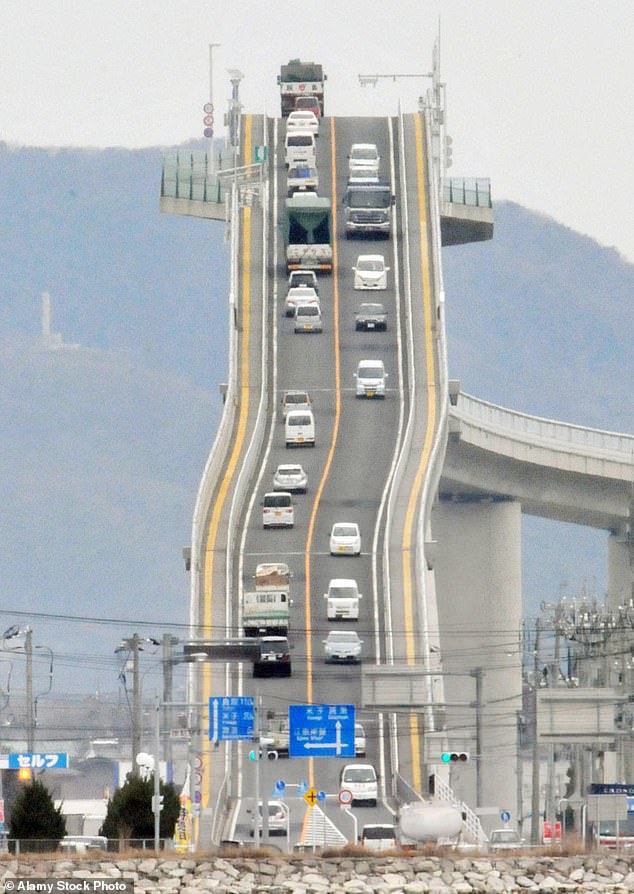
One of the steepest bridges in the world is so daunting that drivers say it gives them nightmares.
Dubbed the ‘rollercoaster bridge’, the Eshima Ohashi in Japan links Matsue in Shimane Prefecture with Sakaiminato in Tottori Prefecture.
The £119million crossing is used by thousands of motorists each day and rises sharply to allow ships to pass underneath.
The bridge is the third largest of its kind in the world, and from certain angles appears almost vertical – fuelling viral footage that makes it look like vehicles are climbing an impossibly steep incline.
Stretching approximately 1.1 miles, it towers 147ft as it spans Nakaumi Lake.
Construction took place between 1997 and 2004, replacing a previous drawbridge that had significant design flaws.
For instance, it could only handle around 4,000 vehicles a day, compared to roughly 14,900 now crossing every 24 hours.
The old bridge was also blocked for around eight minutes each time ships passed, and only vehicles weighing under 14 tons were permitted to cross.

One of the steepest bridges in the world is so daunting that drivers say it gives them nightmares.

Dubbed the ‘rollercoaster bridge’, the Eshima Ohashi in Japan links Matsue in Shimane Prefecture with Sakaiminato in Tottori Prefecture. Photographs of the bridge are typically captured using a telephoto lens, which makes it appear more dramatic than it really is

The £119million crossing is used by thousands of motorists each day and rises sharply to allow ships to pass underneath
At its steepest, the incline measures around 6.1% on the Shimane side – where most photos are taken – while the opposite side is a gentler 5.1%.
Images and footage of the bridge frequently circulate on social media, sparking debate about its ‘terrifying’ appearance, with one Reddit user writing: ‘One of my lifelong recurring nightmares involves bridges that look like this.’
Another posted: ‘Oh. My. God. I get terrified shivers just looking at these pictures. Massive phobia of heights, I don’t think I’d do well on that bad boy.’
Photographs of the bridge are typically captured using a telephoto lens, which makes it appear more dramatic than it really is.
It’s still relatively steep, and additional caution is needed during winter to stop it becoming blanketed in ice and snow.
The Japan National Tourist Organisation describes it as one of the ‘craziest’ or ‘scariest’ bridges in the country.
Even without a vehicle, visitors can cross it on foot or by bicycle, and it serves as an excellent location for photographs.
Telescopes and binoculars are also provided for tourists to gaze across the lake when it’s clear enough.