

Iran launched four missiles at a US-backed Middle Eastern ally on Monday and blew up a major oil port, following Donald Trump’s move to reopen the Strait of Hormuz.
The United Arab Emirates issued a missile alert on Monday morning, the first since the fragile ceasefire between the US and Iran was announced last month.
The UAE’s Defense Ministry said it intercepted three missiles, while a fourth ‘fell into the sea.’ An official noted that the country’s air defenses ‘are currently dealing with missile attacks and incoming drones from Iran.’
Tehran’s decision to launch these attacks officially resumes hostilities between Iran and the US in the Middle East.
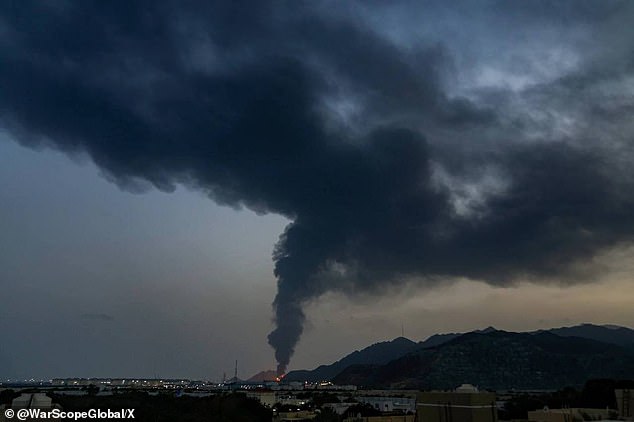
Authorities also announced that a massive fire broke out at the Fujairah Oil Industry Zones on Monday following a drone attack from Iran. Rescue teams were deployed to contain the inferno, Reuters reports.
A senior US official said that US warships and aircraft protected several commercial vessels from Iranian attacks earlier on Monday, according to the Wall Street Journal. Sources said an Iranian drone successfully struck an Marshall Islands-linked oil vessel named the JV Innovation while it was attempting to move through the strait.
US warships responded to the cruise missile fire by sinking six small Iranian boats, Central Command told reporters. The number of casualties from the Iranian attacks remains unclear.
The ongoing military aggression from Iran comes after Trump’s announcement that the US military would begin escorting stranded oil vessels through the Strait of Hormuz, a critical waterway that handles one-fifth of the world’s oil transport.

A massive fire has broken out at an UAE oil port following an Iranian drone attack

The ongoing military aggression from Iran comes after Trump’s announcement that the US military would begin escorting stranded oil vessels through the Strait of Hormuz

US warships responded to the cruise missile fire by sinking six small Iranian boats

Sources said an Iranian drone successfully struck an Marshall Islands-linked oil vessel named the JV Innovation while it was attempting to move through the strait
The Daily Mail has contacted the White House for comment.
Trump responded to Iran’s aggression by claiming it would be ‘blown off the face of the earth’ if the regime attacks US ships guiding vessels in the strait.
Trump launched an effort on Monday to guide commercial tankers through the Strait of Hormuz, where hundreds have been stuck since the Iran war began on February 28.
Tehran’s Islamic Revolutionary Guard Corps (IRGC) responded by warning that any ship found violating the regime’s maritime rules will be stopped by force.
US Central Command later confirmed the Navy would help commercial ships transit the Strait of Hormuz under an operation dubbed ‘Project Freedom,’ advising them on how to avoid mines and protecting them from Iranian attacks.
The uncertainty over control of the strait comes as two US-flagged vessels have successfully passed through waterway, the US military said on Monday.
The closure of the strait has driven gas prices to some of their highest levels since 2022, averaging $4.40 a gallon, up 30 cents in a week.
‘Project Freedom’ will reportedly include a vast number of guided-missile destroyers, drones, more than 100 land and sea-based aircraft, and the infantry support of 15,000 troops, CENTCOM announced.

Iran has managed to effectively close off the Strait of Hormuz in recent months through a combination of small attack boats, drones, and sea mines laid in the narrow waterway
Another US official told Axios that military officers have been authorized to strike immediate threats to naval assets, including Iran’s speedboats.
Iran has managed to effectively close off the Strait of Hormuz in recent months through a combination of small attack boats, drones, and sea mines laid in the narrow waterway.
US forces have also established an ‘enhanced security area’ that advises oil vessels to cross the waterway through Omani waters.
However, vessel traffic remains at a standstill, with most ships transiting Hormuz using the Iranian traffic separation scheme rather than Trump’s “Project Freedom” corridor closer to Oman.