


Australians could face more cancelled flights and supply chain woes from July due to looming industrial action on a massive scale combined with the ongoing fuel crisis.
Bombshell internal government documents, seen by the Daily Mail, reveal some senior Commonwealth officials are concerned Australia’s skies and freight routes could grind to a halt.
The papers, obtained under Freedom of Information laws, show the Department of Employment and Workplace Relations was asked to urgently prepare for nationwide disruption sparked by coordinated industrial action across aviation, freight, and transport.
The authority has closely tracked warnings from the Transport Workers’ Union (TWU) about the synchronised strikes, despite senior officials later claiming ignorance at Senate Estimates.
Major companies identified internally as potentially affected include Linfox, Toll, Cleanaway, Fedex, Qantas, Virgin Australia, Amazon, Aldi, and Armaguard.
An alarm was triggered in May last year, when TWU national secretary Michael Kaine warned workers were prepared to ‘shut down Australian transport’ by aligning the expiry of hundreds of enterprise bargaining agreements set to end this financial year.
On May 17, the same day national media reported the union’s plan, a senior departmental official ordered urgent analysis.
‘We have been asked to start preparing some background in response to the TWU warning that its members are prepared to shut down Australian transport with the simultaneous expiry of 200 enterprise agreements,’ the internal email stated.

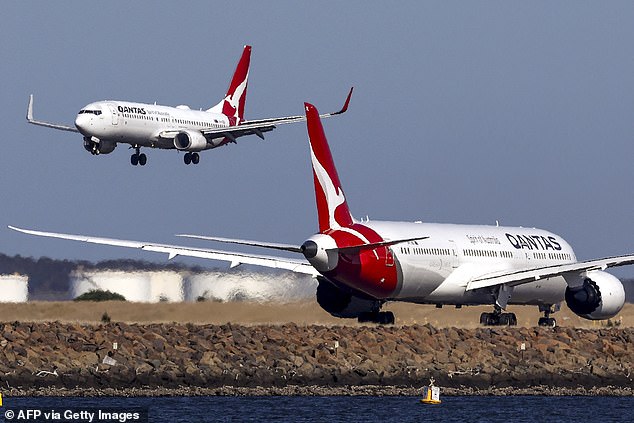
A double hit of fuel prices and industrial chaos could see flights cancelled from July

Freight and supply chains could also be affected with more than 130 industrial agreements needing to be renegotiated from July 1
Within weeks, officials compiled detailed spreadsheets tracking more than 500 expiring enterprise agreements across the transport, postal and warehousing sectors, covering over 78,000 workers nationwide.
Of particular concern were 137 agreements, covering 33,500 employees, all set to expire on June 30, a date officials acknowledged was deliberately selected by union strategists to maximise disruption.
An internal departmental brief titled ‘Bargaining in 2026’ warned of ‘very significant protected industrial action’ across the transport sector and confirmed the union’s claims were ‘broadly correct’.
But, when the issue surfaced publicly months later, officials downplayed the urgency.
At a Senate Estimates meeting in February this year, senior departmental official Greg Manning said he could not recall hearing Mr Kaine’s warning and described any potential disruption as a hypothetical.
Liberal Senator Maria Kovacic pressed Manning on whether internal modelling or risk planning had taken place.
‘Has the department produced any internal briefing notes, risk assessments or scenario planning documents related to what very much appears to be a coordinated expiry?’ she asked.
‘Not to my knowledge,’ Manning replied.

Greg Manning (pictured) said he did ‘not recall’ internal concerns over the TWU threats, despite FOI documents showing the government was tracking the union
Asked directly whether he was aware of the TWU’s threat to ‘shut down Australian transport’, Manning again said he wasn’t aware: ‘I do not have a recollection of hearing that comment.’
Officials also repeatedly assured senators no economic modelling had been undertaken because the threat remained hypothetical.
However, the FOI documents show other detailed work was indeed being done on it.
Internal briefings show the department had been actively monitoring the TWU campaign, briefing ministers, and preparing media talking points well before appearing before Parliament.
One ministerial brief noted the TWU was party to 218 expiring agreements, covering almost 50,000 workers, with 87 agreements sharing the same 30 June expiry date.
‘This is the first time in history that transport workers have aligned more than 200 enterprise agreements to expire together,’ the briefing states.
The agreements stretch across aviation, road freight, airport ground handling, waste services, bus operations and even ambulance transport.
Officials warned the timing could not be more unfortunate, with winter school holidays, regional tourism and freight supply chains all exposed if industrial action escalates.
Mr Kaine has been explicit about the union’s intentions if bargaining demands are not met.
‘Significant disruption will occur if worker safety is not improved and higher pay and better conditions are not achieved,’ he said.
Those warnings now loom over an aviation sector already under significant strain.
The industrial threat is unfolding alongside a worsening fuel cost crisis, which has already forced Qantas and Virgin Australia to cancel flights in recent weeks as soaring fuel prices and supply pressures bite.
Daily Mail contacted the Department of Employment and Workplace Relations for comment.