When you’re shopping for home theater tech, there’s always the pressure of the upsell. You might be looking at basic QLEDs, but find yourself talked (or simply tempted) into buying a mini-LED or OLED instead. And once you head down that road, you discover that there are other specs you can chase, like 144Hz refresh rates or absurd levels of color accuracy. There are some TVs and projectors that claim 100% coverage of the BT.2020 color space, despite the fact that you probably won’t notice most of those colors in any conscious way.
Deep in the weeds, you’ve probably seen the IMAX Enhanced label floating around. That’s bound to be interesting if you’ve ever watched something like Interstellar in a full-blown IMAX theater. You shouldn’t chase Enhanced content or hardware with your cash, though, certainly versus some of the other standards you could invest in.
What is IMAX Enhanced?
A short primer for the masses

The key benefit of IMAX Enhanced is that it restores some of the vertical dimension lost in the transition to wider aspect ratios. Although any TV you buy these days is going to be engineered for 16:9, you’ll still often see black bars (a.k.a. letterboxing) above and below what you’re watching, as movies are frequently presented in even wider ratios in theaters. Most of Captain America: Brave New World is in 2.39:1, for instance.
When an IMAX scene pops up in a compatible movie (like Brave New World), Enhanced expands into those black bars. It might sometimes be a subtle effect, but it’s obviously going to improve your immersion when it’s available. No one likes the idea of paying for a 75-inch TV but only using a portion of it most of the time. Back in the 1980s and ’90s, there was a ratio war between the fullscreen (4:3) and widescreen (16:9) camps for just this reason.
Typically the Enhanced ratio is going to be 1.90:1. That’s wider than 16:9, but still slightly more vertical than something like 2:39:1. It’s not as vertical as you’d see in a full-scale IMAX theater, the aspect there being 1.43:1. What you’re actually getting is the sort of IMAX you see at your local multiplex, which won’t necessarily fill your field of view.
Beyond aspect ratios, the Enhanced label is mostly a quality promise. It should, in theory, guarantee that any movie you watch has the best possible colors and contrast, with minimal noise, and less grain if a filmmaker signs off on it. Grain is controversial, I should note, since it’s often intentional on a filmmaker’s part, or part of the charm with older movies. Speaking of which, it is primarily movies you’re going to be viewing — while you might be able to catch sports on a service like Victory+, you’re probably not going to be consuming PBS kids shows or Twin Peaks: The Return this way.
You’ll also find the Enhanced label on some TVs, projectors, speakers, headphones, and receivers. This usually doesn’t have much bearing on whether you can watch video in the format, with one exception: DTS audio. While DTS has become increasingly marginalized given the omnipresence of Dolby Atmos, it’s still out there, and IMAX-certified hardware should support DTS:X spatial audio for Enhanced movies. I’m all in favor of having more options, no matter that DTS charges royalty fees to providers, just like Dolby.
Why is IMAX Enhanced irrelevant, then?
The devil’s in the details

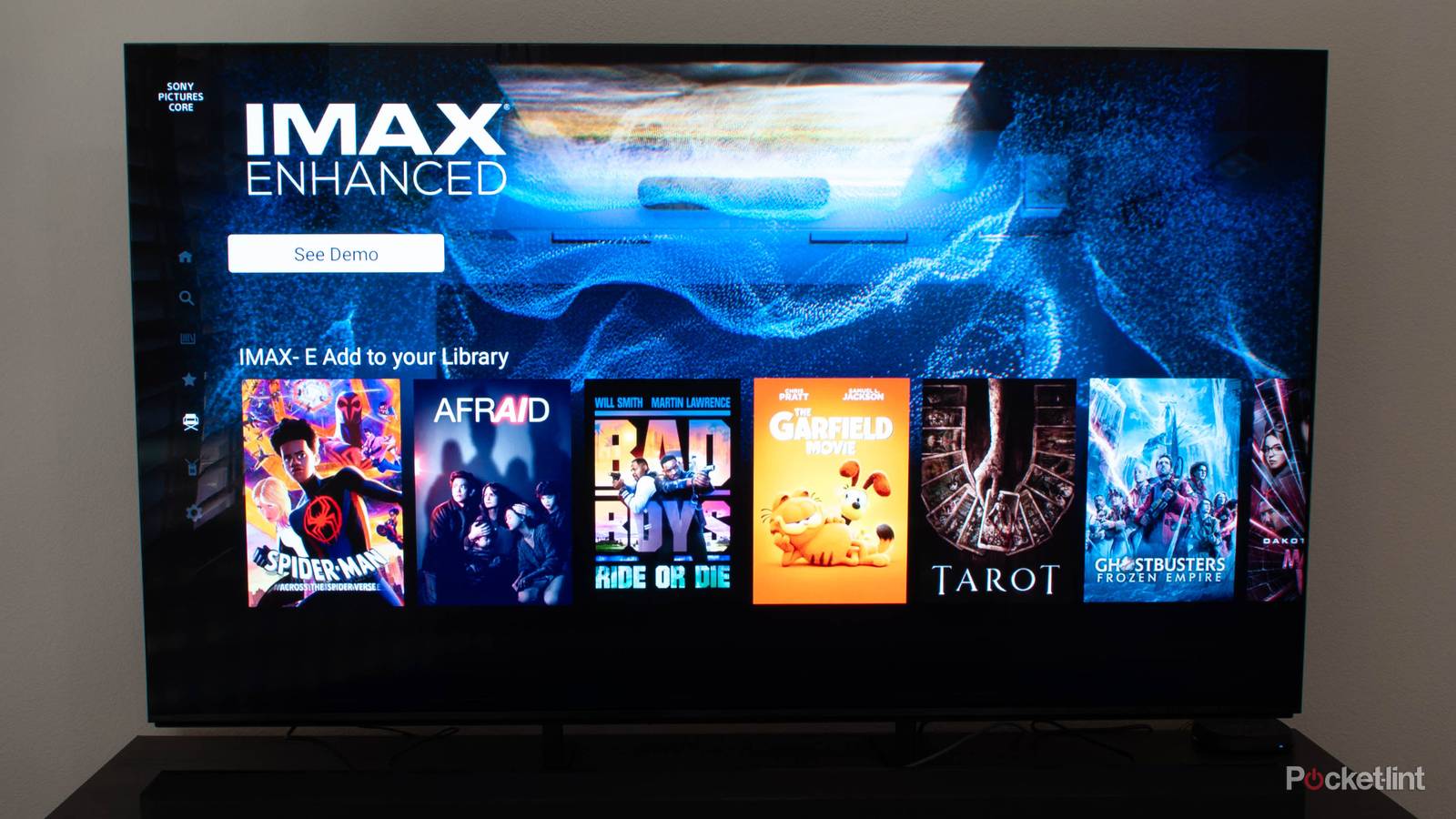
To begin with, there’s a dearth of titles to watch. In North America, the only streaming services that regularly carry Enhanced content are Disney+, Sony Pictures Core, and Rakuten TV. Disney and Sony are huge names — but you’re not going to browse Core unless you own a Sony TV or a PlayStation, and even Disney’s support doesn’t include everything in its collection. You have to cross your fingers that something you want to watch is in the Enhanced category. There are a lot of Marvel movies there, but that hardly matters if what you want to watch is on Netflix, HBO Max, or the Criterion Channel instead.
There are Enhanced Blu-rays out there, but only a relative handful. You can’t count on support by any means, and really, the effort to push Enhanced discs seems to have dried up. The focus is squarely on streaming these days.
As for quality assurance, that’s nice to have, but mostly meaningless. Any title that offers both 4K and dynamic HDR is likely to be well-mastered regardless. The IMAX branding would count for more if we were talking about neglected releases that haven’t appeared on streaming or Blu-ray before. No one, though, is champing at the bit for a more polished version of Iron Man or 28 Years Later.
What you’re left with is the chance to watch more immersive versions of movies if you happen to stumble across them on a service you happen to have. But even that’s not necessarily something to embrace, since as I mentioned, what you’re getting isn’t that greatly improved. Disney itself admits that you get to see “up to 26% more of the original image.” That isn’t a whole lot on a 75-inch screen. The implication, moreover, is that you’re still missing out on the theatrical experience — just less than you would otherwise.


4.5/5
- Brand
-
Sony
- Display Size
-
65″, 75″, 85″
- Dimensions
-
Without Stand: 1443 x 835 x 48 mm
- Operating System
-
Google TV