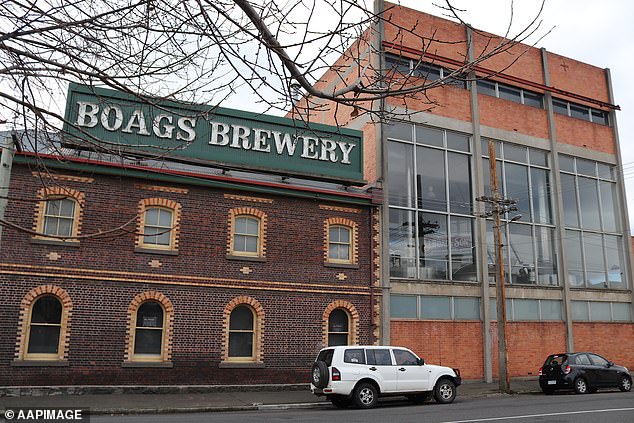
Tasmanian brewery James Boag plans to cease operations in Launceston by the end of the year as the beer market faces increasing costs.
The 145-year-old brewery, which opened in the city in 1881, has proposed stopping beer production by November, it announced on Tuesday.
Its operations would be shifted to Queensland and New South Wales.
‘Long-term decline in the national beer market has caused the brewery to run significantly under capacity for many years,’ parent company Lion Australia said in a statement.
‘It is currently operating at about a fifth of its capacity.
‘This, combined with significant cost inflation, means the brewery is no longer viable.’
Most of Boag’s production had already moved to mainland Australia, but the brewery continued supplying locally until now.
As a result of the closure, the company is now holding ‘consultation conversations’ with the 42 employees at the Launceston brewery.

Tasmanian brewery James Boag will close its doors in Launceston by the end of this year
A decision will then be made on their future with the company.
Lion is also exploring redeployment opportunities for the 42 staff across its network of brands. Those who cannot be moved will be entitled to redundancy payments.
Tasmanian Premier Jeremy Rockliff said the decision to close the Launceston brewer was worrying for the employees.
‘We are extremely disappointed with Lion’s decision. The Government has been a strong supporter of the business over a number of years,’ he said in a statement.
‘Today’s announcement by Lion of its proposal to close the historic James Boag’s Brewery in Launceston will be deeply concerning for the 42 workers affected, their families, and the broader Northern Tasmanian community.
‘Our immediate priority is the wellbeing of the workforce. We will engage closely with Lion, the union, workers and the hospitality industry to support those impacted.’
Launceston Chamber of Commerce chief executive Alina Bain said the loss would be ‘felt very deeply’ while acknowledging beer market conditions were declining.
‘It’s really difficult news, and we’re just processing it now. And then of course, increasing costs are causing difficulty,’ she told the ABC.
Join the discussion
How should Tasmania protect its local jobs and heritage when iconic brands shift production elsewhere?

Its operations will be shifted to Queensland and New South Wales (stock image)
Lion has said the proposal to close the brewery would see the creation of the James Boag’s Community Fund initiative.
It would offer $500,000 in funding over five years for partnerships and grants for grassroots organisations in Launceston and northern Tasmania.
Lion said it would also repay the $1million grant which the Tasmanian Government contributed to the redevelopment of the Boag’s Brewhouse.
‘I sincerely apologise for the negative impact this announcement will cause,’ Lion’s chief executive and managing director Anubha Sahasrabuddhe said in a statement.
‘We know this is difficult news for our Boag’s Brewery team and the broader Launceston community.
‘This proposal is no reflection on the incredible capability, passion and commitment of our brewery team members, and the many more who have come before them, who have worked hard to operate the brewery as efficiently as possible despite decreasing volumes.’
Neil Gillin, from Phillip Island Brewing Company, told the Daily Mail the loss of the brewery was part of a bigger trend.
‘It’s not entirely surprising to see this move to the mainland,’ he said.
‘We’re seeing a broader trend across the beverage industry where businesses are looking to consolidate operations, reduce overheads and bring production under a larger umbrella to improve efficiencies. It’s not just happening in the beer sector.
‘Many wineries and distilleries are facing similar pressures, with some choosing to centralise production, while others are closing sites altogether as a way to manage rising costs and streamline their operations.
‘Unfortunately, it’s a sign of the times and I think we’ll continue to see more businesses across the industry making these kinds of difficult decisions in the years ahead.’