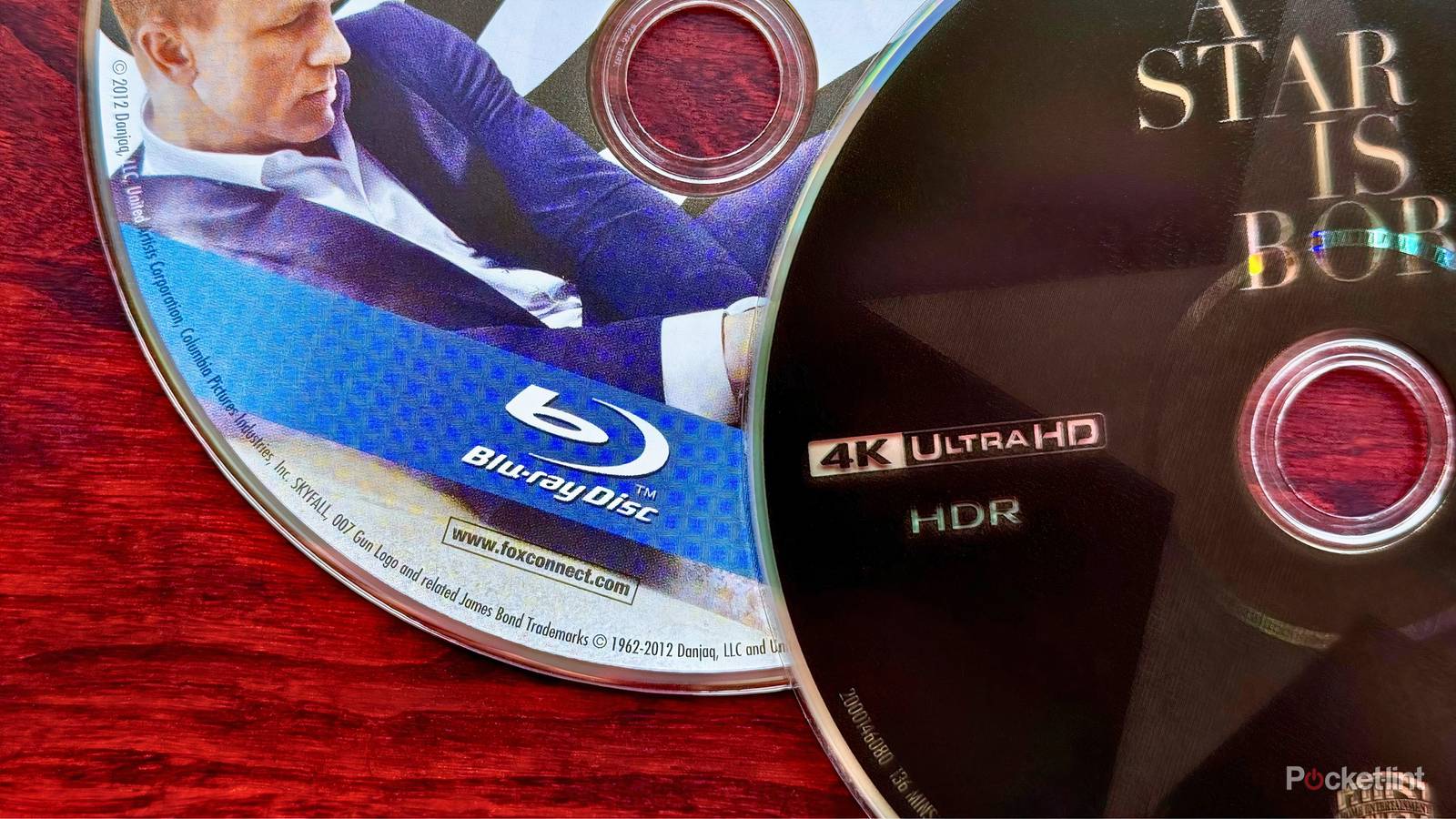
If you want peak fidelity for a movie, there’s nothing better than Blu-ray at the moment. Whereas services like Netflix impose bitrate limits on the quality of audio and video to cope with the limitations of internet bandwidth, Blu-ray delivers consistently higher settings, and it’s the only way you’ll get to hear lossless audio formats like Dolby TrueHD or DTS-HD Master Audio.
The technology does have limitations beyond price and convenience, though. I’m going to cover a few of those here. They probably won’t deter you if you’re a cinephile with a budget, but they might cause you to think twice about putting all your eggs in one basket.
It’s already running into space restrictions
The future is bearing down

Blu-ray’s capacity is a gigantic leap over DVD. At most, a double-sided, dual-layer DVD can hold a little over 17GB. Blu-ray starts at 25GB, and modern 4K UHD discs can hold anywhere from 50 to 100GB.
That might sound amazing — until you realize that longer movies often push against that 100GB ceiling, sometimes without leaving room for bonus features. Rogue One is only about two hours and 13 minutes, and yet its special edition shifts most of its extras onto other discs. There’s a price to pay for lossless spatial audio and the sharpest possible 4K.
There’s a potential crisis looming, in fact. While development has been done on discs with larger capacities, they’re not available commercially, and your existing player can’t handle them. That’s tolerable for the moment — but once 8K evolves past an impractical gimmick into the new norm, companies might decide the market for physical media is too small to bother keeping up.
There’s an expiry date on every disc
No library is forever

Compared to VHS, Blu-ray is pretty resilient. A disc can’t become tangled up, and there’s no magnetic material that will slowly lose its charge, or erase completely if you put it next to the wrong electronics. It’s actually less vulnerable to UV radiation than DVD.
In truth, though, it still has a ticking clock. The Canadian Conservation Institute estimates that commercial discs should last between 10 to 20 years. The main threat is something dubbed “disc rot,” actually an umbrella term for conditions like oxidization of the reflective layer. Some discs may last closer to the 20-year mark or beyond with proper treatment — but given that the format dates back to 2006, it’s possible that some of the movies you own are already on their last legs.
Your best bet is to store Blu-rays in a clean, dry place, preferably with temperatures between 39 and 73F (4 to 23C). And if you really do want to own a movie forever, you should consider ripping it to a local media server.
There are fewer and fewer ways to play them
The players are exiting the stage

Despite a recent resurgence in the popularity of physical media, companies continue to abandon the market for Blu-ray players. Your dedicated living room options have largely been reduced to Sony, Panasonic, and generic Chinese makers. You can also play Blu-rays using some PlayStation and Xbox consoles, but Sony has already announced plans to stop printing game discs in 2028. That hints that both Sony and Microsoft are liable to drop disc drives in the next generation.
Even computers are losing support. Most laptops (and desktops) no longer include an optical drive of any kind, and manufacturers are withdrawing from add-ons too. Don’t get me wrong — in 2026, it’s not too hard to find an add-on product online. But the industry is shrinking, and there’s no sign of a reversal that will guarantee your ability to play discs when and where you like at an affordable price.