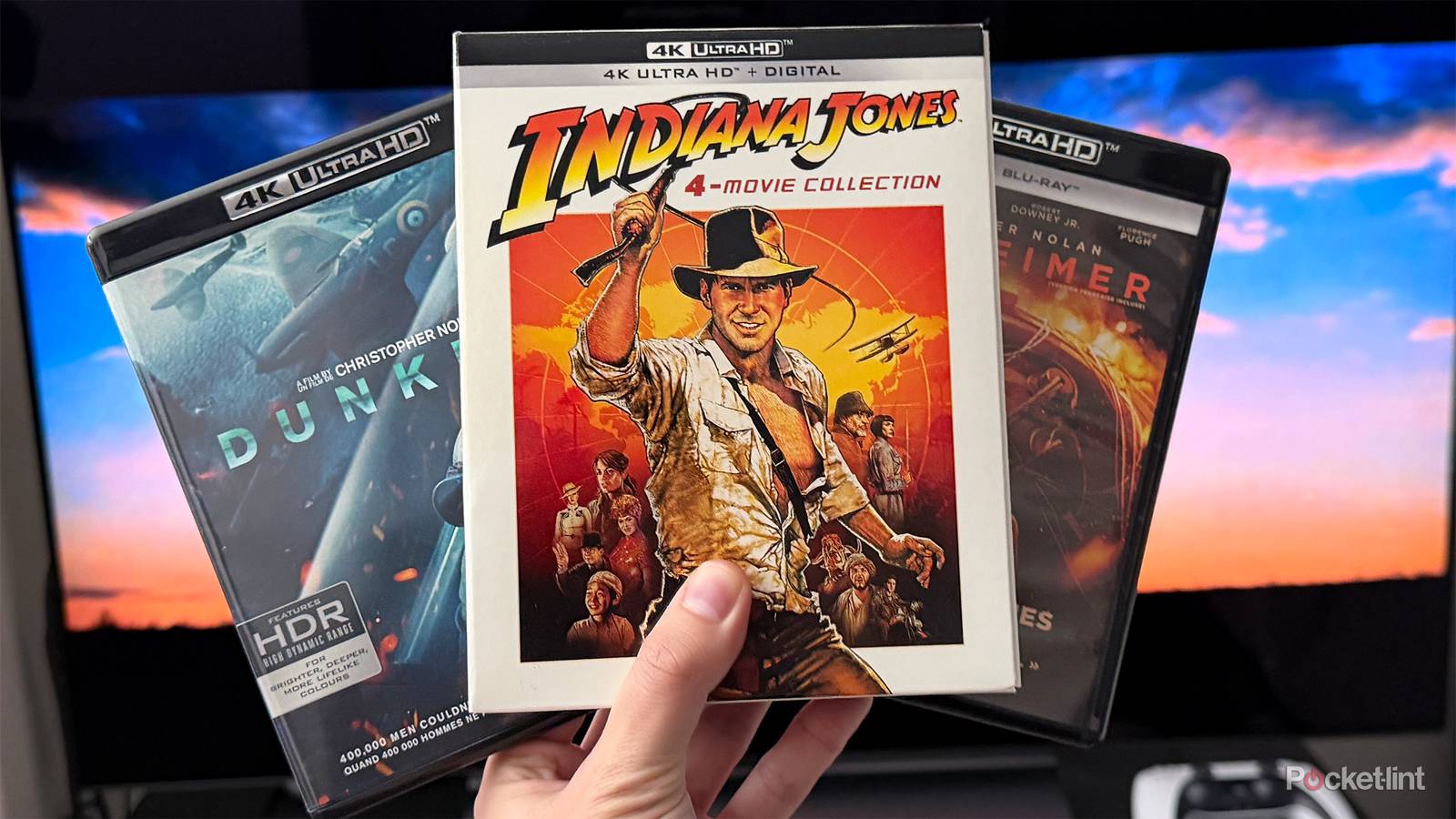
For as long as I can remember, I’ve been an avid collector of physical media. It all started with VHS tapes, and I have plenty of fond memories of watching the original Star Wars VHS tapes over and over as a kid because I loved those movies so much. That was really the catalyst for my love of movies and collecting, which eventually led me from VHS to DVDs in the early 2000s, then to Blu-ray later that decade, and finally to 4K Blu-rays in more recent years.
I’ll admit that when streaming took off, I stopped buying as many Blu-rays. But with physical media making a comeback amid rising streaming prices and the growing sentiment that it’s better to actually own the movies and shows you enjoy, I’ve found myself getting back into collecting. It’s reminded me of two key things: there’s something special about actually holding the movies you love and seeing them on your shelf, and from a visual standpoint, 4K Blu-rays look way better than even the best 4K streams.
However, whenever I tell someone about my physical media collection, one question I often get is what kind of Blu-ray player I have. It’s a fair question, since standalone Blu-ray players aren’t something you see advertised much anymore, and many models on the market are nearly a decade old at this point.
The funny thing is, despite collecting Blu-rays for years, I’ve never actually bought or owned a dedicated Blu-ray player. Why? Well, for one, they’re not exactly cheap. And two, I’ve always had a much more powerful alternative.
A PlayStation has always been my Blu-ray player
Sony used the PlayStation to help cement Blu-ray as the standard

The core reason I’ve never bought a Blu-ray player or a 4K Blu-ray player is simple: every generation of PlayStation console I’ve owned, whether it’s the PS3, PS4, or PS5, has been able to play Blu-ray discs. The PS5, in particular, can also play 4K Blu-ray.
When the PS3 launched back in 2006, one of its biggest selling points, besides its HD graphics, was its built-in Blu-ray player. This made the PS3 an affordable way to play Blu-ray discs and helped movie studios establish Blu-ray as the format of choice for home releases, eventually making it the new standard over HD DVD. The PS3 was also my first introduction to Blu-ray, and I remember constantly borrowing my brother’s PS3 to watch Blu-ray movies like Sam Raimi’s Spider-Man trilogy and Casino Royale.

When the PS4 launched in 2013, it carried on the PS3’s legacy with a built-in Blu-ray player. So when I picked one up, I once again had a console that was perfectly capable of playing all my Blu-rays, and I never felt the need to even look into buying a dedicated Blu-ray player.
It wasn’t until around 2019 that I came close to buying a 4K Blu-ray player. I had recently gotten my first 4K TV and really wanted to start collecting 4K Blu-rays, so I figured it was finally time to get a dedicated player. But I waited, and, lo and behold, when Sony launched the PS5 in 2020, it not only came with much more powerful hardware for gaming but also a 4K Blu-ray player (if you didn’t buy the Digital Edition). So when I finally got a PS5 in early 2021, I finally had a 4K Blu-ray player and swiftly picked up the Indiana Jones 4K Collection as my first 4K Blu-ray and was mind-blown by the quality.
When I upgraded to the PS5 Pro last year (something I have no regrets about now, especially after the recent price hikes and the PS6’s delay), the first thing I did was buy a disc drive for it so I could continue playing my 4K Blu-rays.
The PS5 isn’t perfect for 4K Blu-rays
But it gets the job done

While I’ve used the PS5 to watch all my 4K Blu-rays and have had a great experience with it, I will concede that there are a few compromises with it.
For starters, it doesn’t support Dolby Vision or HDR10+. I’ve used both HDR10+ and Dolby Vision on my Roku Ultra, and while they offer better color accuracy and brightness, I’ve never found the difference significant enough to justify buying a dedicated 4K Blu-ray player just for those formats. My PS5 still looks fantastic when playing 4K Blu-rays with standard HDR10, and the picture quality is noticeably clearer than what I get from streaming.
Another downside is that the PS5’s disc drive can be noticeably louder when reading discs than the drive in a premium 4K Blu-ray player. However, if you’re sitting a decent distance from your PS5 or have it tucked away in a cabinet, you’re unlikely to notice it all that much.
Ultimately, my PS5 has been a reliable 4K Blu-ray player for the past five years, and I haven’t once felt the need to buy a dedicated 4K Blu-ray player. Plus, most 4K Blu-ray players cost anywhere from $300 to $600, including models like the Sony UBP-X700 and Panasonic UB820-K, and I’d much rather spend that money expanding my 4K Blu-ray collection.
Of course, if you don’t game, buying a 4K Blu-ray player makes a lot more sense than spending hundreds of more dollars on a PS5 just to watch movies. But in my case, I already had the console for gaming, so buying a dedicated 4K Blu-ray player to sit next to it has just never made sense.

- 4K Capability
-
Yes
- Brand
-
Sony
- Storage
-
1TB