


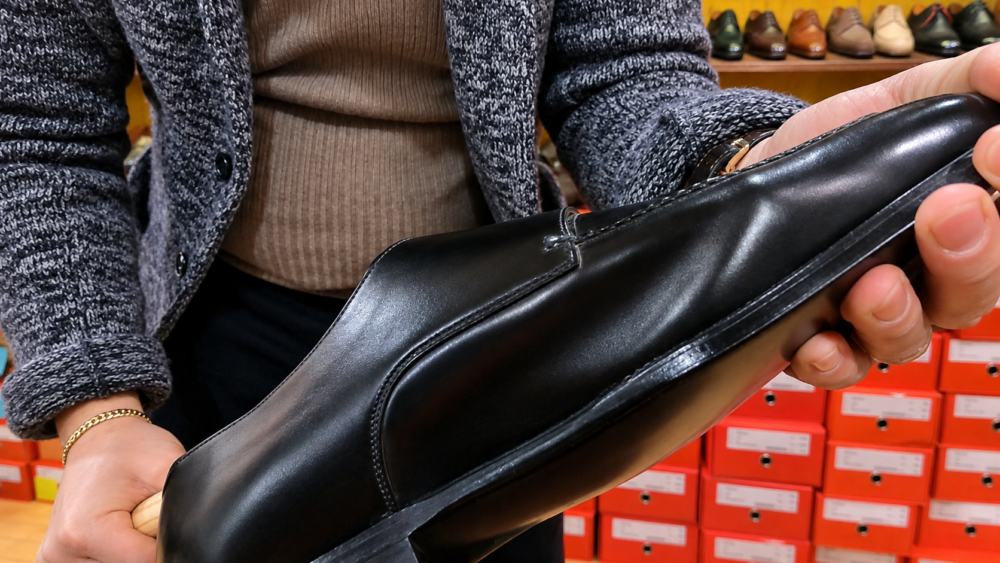
One of the most common issues people have with new shoes is that they fit well almost everywhere, but there might be one particular area that feels just a little too tight. Maybe it is across the forefoot, around a toe, or another pressure point that becomes uncomfortable after wearing the shoes for a while.
The good news is that leather has some give to it. And in certain circumstances, you can manually stretch a pair of leather shoes to relieve a tight area without having to completely alter the fit of the shoe.
This is something I have done countless times over the years, both with my own shoes and during my years working in the footwear industry.
But there is an important distinction to make from the beginning:
Stretching a shoe is not the same thing as changing its size. This is not about making your shoes larger. It is about helping manually adjust pinpointed areas that might cause a small amount of tension.
If a shoe is fundamentally too small, stretching is unlikely to fix the problem. What you can often do is manipulate the leather in a very specific area to give yourself a little more room.
This type of post is hard to capture in photographs, so you can watch the full video here for visual context:
Why Leather Shoes Can Be Stretched
Leather is a natural material. It is not completely rigid, and over time it naturally begins to conform to your feet. That is essentially part of what we call “breaking in” a pair of shoes.
The problem is that sometimes you do not necessarily want to wait weeks for a painful pressure point to resolve itself naturally. Or perhaps there is one particular area where you know you need just a touch more space. That is where manually stretching the shoe can help.
You are essentially accelerating a process that would otherwise happen gradually through wear. The key word here, however, is gradually.
You do not want to attack the shoe with the idea that you are going to dramatically increase its dimensions. You are simply trying to manipulate the leather enough to relieve a particular pressure point.
How I Manually Stretch Leather Shoes
The technique I demonstrate in the video is very simple and does not require a traditional shoe-stretching machine.
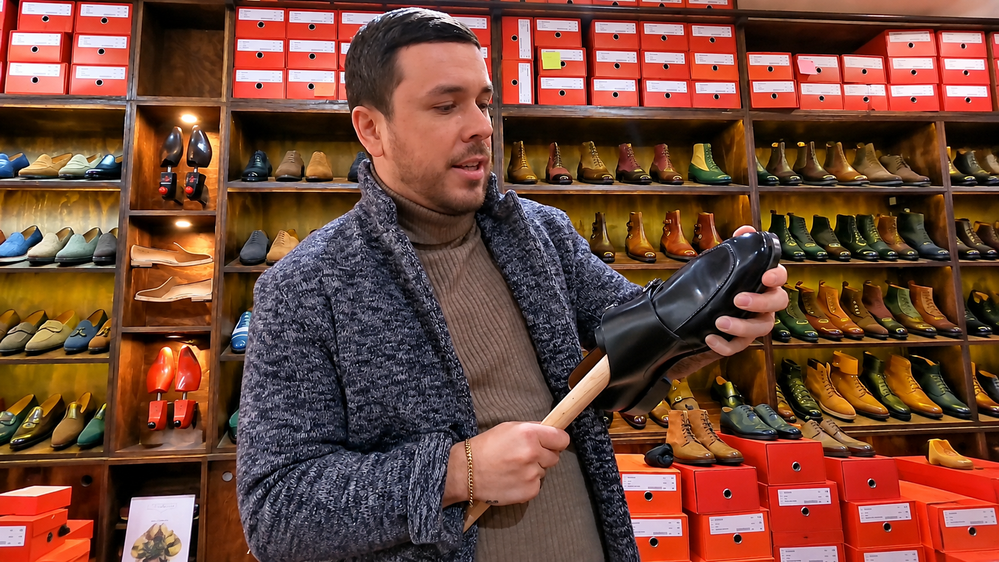
What you need is something hard and rounded that can sit behind the area of leather you want to stretch. You then carefully work the leather against that solid surface. The ideal tool is a broom or mop handle in wood. And the handle end must be round.
The rounded wooden handle simply gives me a firm surface behind the leather that won’t scratch the lining. I position it inside the shoe underneath the exact area I want to stretch and then manually work the leather over and around it.
The objective is controlled pressure, but also not being afraid to put some elbow grease into it. Rubbing lightly won’t do anything.
Rather than trying to stretch an entire shoe indiscriminately, you can concentrate that pressure exactly where the shoe is causing discomfort.
Find the Exact Pressure Point First
Before doing anything to the shoe, identify where the problem actually is. Put the shoes on and determine exactly where you feel the pressure. Do not simply decide that “the shoe is tight.”
Where is it tight? That distinction matters. You want to pinpoint the manual stretch.
If one particular toe is rubbing against the upper, for example, that is a very different problem from the entire forefoot being too narrow. Once you know the exact location, you can concentrate your stretching there instead of unnecessarily manipulating the rest of the shoe.
This is one reason I like manually stretching shoes. It gives you far more control over where you create additional space.
Place the Rounded Surface Behind the Leather
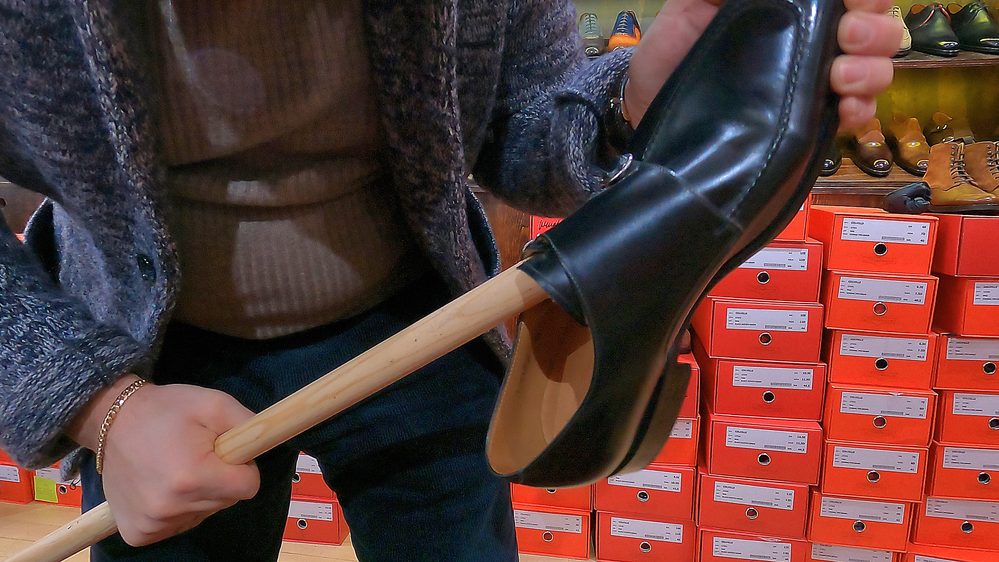
Insert the rounded handle into the shoe and position it directly underneath the pressure point. You want the leather sitting firmly against the rounded surface.
From there, grip the sole of the shoe and start maneuvering it so that the handle (which should stay in place) is actively rubbing against the lining, pushing it outward.
You are effectively encouraging the leather fibers to relax and expand in that localized area. Work the leather progressively and check your results rather than immediately trying to force as much stretch as possible.
You Don’t Need Much Stretch
This is probably the most important thing to understand.
When a shoe is almost right, the difference between uncomfortable and comfortable can actually be very small. You might only need a few millimeters of additional room at one pressure point.
People sometimes approach shoe stretching as though they need to visibly transform the shoe. That is not what I am trying to achieve with this method. If you need that, then the shoes are too small.
If you can visually see that you have dramatically distorted the upper, you have probably gone too far.
The goal is simply to give your foot enough additional room that the pressure point disappears.
Can You Stretch Shoes a Full Size?
This is where expectations need to be realistic. I would never buy a shoe that is clearly too small with the assumption that I can simply stretch it into the correct size later.
You cannot meaningfully change the fundamental architecture of a shoe this way.
The last determines the shoe’s overall length, width, volume, and shape. Stretching the upper does not suddenly turn one size into another.
You can potentially gain some room in leather, particularly in width or at localized pressure points, but you cannot stretch a shoe longer in any meaningful way.
If your toes are hitting the front of the shoe because it is too short, this technique is not going to solve your problem. The shoes are just too small.
Likewise, if the entire shoe is painfully tight, you may simply be wearing the wrong size or the wrong last for your foot. Again, this is not a post to convince you to make ill-fitting shoes work. It is about a well-fitting shoe that slightly bothers in one spot and being able to fix that yourself, at home using normal items.
Stretching Shoes vs Breaking Them In
These two things are related, but they are not quite the same. Breaking in shoes happens naturally through wearing them. Your feet create heat, moisture, and pressure, and the leather gradually begins conforming to your foot.
Manual stretching is more targeted. Instead of waiting for your foot to repeatedly push against an uncomfortable area, you are deliberately working that particular section of leather beforehand.
That is why I would consider this technique most useful when you already know that the overall fit is correct but one area needs some help.
If the entire shoe simply feels firm because it is new, wearing it for short periods and allowing it to break in naturally may be all that is required and is ultimately the ideal method of break-in.
Be Careful With Delicate Leathers
Not every leather should be attacked with the same amount of pressure.
Smooth calfskin is generally quite workable, but even then you need to use common sense. Excessive pressure can potentially distort the leather, affect the finish, or create an unwanted mark. Veg-tanned leather is more pliable and might stretch too easily, causing distortion. On the opposite end, Cordovan might be difficult to manipulate at all.
The more delicate or unusual the leather, the more cautious I would be.
And if you are dealing with an expensive pair of shoes and are not comfortable doing this yourself, there is absolutely nothing wrong with taking them to a competent cobbler.
Professional shoe-stretching equipment exists for a reason.
This manual technique is simply a useful option when you understand what needs adjusting and only require a small amount of additional room.
Should You Use Shoe Stretching Spray?
There are products designed to help soften leather before stretching, and they can be useful in certain circumstances. Personally, I would still approach them conservatively.
Anything you apply to leather has the potential to interact with its finish, particularly on highly polished, antiqued, or unusual leathers. I would always test a product somewhere inconspicuous before applying it liberally to an expensive pair of shoes.
For a small adjustment, I prefer to start with the least invasive approach and see whether manually working the leather is enough.
You can always do more. It is considerably harder to undo something once you have gone too far.
The Most Important Part: Start With the Right Fit
Stretching is a useful tool, but it should never become a substitute for buying shoes that fit correctly. Correct fit is always the ultimate goal. But that can be easier said than done for many. Blessed are those who always fit size US 10 😉
A well-fitting shoe should feel secure. Depending on the style and construction, a new pair can certainly feel firm. But there is a difference between firm and painfully tight.
That distinction is particularly important with quality leather shoes because people are often told that their shoes will “stretch.”
Yes, leather will give. That is a fact.
But that does not mean you should buy shoes that are obviously too small and endure pain while hoping they eventually become comfortable. Use stretching to fine-tune a good fit, but not to rescue a bad one.
Final Thoughts
Knowing how to stretch shoes manually is a useful skill, particularly if you own a lot of leather footwear.
You do not necessarily need elaborate equipment. For small, localized adjustments, a simple rounded object such as the wooden handle shown in my video can allow you to work a very specific area of the upper and create that little bit of additional room you need.
Just remember that less is more. Find the pressure point, work the leather gradually, try the shoes on again, and repeat if necessary.
You can always stretch a little more. You cannot always put the leather back exactly where it started.
FAQ: Stretching Leather Shoes
Can leather shoes be stretched?
Yes. Leather naturally has some elasticity and can often be stretched slightly, particularly across the width or at specific pressure points. How much it will stretch depends on the leather, construction, and area of the shoe. The length can never be stretched, though. A short shoe will always be a short shoe.
How can I stretch tight shoes at home?
For a localized pressure point, you can place a hard, rounded object behind the leather and carefully manipulate the upper around it. This allows you to target a particular area rather than stretching the entire shoe.
Can you stretch leather shoes a full size? Or even a half size?
Generally, no. Stretching can provide additional room, but it cannot fundamentally change the size or shape of the shoe. In particular, you cannot meaningfully increase the shoe’s length.
Does stretching leather damage shoes?
It can if done aggressively. Excessive stretching can distort the upper or potentially affect the leather’s finish. Work gradually and use only as much pressure as necessary.
Is stretching the same as breaking in shoes?
No. Breaking in happens naturally as the shoe conforms to your foot through wear. Stretching deliberately manipulates the leather to create additional room, often in a specific problem area.
If you enjoy educational posts such as these, make sure to check out our ‘How To’ guides
—Justin FitzPatrick, The Shoe Snob
Shop · Marketplace · Patreon


