This article is from Proof Positive, our friendly math newsletter that’s delivered to your inbox every Tuesday afternoon. Sign up today and read it first.
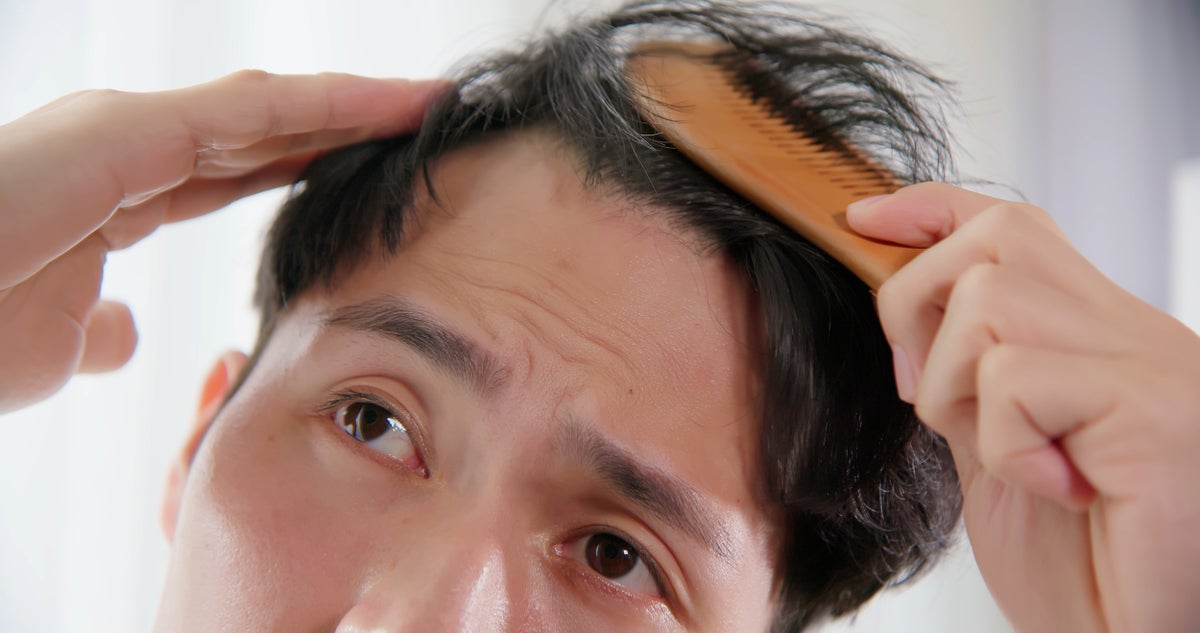
Is math to blame for bad hair days? Before I answer that question, let me introduce the “hairy ball theorem.” (Yes, that’s really what it’s called—though in Europe it’s sometimes called the “hedgehog theorem.”) It essentially states that it’s impossible to comb hair on a sphere without creating a cowlick or bald spot somewhere.
On supporting science journalism
If you’re enjoying this article, consider supporting our award-winning journalism by subscribing. By purchasing a subscription you are helping to ensure the future of impactful stories about the discoveries and ideas shaping our world today.
If that surprises you, you’re not alone. After all, who would have thought that complex topological concepts such as Euler characters and homotopies might have anything to do with hairstyles? Topology is among the most abstract fields in mathematics. In topology, the exact shape of a figure doesn’t matter. Two objects are considered to be the same if you can reshape each into each other without tearing them or gluing them together. A famous example is a mug and a doughnut, which are identical to topologists because both have exactly one hole, so you can reshape them into each other. Meanwhile a bread roll can never become a bagel or a pretzel for a topologist.
Where does hair come in? Let’s keep it simple and think of someone with short, straight locks. Their hair resembles a vector field: each point (strand) can be described as a small arrow that points in a certain direction. A typical example of a vector field is wind direction: at any place on our planet, you can determine it. If you plot the arrows of wind on a globe, the result will resemble a hairy ball or coconut. The theorem essentially says that, on a sphere, you cannot create a perfectly continuous vector field—at some point, there will be a break, such as a bald spot on the back of a neatly combed head.
To understand that, the windy planet analogy helps. Imagine you go for a walk, headed eastward along the Arctic Circle, with an unchanging wind blowing throughout the journey. When you start, you feel the wind against your back and then, as you travel the circle, it seems to come from the left, then from the front and finally from the right. When you return to the starting point, it blows at your back again. So, for you, the wind has turned clockwise during the walk.
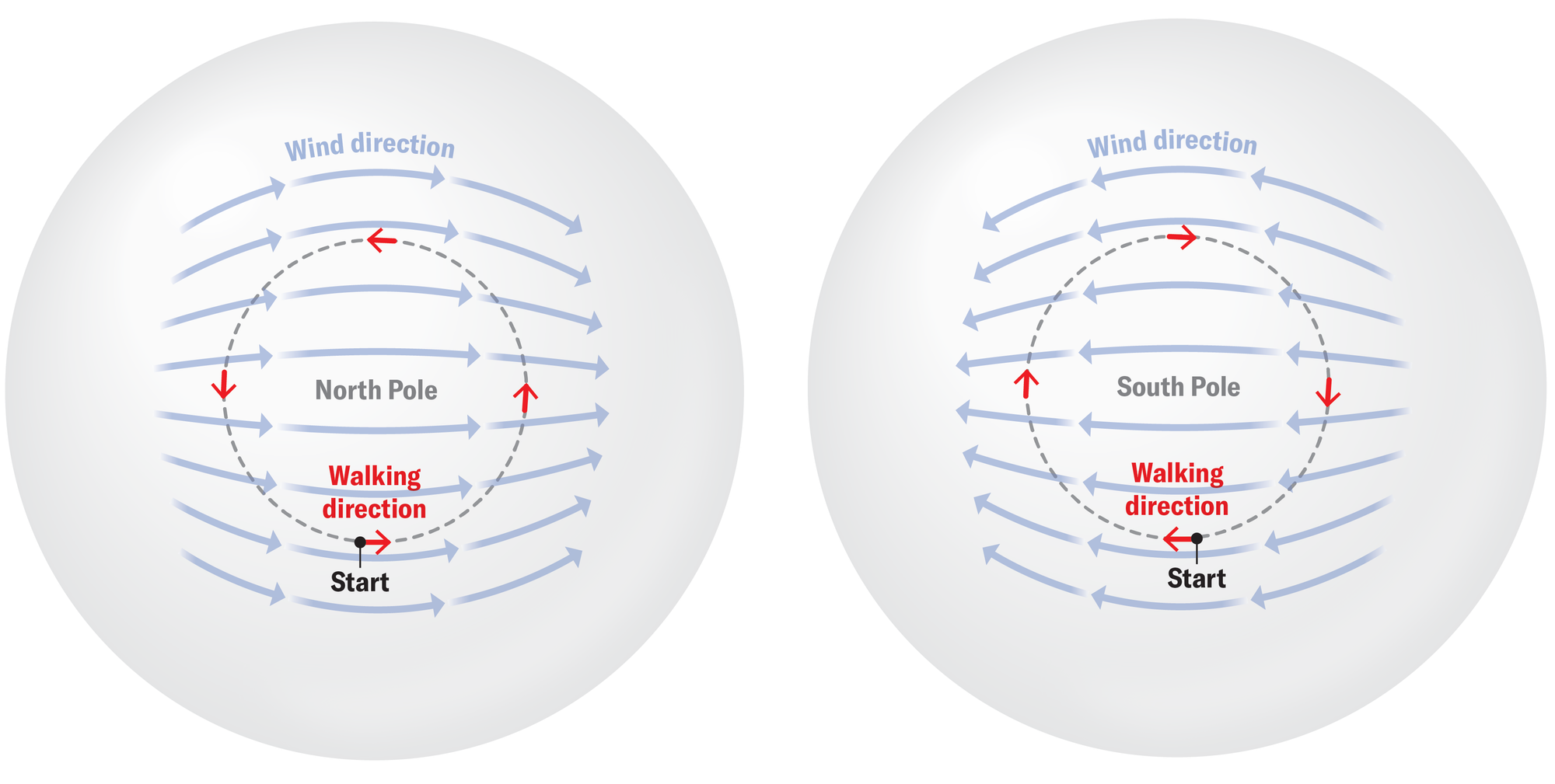
Now you fly to the Antarctic Circle to do the same thing: Start again with the wind at your back. Then it blows first from the right before it reaches you from the front and finally from the left. In this case, too, your sensation of where the wind hits you has turned—but counterclockwise.
In this scenario, the wind is blowing constantly in the same way but you perceive it changing over time. That perceived change can turn along a circular path only by an integer multiple of 360 degrees because otherwise the wind would have to blow in different directions at the start and end point (which is impossible because they are the same—you’ve traveled in a circle, after all). So keep in mind that for a vector field to be continuous, it must not change its orientation jerkily.
In our example, the wind direction along the northern and southern polar circles varies by the same value in each case but with different signs: In the first case, the perceived wind direction rotates clockwise. In the second, it rotates counterclockwise. That is, the wind rotates by –360 degrees in the Arctic Circle and by 360 degrees in the Antarctic Circle, and this makes an angular difference of 720 degrees. If the vector field is to be continuous, it must be zero at one point at minimum. Such a point is usually a vortex in a continuous vector field. Meteorologically, this also means that, somewhere in the world, there is always a hurricane, in the eye of which there is no wind at all. What’s more, this theorem has implications for nuclear fusion.
Now, all of that said, we can’t really blame math for bald spots and cowlicks. That’s because, strictly speaking, our head doesn’t fulfill the necessary criteria for this theorem to apply. For one thing, we have too few hairs—in the mathematical world, every point on a surface must be occupied by a vector. For another, our body has multiple openings, including one hole running through from our mouth through our digestive system. So to a topologist, we’re more like a doughnut than a sphere.
Still, I’m happy to blame the hairy ball theorem for my next bad hair day. It’s a creative excuse, if nothing else.
This article originally appeared in Spektrum der Wissenschaft and was reproduced with permission. It was translated from the original German version with the assistance of artificial intelligence and reviewed by our editors.
It’s Time to Stand Up for Science
If you enjoyed this article, I’d like to ask for your support. Scientific American has served as an advocate for science and industry for 180 years, and right now may be the most critical moment in that two-century history.
I’ve been a Scientific American subscriber since I was 12 years old, and it helped shape the way I look at the world. SciAm always educates and delights me, and inspires a sense of awe for our vast, beautiful universe. I hope it does that for you, too.
If you subscribe to Scientific American, you help ensure that our coverage is centered on meaningful research and discovery; that we have the resources to report on the decisions that threaten labs across the U.S.; and that we support both budding and working scientists at a time when the value of science itself too often goes unrecognized.
In return, you get essential news, captivating podcasts, brilliant infographics, can’t-miss newsletters, must-watch videos, challenging games, and the science world’s best writing and reporting. You can even gift someone a subscription.
There has never been a more important time for us to stand up and show why science matters. I hope you’ll support us in that mission.