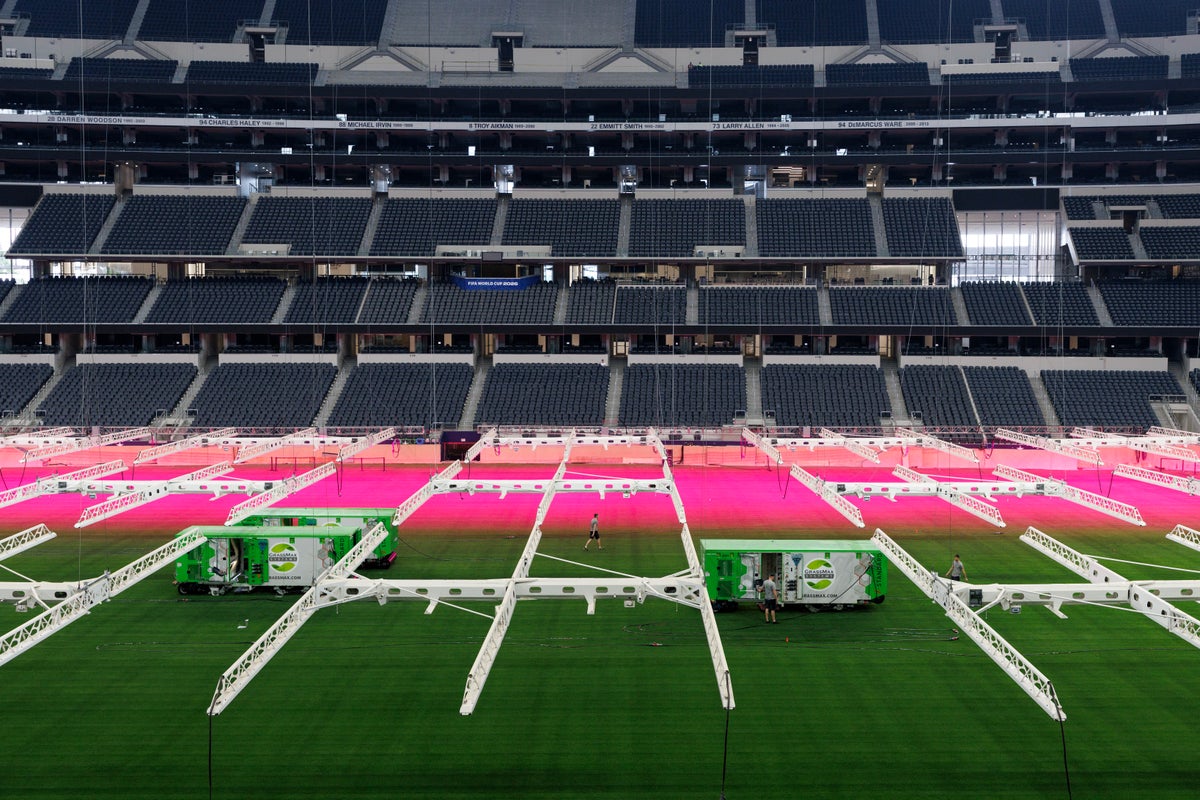
Drop a soccer ball onto a dead patch of grass, and the problem is immediately obvious: the ball rebounds strangely or just dies at a player’s feet. In the run-up to this year’s FIFA World Cup across the U.S., Mexico and Canada, videos and photographs of soccer pitches have already drawn scrutiny, including a viral clip from a Senegal training session at a New Jersey stadium and British coverage of a patchy field in Tampa, Fla., used for an England warm-up match.
That is the nightmare FIFA has spent years trying to avoid. It got a preview at the 2024 Copa América, during the tournament opener in Atlanta, where players said the ball sprang off the field like a trampoline. FIFA’s challenge this year is to make living grass behave consistently across 16 match venues in three countries. Conditions range from open-air heat and rain to roofed venues with managed airflow. If the surface fails at any one of them, it could become part of the game, altering footing, bounce, how quickly the field recovers and, potentially, competitive fairness.
The last time the men’s World Cup was played in the U.S., in 1994, natural grass had to be moved into places never built for it. Inside the Pontiac Silverdome in Michigan, grass arrived in hexagonal modules and “was just in survival mode until the end [of the tournament],” says John Sorochan, a distinguished professor of turfgrass science at the University of Tennessee. This time, FIFA is trying to remove as much improvisation as possible.
On supporting science journalism
If you’re enjoying this article, consider supporting our award-winning journalism by subscribing. By purchasing a subscription you are helping to ensure the future of impactful stories about the discoveries and ideas shaping our world today.
John Trey Rogers III, a professor of turfgrass research at Michigan State University, built that Silverdome field with Sorochan, then his student, on the crew. Rogers and Sorochan were hired by FIFA five years ago to help turn World Cup fields into a science-based system designed to make the ball and the player’s foot meet the ground the same way from one venue to the next.
Eight of the 16 stadiums typically use artificial turf—and five of those have roofs that limit the sunlight that reaches the pitch. “If you’re not designed to have natural grass, and you want to put your field in that has the eyes of the world on it, you have to put in all of the technical aspects that would already be in a natural grass stadium,” Rogers says. That includes irrigation, drainage and, at some venues, a FIFA-standard vacuum ventilation system beneath the surface.
The project had what sounds like a simple goal: ensure all surfaces used during the 104-match, 48-team tournament meet FIFA’s standards for an elite competition. But those standards are exacting. The surface must be able to drain a downpour but not dry out, and it must stay firm enough to play fast without becoming hard enough to hurt players. The fields have also forced changes to the stadiums themselves. Dallas was not wide enough at field level for a regulation soccer pitch, for instance, while Kansas City, Rogers says, took out 10 rows of seats. Philadelphia had to remove its corner seating.
The grass itself has to be grown to a narrow specification. Warmer venues are using Bermuda grass–based systems; cooler or lower-light ones use cool-season grasses, often with hybrid reinforced fibers. The roofed stadiums pose the most unusual problem: Sorochan says they will use a grass native to the British Isles that’s suited to low light.
Crews compensate with artificial light. Dallas has 18 ceiling-mounted grow-light rigs that lower, open over the grass and then fold away before matches; other stadiums have nine to 12 wheeled rigs. Sorochan says he has spent recent weeks “on my hands and knees, measuring the light under light rigs” to smooth out variability. The two-inch-thick sod is grown on plastic so it can be transported without rooting into the stadium. Synthetic fibers, stitched into the base, act like rebar for the natural grass, Sorochan says, helping stop the surface from tearing loose when players cut sharply or goalkeepers churn up the six-yard box.
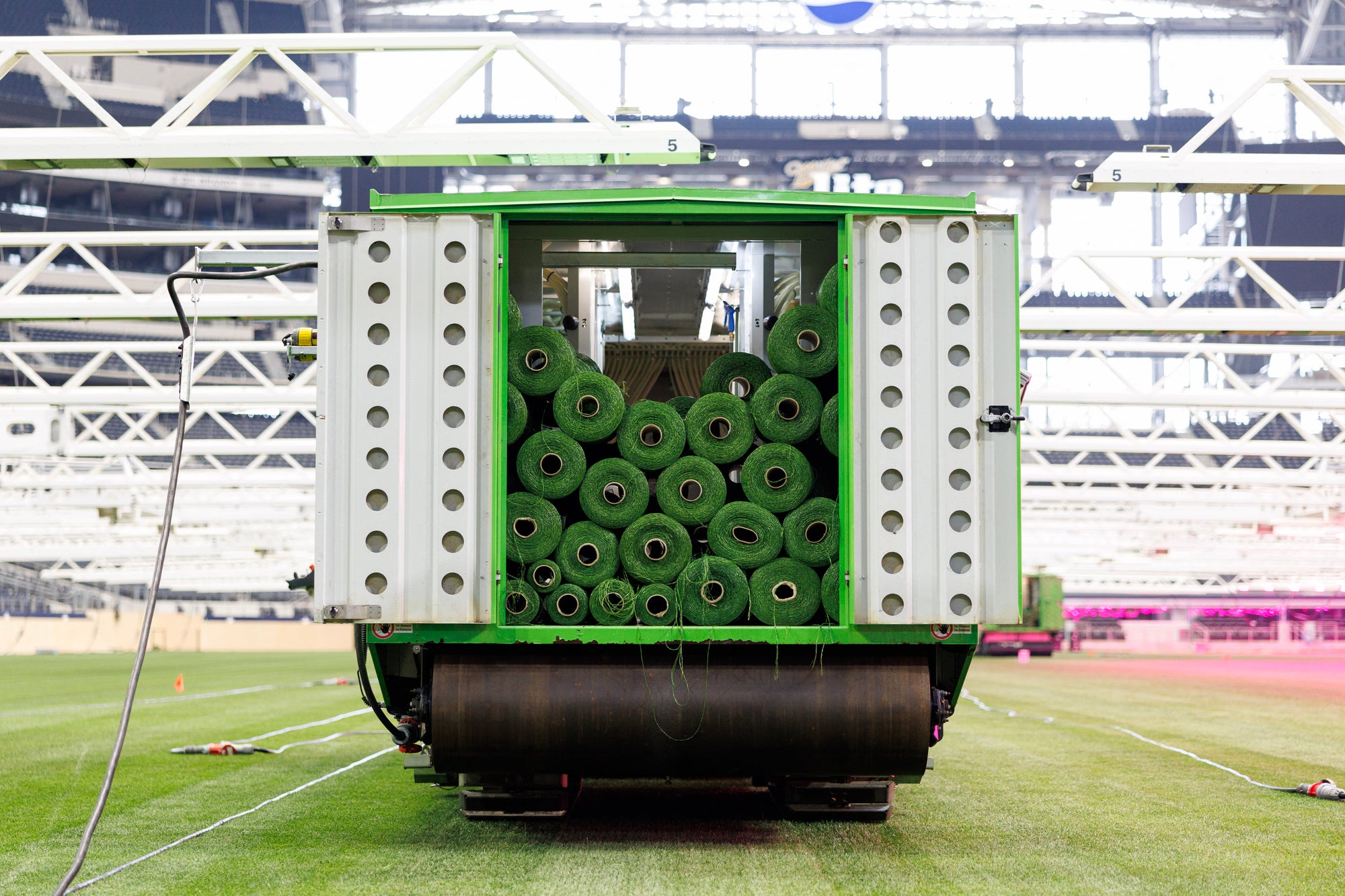
A stitching machine inserts synthetic fibers into natural grass to reinforce the playing surface. The fibers act like rebar, helping to hold the pitch together.
Mark Felix / AFP via Getty Images
Once installed, the grass is monitored constantly. Crews probe it for moisture, aerate it to feed oxygen to the roots and prolong its life, and mow it to keep the ball roll and bounce consistent. To test how it plays, they fire balls at the surface at 55 miles per hour and a 17-degree angle. The fields will never be botanically identical, but the goal is to narrow nature’s variation until players stop noticing it. “Because the stadiums span three distinct climatic zones, the grasses and mixtures will perform differently when exposed to these unique growing conditions,” explains Gerald Henry, a professor of environmental turfgrass at the University of Georgia.
Weather can still upset the plan, and high-level players are exquisitely sensitive to a strange bounce. Yet Sorochan says he is not anxious as the tournament begins. “I can’t foresee anything that would cause a failure for the pitches,” he says. “I’m excited. I just think we’re in good shape.”
Still, the researchers have tried to narrow the room for surprise. Through FIFA, they have distributed guidance to pitch teams. It covers mowing, fertilization, irrigation, cultivation, pest management and the minimum amount of light that the indoor surfaces need. But it is not a paint-by-numbers manual. “We’re here to complement the pitch managers,” Sorochan says. “There’s not too many cooks in the kitchen. There’s the cook in the kitchen, and there’s a lot of good sous-chefs that provide support for them.”
Tony Leonard manages the turf at Lincoln Financial Field year-round for the Philadelphia Eagles. “The goal is to make sure that every pitch in this World Cup plays fairly similar,” he says. Philadelphia’s unpredictable weather is his biggest concern. “Groundskeeping and field management is a little bit of an art and a little bit of science,” he says. Crews are tracking 50 areas on each pitch. Leonard is also thinking about what comes next. Lincoln Financial Field’s final World Cup game is on July 4; its first post-World Cup concert is July 17.
Sorochan, a proud Canadian, has been looking forward to the tournament—because if the turf team has done its job, the grass will disappear into the game. He imagines Canada winning the World Cup, with team captain Alphonso Davies healthy and at the center of the celebration. “People are going to talk about that, not how good the pitch is,” he says. “But we’ve got to remember the pitch is part of it.”