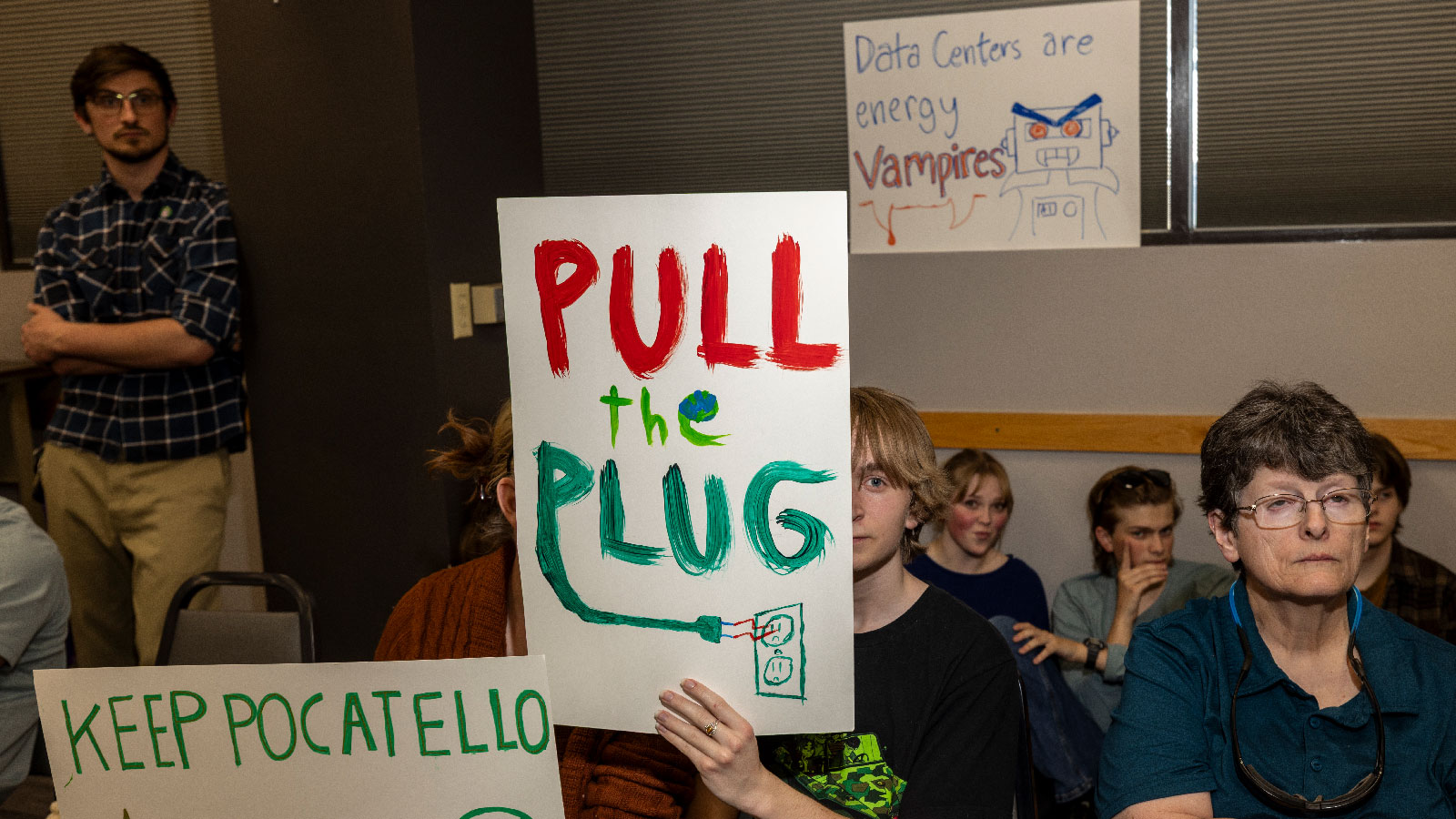
Sarina Virmani lives in Loudoun County, Virginia, which is home to over 200 data centers and colloquially known as Data Center Alley. As a high school student, Virmani published a paper on the environmental impact of data centers in the American Journal of Student Research. She also organizes for more transparency and regulation in the industry.
“A lot of people think that artificial intelligence is something that’s invisible, but it’s not. It lives in these massive buildings,” she said.
Data centers aren’t new in Loudoun County, but the explosive growth of AI chatbots like OpenAI’s ChatGPT, Anthropic’s Claude, and Google’s Gemini is driving demand for more. The environmental impact of all of those data centers can be tricky to parse, but there are a few things we know for certain: Data centers are extending the life of aging oil, gas, and coal infrastructure, they are spurring the building of new fossil fuel infrastructure, and they can pose risks to water resources.
What is AI, and why does it need so much electricity?
To some extent, AI technology is as old as the computer. The term artificial intelligence was popularized in the 1950s, and as computer technology has become increasingly affordable and powerful, machine learning and algorithms have become part of our economy and everyday lives. The Instagram algorithm, for example, just turned 10 years old.
The current iteration of AI began in November 2022, when OpenAI publicly launched ChatGPT. ChatGPT’s secret weapon was access to a massive amount of data — some of which was used without copyright permission — and the computer power and architecture to process it and train models. This process is enormously energy-intensive. In a Q&A published by the University of Washington, AI scholar Sajjad Moazen said that training one single large language model like ChatGPT-3 can use up to 10 gigawatt-hours of power.
“This is on average roughly equivalent to the yearly electricity consumption of over 1,000 U.S. households,” he said.

How much climate-changing pollution does generative AI create?
The training and deployment of large AI tools requires so much power that it is leading to a boom in new fossil fuel infrastructure and extending the life of aging power plants.
“I like to call them zombie power plants,” said Quentin Good, coauthor of a report on data centers by the Frontier Group. “They should be dead, but we keep reviving them, and they’re walking around like zombies polluting our communities.”
The report found that the retirements of at least 15 fossil fuel plants have been postponed to meet increased energy demand. Those 15 plants alone emit more climate-changing pollution than the entire state of Massachusetts. Utilities, grid operators, and the federal government have all cited data center energy demand as a reason to keep aging fossil fuel infrastructure online. In some cases, power plant retirements have been pushed back by more than a decade.
In the case of one coal plant in southern Virginia, which was set to phase out in 2025, operations have been extended indefinitely. In 2023, the plant emitted more pollution than over 65,000 typical gasoline-powered vehicles produce in a year.
“[The U.S. had] been planning to get pretty much all of our coal plants offline by 2040,” Good said. “Those plans are basically out the window now.”
On top of that is all of the new fossil fuel infrastructure being built to meet AI demand. Wired writer Molly Taft reported in April 2026 that new gas plants linked to just 11 U.S. data center campuses could generate more climate-changing pollution than the entire country of Morocco emitted in 2024.
And some data centers use highly polluting diesel generators as backup when there’s too much demand on the electric grid. Good said that although restrictions limit how much a company can run diesel generators, many states are considering exceptions for data centers.
How much water does AI use, really?
Details around data center water use are murky, and the environmental impact is at least partially dependent on where data centers are located. Good has found that although data centers do need large volumes of water to cool down servers, data center water use is not a crisis in Virginia — though that could change in times of drought.
Data centers in water-stressed areas, like arid parts of Colorado, pose larger water-use concerns. Good noted that the highest data center water demand comes during the hottest, driest months, which is when river flows tend to be lowest and other water needs also peak.
Other water-related issues arise when water is discharged after it has been used in a data center. Good said the environmental impacts of this process and the effects on local waterways and wildlife are an underresearched area that he hopes to study more.
“When they discharge the water that they used to cool the servers, that water has elevated levels of sodium and other nasty stuff in it,” Good said. “And it’s really hot, so that could impact fish and other animals in streams and rivers.”
What can you do to reduce AI’s climate-changing pollution?
Like most climate solutions, the fight against polluting AI systems happens at all levels, including through regulation, community organizing, and limiting individual use of energy-intensive tools.
The Trump administration has tended to favor accelerating permits for data centers, and the president signed an executive order in late 2025 attempting to limit states’ ability to regulate their construction and energy use. Yet NPR has reported that there is bipartisan support for AI industry regulations in Congress and in state governments.

At a local scale, residents can attend public meetings and hearings about data centers and ask questions. Well-organized neighbors across the U.S. have shut down projects, passed local moratoriums, and limited electricity rate hikes.
On the individual level, people can think twice before using a generative AI tool. By reducing unnecessary use of AI tools and encouraging others to do the same, people can reduce demand for these tools and the enormous amounts of energy they require.
This <a target=”_blank” href=”https://yaleclimateconnections.org/2026/06/how-bad-is-ai-for-the-environment/”>article</a> first appeared on <a target=”_blank” href=”https://yaleclimateconnections.org”>Yale Climate Connections</a> and is republished here under a <a target=”_blank” href=”https://creativecommons.org/licenses/by-nc-nd/4.0/”>Creative Commons Attribution-NonCommercial-NoDerivatives 4.0 International License</a>.<img src=”https://i0.wp.com/yaleclimateconnections.org/wp-content/uploads/2020/10/ycc-favicon.png?resize=100%2C100&ssl=1″ style=”width:1em;height:1em;margin-left:10px;”>
<img id=”republication-tracker-tool-source” src=”https://yaleclimateconnections.org/?republication-pixel=true&post=139681&ga4=1401ERFF5Q” style=”width:1px;height:1px;”><script> PARSELY = { autotrack: false, onload: function() { PARSELY.beacon.trackPageView({ url: “https://yaleclimateconnections.org/2026/06/how-bad-is-ai-for-the-environment/”, urlref: window.location.href }); } } </script> <script id=”parsely-cfg” src=”//cdn.parsely.com/keys/yaleclimateconnections.org/p.js”></script>