

by Bridgett Ennis, Yale Climate Connections
July 10, 2026
As the prices of home battery systems fall, they’re becoming a key part of the modern electric grid. They can help homeowners store power from rooftop solar panels or the grid for use during outages or periods of high demand. And they can reduce strain on the grid during heat waves when electricity demand soars.
In this interview with Yale Climate Connections, Raghu Belur, the chief products officer for Enphase Energy, explains how home battery systems can lower utility bills and create backup power during grid failures. He also says that batteries, including the batteries in electric vehicles, may one day make it possible for utilities to use power from many small sources to maintain a more reliable grid.
This interview has been edited for clarity and length.
Yale Climate Connections: Could you explain what a home battery is, how it works, and the benefits it provides customers?
Raghu Belur: The beauty of the battery is it can do a few different things. The home – which traditionally has been only a consumer of energy – is actually producing its own energy with solar on the roof. One of the limitations to solar is that it’s an intermittent resource – we don’t have solar at night – so the best way to actually maximize the utilization or the usability of solar is to add a battery.
The second use case is you can actually sell energy back to the grid [in some places]. When there is a lot of demand on the grid and you have all these stored electrons, those electrons are very valuable for yourself as well as for the grid. So you as a prosumer – a producer and a consumer – can sell that energy to the grid and actually make money.
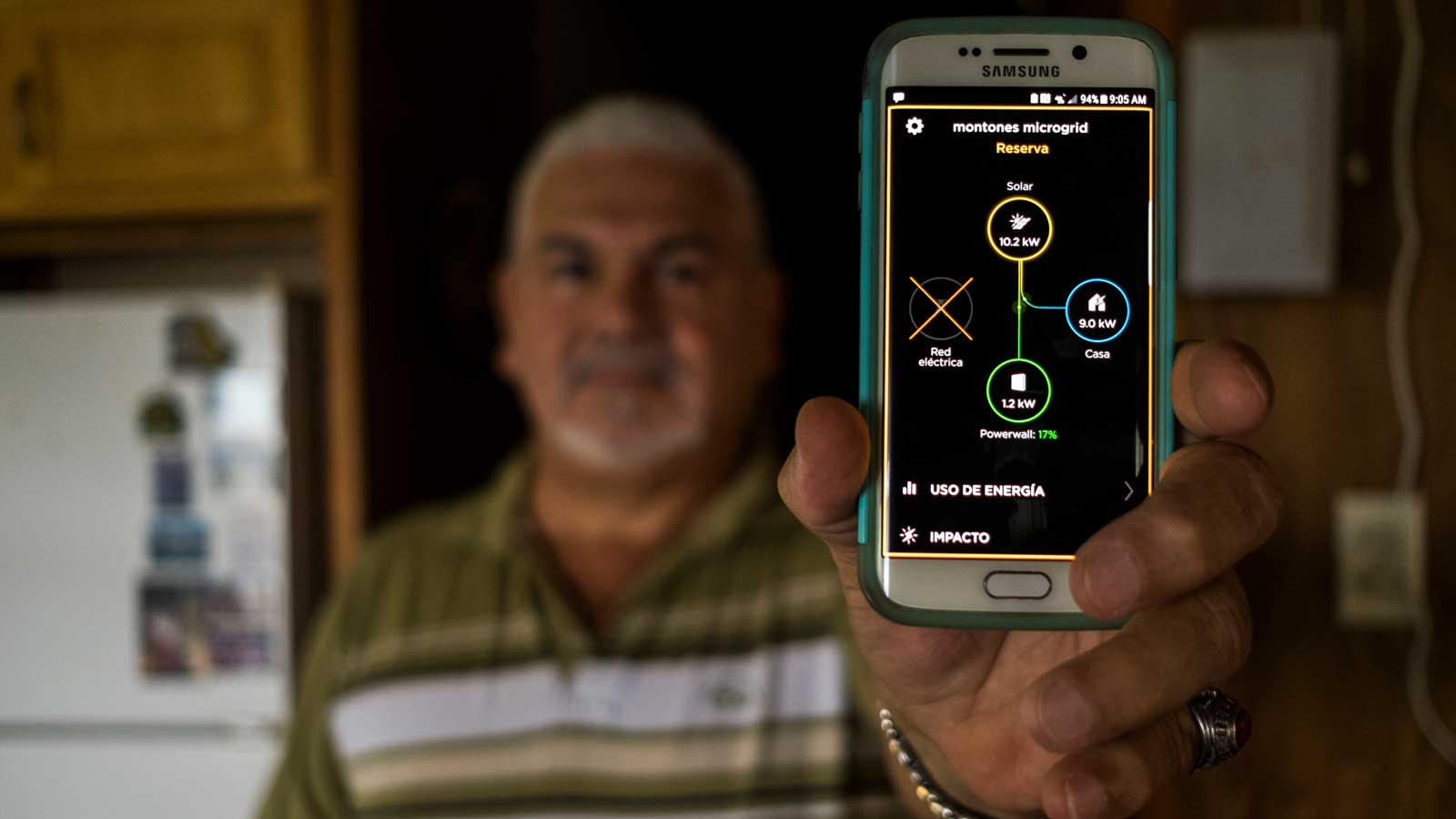
The third use case for that battery is, of course, if the grid were to fail. So when the grid goes out, these batteries can create a microgrid and power the home. The whole process is seamless: It senses that the grid is gone, takes over, and runs the home on the energy that it has saved so the homeowner wouldn’t even know that the grid is gone.
YCC: How do batteries help provide resiliency for homeowners during power outages or extreme weather?
Belur: We are living in times where 100-year storms are the norm now. We also have to deal with things like forest fires. Usually, if there’s a storm or winter event, it lasts for a finite period of time, and the sun eventually does come out. So if you have solar and a battery, then you can ride through a multiday outage.
And the deployment of solar and batteries is going to become more and more critical, especially as the demand in the overall infrastructure is going up significantly. The electrical demand on homes is going up substantially – you’re seeing homes getting electrified, with everything from heat pumps, induction ovens, EVs.
But that’s not all the story. Massive demand on the utility is coming from the hyperscalers, from the AI data centers as well.
So addressing the demand on the residential side, with deploying more and more batteries, is massively beneficial for everybody because they can help alleviate some of the stress that the grid feels as a result of all that demand that’s coming from the data center side.
YCC: How common is it to deploy batteries on homes that don’t have solar?
Belur: It’s not that common, but I don’t see a reason why that cannot become a trend. Solar used to be the point of entry for [a home energy] system, but an EV is also a very large battery. So we can not only intelligently charge your EV, but [with a bidirectional EV charger] you can also discharge your EV to support the grid, provide grid resiliency, or you can use the EV to power your home in the event of an outage. So you’ll find that there will be a lot of deployments where people use their car as the battery, and that’s the only thing that they have – and we believe that an EV will be the point of entry into that energy system for a lot of people.
Read: When the power went out, an electric car kept the AC running
If you look at the way technology evolves over the long run, it decentralizes. If you think about mainframes, 40 or 50 years ago, people used to have mainframe computers – that was the norm. That’s where all the intelligence was, and all the decision-making happened there. Today we have arguably much more intelligence in our laptops and in our phones, and so we have decentralized that intelligence.
I believe the same thing is going to happen with energy as well. Historically, all the power production or generation of energy has been centralized – you’ve got big hydroelectric plants, nuclear plants, gas-powered plants, coal plants, and large-scale solar, large-scale wind.
What we are seeing now is this decentralization or distribution of energy, where the home is becoming the unit of intelligence. It’s the one that produces its own energy, stores and consumes [energy] intelligently, and can also optimize not only for the homeowner’s needs but also provide resiliency to the grid by exporting electrons into the grid.
YCC: We’re seeing rising energy prices. When we talk about consumers, whether they’re leasing or buying these battery systems, what does all of this mean for consumers’ bills?
Belur: Here’s this opportunity for the homeowner to become a prosumer – produce your own energy, consume your own energy, manage your own energy intelligently – so you can optimize your bill as well as provide resiliency. It’s a way to hedge against future energy rate increases. Depending on the location, for example, you can have a payback period of as low as four to five years. Four to five years, your energy system pays off because what you’re offsetting is a very large utility bill.
Then other places may take seven to eight years, but you’re looking at a 25-year asset. When you’re looking at a 25-year asset, a payback period from anywhere from four to eight years, that’s not too bad because once I’ve paid off my system, because I’ve offset my consumption – and by the way, my rates don’t go up – it’s my own system.
I think it makes absolute sense that people should deploy their own energy system within their home. Of course, solar is kind of the hero of the show. That’s what this is all about, but you do need solar. You need batteries. You need EV chargers. You need software to manage everything, and you can create a tremendous amount of value and shrink that payback period down even further.
YCC: What needs to happen to scale up this approach to reach those low-income consumers who might not be able to afford to make these investments up front?
Belur: Investors look for some level of certainty, and this is an asset class that the investment community is starting to get very comfortable with because the default rates are very low. So you’re seeing more and more dollars being invested into deploying more of these systems, because not a lot of people are defaulting on their loans, because what is their alternative? It’s not a luxury. Energy is a necessity.
The place where things are a little uncertain is all of these government regulations changing. Whatever decision the government makes regarding whether there is going to be tax incentives or no tax incentives, those decisions need to happen quickly so you bring stability into the market.
Read: Trump just gave a huge gift to China’s economy
In the long run, I believe that incentives should be a catalyst and not a crutch. We know we have the technology capabilities, so let’s get some of these government uncertainties out of the way and let our industry do what it does best: Deliver great economics, great value to the homeowner, and the finance industry will love that because it’s a strong asset class. It’s got low default rates, and we know we’ll always need energy.
This <a target=”_blank” href=”https://yaleclimateconnections.org/2026/07/home-batteries-could-become-the-next-must-have-household-appliance/”>article</a> first appeared on <a target=”_blank” href=”https://yaleclimateconnections.org”>Yale Climate Connections</a> and is republished here under a <a target=”_blank” href=”https://creativecommons.org/licenses/by-nc-nd/4.0/”>Creative Commons Attribution-NonCommercial-NoDerivatives 4.0 International License</a>.<img src=”https://i0.wp.com/yaleclimateconnections.org/wp-content/uploads/2020/10/ycc-favicon.png?resize=100%2C100&ssl=1″ style=”width:1em;height:1em;margin-left:10px;”>
<img id=”republication-tracker-tool-source” src=”https://yaleclimateconnections.org/?republication-pixel=true&post=140070&ga4=1401ERFF5Q” style=”width:1px;height:1px;”><script> PARSELY = { autotrack: false, onload: function() { PARSELY.beacon.trackPageView({ url: “https://yaleclimateconnections.org/2026/07/home-batteries-could-become-the-next-must-have-household-appliance/”, urlref: window.location.href }); } } </script> <script id=”parsely-cfg” src=”//cdn.parsely.com/keys/yaleclimateconnections.org/p.js”></script>