


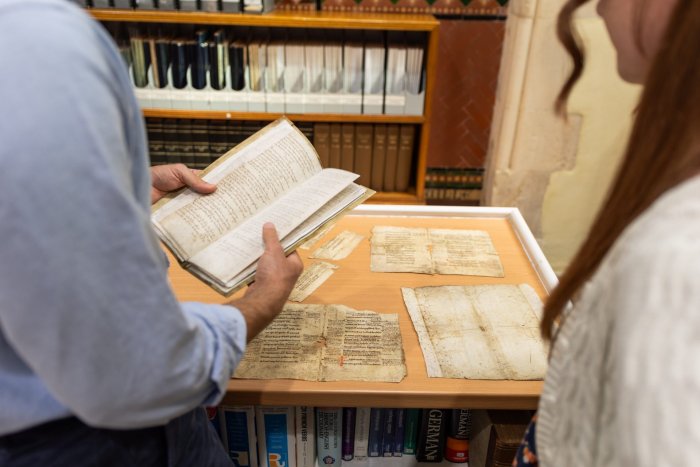
Conny Waters – AncientPages.com –With support from Kent manuscript expert Dr David Rundle, seventeen medieval manuscript fragments have been identified in Guernsey. These discoveries provide rare insight into the island’s literary and intellectual life during a period with little surviving evidence.
Credit: University of Kent
These medieval fragments were hidden in plain sight, having been reused centuries ago as covers for early modern notebooks. Located in the Island Archives and His Majesty’s Greffier’s Strongroom, they served as bindings for administrative records on the island’s feudal holdings and have been preserved through this reuse.
The team at Guernsey’s Island Archives, in collaboration with Dr David Rundle and Professor Tamara Atkin, identified the fragments.
Some of these fragments have only recently been discovered, while others were already known to Guernsey archivists. However, their rarity and what they reveal are just now being fully understood thanks to academic research. Together, the seventeen fragments make up a truly important collection.
Before this discovery, there was almost no proof of libraries, book collections, or a literary culture on Guernsey in medieval times. These fragments are the first solid evidence of the books that existed on the island and the texts people read there.
The surviving fragments indicate that late medieval Guernsey had an active reading culture, with vernacular texts primarily in French rather than English. While many fragments are in Latin, six are in French. Most are popular works found in multiple copies across England and France, such as the Anglo-Norman Lumere as lais.
All of these fragments provide a unique perspective on how texts were shared, used, and preserved, collectively highlighting distinctive aspects of Guernsey’s literary culture. One fragment comes from L’Estoire de Griseldis, a secular dramatic poem likely written by Philippe de Mézières around 1395. It retells the story of Griselda, originally recounted by Giovanni Boccaccio in the Decameron in 1353.
While the Griselda story was widely known in late medieval Europe, the version in the Guernsey fragment is exceptionally rare. It appears in only one other manuscript and two sixteenth-century printed editions.
The Guernsey fragment therefore represents a significant missing link in the transmission of this text over time. it also demonstrates for the first time that the manuscript play was read outside the French royal court, where it likely first circulated. This finding helps explain how the play reached a broader audience in the sixteenth century. The manuscript also provides insight into contemporary reading habits and the dissemination of popular stories.
According to Dr David Rundle: “Each new fragment found brings excitement, and this island is truly vibrant with discoveries. The collection’s range of subjects and dates is remarkable, suggesting a culture beyond what we have previously imagined.
“The Island Archives team has already identified many key elements among these fragments, but what is even more promising is that much remains to be discovered. It is likely that more fragments will come to light,” Dr Rundle added.
And as Callum Tostevin-Hall, Archival Assistant at Guernsey’s Island Archives, said “This first began when I was asked to track down a 16th century copy of Edward III’s 1331 Extente of Guernsey, and I noticed that the shelfmark contained a reference to a vellum cover with Latin text that had been removed from the notebook in a previous round of conservation. I checked this cover and was astonished to find that it was clearly a reused bifolium from a medieval manuscript.
“This project has been a personal passion, and seeing it come to fruition, along with discovering several manuscript fragments, is both an honor and a privilege. Collectively, these fragments offer an unprecedented glimpse into Guernsey’s medieval past, which is exciting for the Islands Archives and for me as a medievalist.”
“We are delighted that these remarkable fragments have been identified and are generating interest among researchers both on and off the island. This discovery highlights the vital role of archives and libraries in enabling new research, and we look forward to uncovering further insights in collaboration with academics in this field,” said Vikki Hart, Island Archivist at Guernsey’s Island Archives.
I thank Callum and the team for their dedication and hard work on this project, and I am grateful to Mrs Gillian Lenfestey for her invaluable help in identifying the manuscript fragments at the Greffe. These fragments are early examples of recycling, demonstrating that resourcefulness has long been part of Guernsey’s history.
See also: More Archaeology News
What began as a practical reuse of parchment has, centuries later, preserved important pieces of the island’s past that might otherwise have been lost.”
Island Archives will host an academic study day on 10 September 2026 to share these discoveries with a wider audience. The event includes a roundtable with experts from the UK and France, a hands-on session with the fragments, and a public talk for the local community. The goal is to raise awareness about the fragments and encourage more research.
Written by Conny Waters – AncientPages.com Staff Writer

