

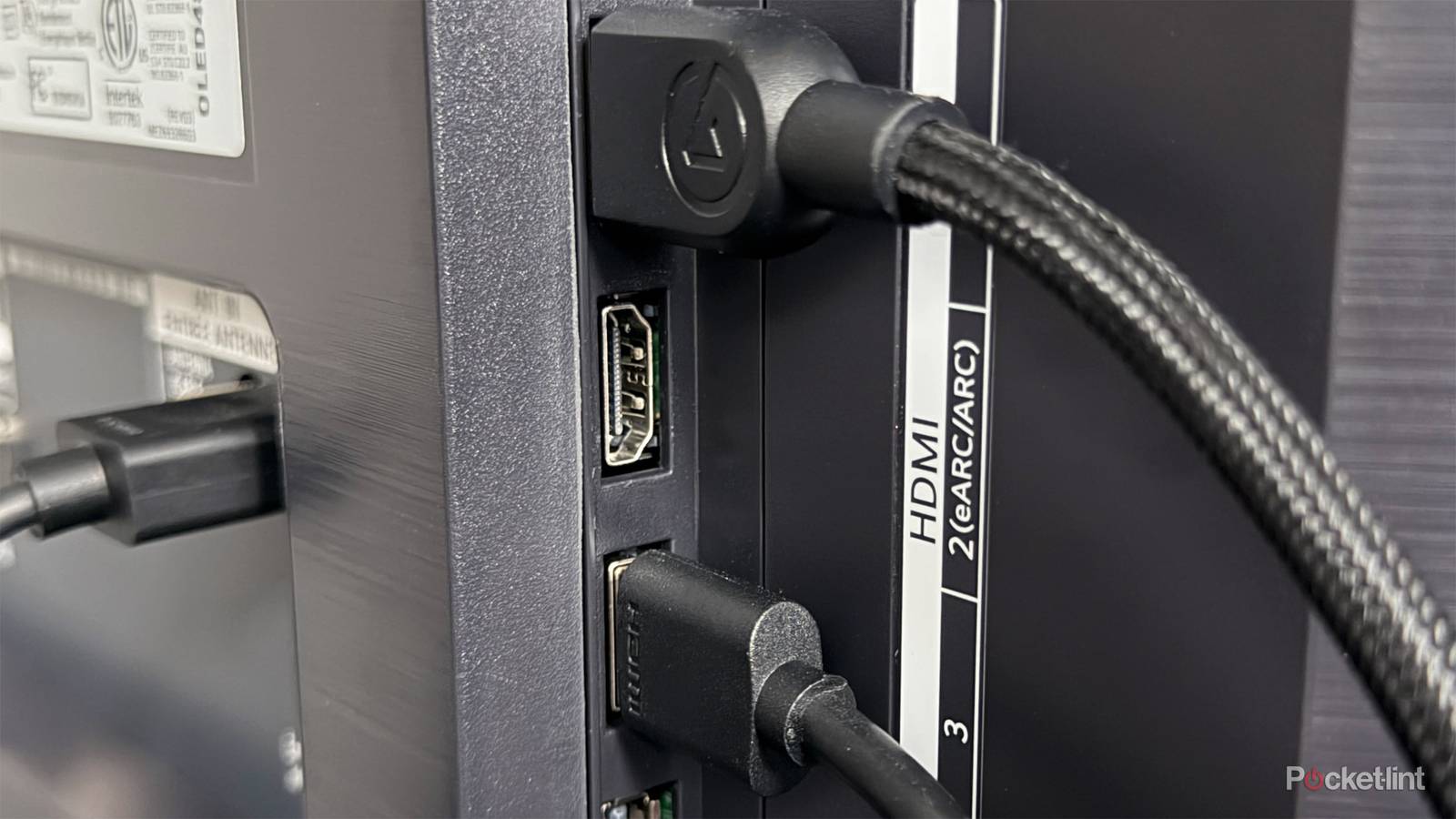
When you spend $3,600 on a television, you probably expect that, as an expensive new model, it will come with all the newest connections at the back. Pay more, get more: more bandwidth, more headroom, more space for whatever you end up plugging in over the next few years. Sony’s 2026 lineup breaks that assumption, though, and it does so against itself.
The flagship True RGB Bravia 9 II has fewer full-speed HDMI inputs than the entry-level Bravia 3 II sitting several rungs below it, and if you’re shopping at the top of anyone’s range this year, the port count is the spec worth looking at before you buy.
Sony’s cheapest 2026 TV has twice the fast ports of its priciest
Same brand, same year, roughly a quarter of the price

The Bravia 9 II has four HDMI inputs, which sounds like enough until you look at what they actually do. Two run at the full 48Gbps that HDMI 2.1 is meant to signify, while the other two are HDMI 2.0 in all but name. And one of the two fast ports doubles as the eARC output, which is the connection your soundbar or receiver (if you have them) claims.
The Bravia 3 II, meanwhile, runs all four of its HDMI ports at full bandwidth, with 4K at 120Hz, VRR, and ALLM available on every one of them. The 65-inch model costs $899.99, but the 65-inch Bravia 9 II costs $3,599.99.
Sony told CE-Sphere that the Bravia 9 II still runs on MediaTek’s Pentonic 1000, a platform locked in early during the set’s long development, and that chipset natively supports two full-bandwidth HDMI 2.1 inputs. The Bravia 3 II, meanwhile, is thought to use the newer Pentonic 800, which supports four. Sony hasn’t confirmed the second half of that, but the port count rather speaks for itself.
Where the eARC port complicates the math
One soundbar and you’re down to a single fast input

Plug a soundbar or an AV receiver into the eARC port, which is where you’ll get lossless Atmos and DTS:X passthrough, and the Bravia 9 II leaves you exactly one 48Gbps input for everything else. That’s one, for a PS5, an Xbox Series X, and possibly a gaming PC.
The workarounds are all pretty annoying, too. You can swap cables, which nobody does more than a couple of times, or you can run one console without VRR or 120Hz and try not to think about it. Or you can buy a receiver with enough HDMI 2.1 inputs to fix a problem the television introduced, which is several hundred dollars to restore functionality you thought you’d already paid for.
We made a version of this argument from the other end of the market, pointing out that budget sets are where HDMI corners usually get cut. It’s right about the broad pattern, and has been for years, but what’s changed in 2026 is that it has stopped being a reliable rule of thumb. The compromise hasn’t gone anywhere, but it’s turned up somewhere less expected.
The HDMI 2.1 label won’t answer it for you
The specification allows far more than most people assume

This isn’t an industry-wide retreat, and it would be unfair to characterize it as one. LG’s 2026 flagship OLED, the G6, runs all four HDMI ports at 48Gbps and pushes to 4K at 165Hz for PC gamers, which is more than most people will use this decade, and the two-port limit is a Sony and Panasonic characteristic tied to silicon choices, not a market-wide slide.
Which is precisely why the badge on the box is no help. It’s a per-model query, and it has to be questioned with every model.
The HDMI Licensing Administrator retired HDMI 2.0 as a certifiable name years ago, which means a port can legitimately carry an HDMI 2.1 label while running the older TMDS signaling at 18Gbps and offering none of the features anyone associates with the number. Manufacturers are supposed to state which HDMI 2.1 features a product actually supports, but enforcement is, let’s say, relaxed.
So the number on its own tells you close to nothing. The bandwidth figure and the port map do tell you something, and both live further down the spec sheet than they should.
What I’d check before buying
Count the fast ports, not the ports

If you’re shortlisting a TV this year, I’d ignore the HDMI 2.1 badge entirely and go looking for two things. First, how many inputs are specified at 48Gbps, or at 4K 120Hz, manufacturers usually list these against numbered ports, as in “HDMI 3 and 4.” Second, which port carries eARC, because that one is effectively spoken for the moment you add external audio.
For a household with two consoles and a soundbar, I’d treat three full-bandwidth inputs as the floor and four as the target. If you own a streaming stick and a 4K Blu-ray player and nothing else, two is genuinely fine, and there’s no shame in filling the older ports with devices that can’t use the newer ones anyway.
HDMI 2.2 is expected in TVs and AV gear from 2027, and it arrives with three bandwidth tiers — 64, 80, and 96Gbps — of which only the top one is what’s quoted. Full speed is optional again, and HDMI 2.2 will supersede 2.1 as the umbrella marketing term in the same way 2.1 swallowed 2.0. That means the next round of spec sheets will need reading as carefully as this one.
The Bravia 9 II is, by nearly every account, a superb television: brighter and more color-accurate than anything Sony has put into an LCD. It just can’t take all of your things at once, and if you do end up living with a set that’s short on fast inputs, there are at least a couple of HDMI tweaks worth making to get the most from the ports you have, though at $3,599.99 that’s a strange thing to have to plan around.

- Brand
-
Sony
- Display Size
-
65″, 75″, 85″, 115″
- Dimensions
-
Without Stand: 57 x 32 5/8 x 1 3/4 in (65-inch)
- Operating System
-
Google TV
- Display Type
-
LCD True RGB Mini LED
- Display Resolution
-
3840 x 2160