



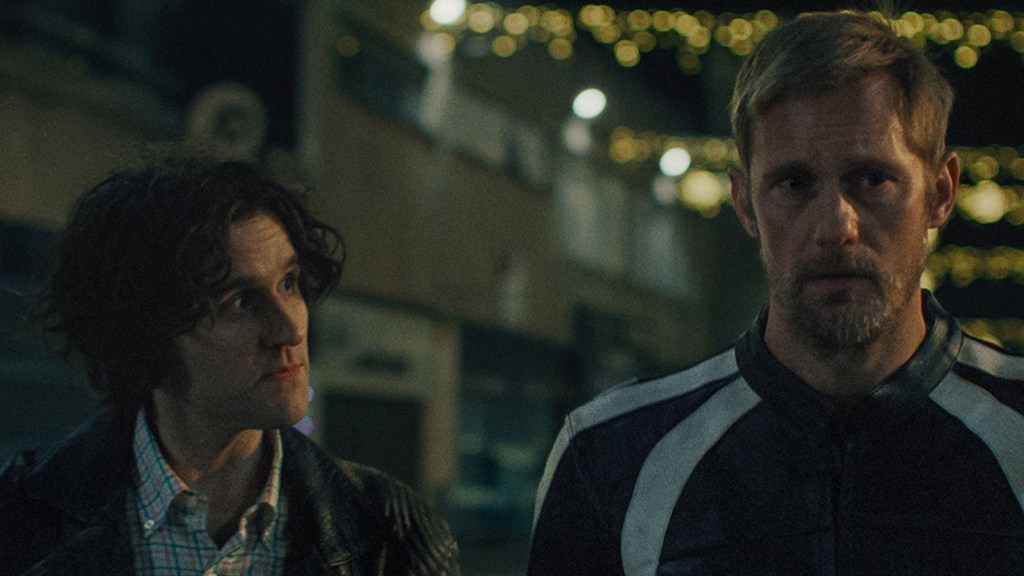
Filmmaker Harry Lighton, whose debut film Pillion won the BIFA award for Best Independent Film last year, sat down with the film’s producer Emma Norton at Dublin’s Storyhouse screenwriting festival where he broke down his process of adapting the film from Adam Mars-Jones’ 2020 novella Box Hill.
“A lot of what we talked about in terms of how to approach the film was how to play with the contrasts of the novel,” Lighton told an audience at the Light House Cinema. “In the novel, there’s this kind of extreme contrast between this character who has got this kind of naïve optimism and romantic idealism and then this kind of hardcore sexual element in this relationship, which feels very divorced from romantic idealism.”
The film follows Colin (Harry Melling), a timid man who is swept off of his feet by Ray (Alexander Skarsgård), an impossibly handsome biker, who takes him on as his submissive.
In the candid conversation, Lighton, who admitted he “loves romantic comedies,” dissected specific scenes in the film and the decision-making processes that went behind each when it came to adapting the story for the big screen. Examining the scene where Colin and Ray first meet in a pub, Lighton said he decided to set the scene around Christmas time to evoke the warm feelings the holiday represents before the story quickly pivoted to a sexual scene between the two characters in an alleyway.
“Christmas is a time when you sit down with your family and watch movies and have comfort food,” he said. “It feels like sitting in a warm bath and allows you to luxuriate and I wanted to really invite the audience and have them get soaked into it so that suddenly, when we’re sort of gagging in an alley, there is a sharp contrast but also difficulty for the audience to detach themselves totally from what they are watching, because they’ve probably seen something which is quite familiar to them and something which might be unfamiliar. That way they’re having to try and not reconcile, but deal with the fact that there’s something alien and something familiar and they can’t just let their mind run out of the cinema.”
Continuing about contrasts, Lighton outlined the decision to have Colin’s character be part of a barbershop quartet in the movie, rather than part of a Mensa group, the latter of which is used in the novella.
“Mensa isn’t exactly cinematic,” he said. “So I thought what would be the most extreme opposite to a sexy, white gang built on extreme power differentials and, for some reason, I don’t know how it came about, but barbershop is like the opposite of leather because they are wearing those hideous straw hats and very nasty jackets and they are singing in harmony so it’s about equal harmony and cohesion.”
He continued: “It also has a very syrupy sweetness to it, and I often thought of the film in terms of bits of syrup and then bits of hot sauce. And I figured that barbershop would be the syrup to the hot sauce of Ray and the bike.”