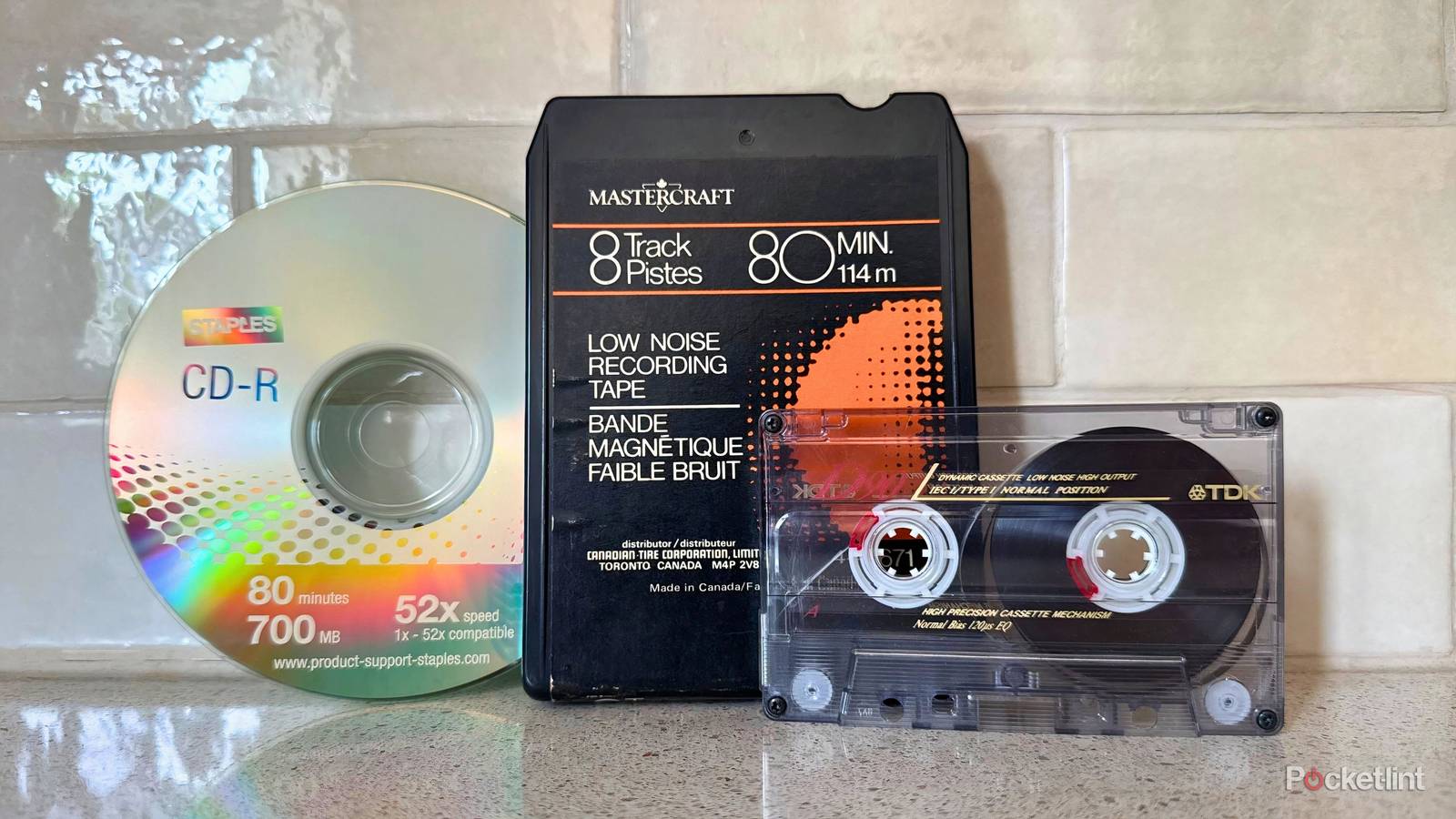
Through the ages, we’ve seen several physical music formats come and go. These mediums are each very much a product of their time, with distinct strengths, weaknesses, and attributes that make them wholly unique from one another.
As both a collector of physical media and a lover of retro technology, I’ve chosen to wholeheartedly embrace all formats equally, which means, naturally, that I’ve garnered quite a collection of albums, Long Plays (LPs), Extended Plays (EPs), and singles.
As such, I’m intimately familiar with the inner workings of just about every mainstream storage medium used to mass distribute music. Below is my ranking of each format in question, from last place all the way up to first place.
8-track cartridge (Stereo 8)
Fourth place

- North American release to market: 1965
- Developed by: Lear Jet Corporation, Ampex, Ford Motor Company, General Motors, Motorola, RCA Victor
8-track tapes are a curious technology. They were only briefly popular, specifically in the context of the North American automotive industry of the 1960s through the 1980s. As an analog magnetic sound cartridge, each individual 8-track is capable of forming an endless loop due to having its tape joined at the ends. As such, there’s no need to flip or rewind the tape at any point in time, which is certainly a nice perk.
The medium’s name refers to the fact that it stores up to eight stereo tracks in total, which are divided into four different program sections of two tracks each. Unfortunately, since loop lengths are standardized on the format, it sometimes results in a strange phenomenon in which songs are faded in and out mid-playback in order for the mechanism to swap tracks.
8-tracks are physically quite large, and they’re notorious for being a finicky storage medium on the whole. Most notably, the foam pressure pads found within the cartridges physically deteriorate over time, requiring restoration work to stay playable in the long term. As with other tape-based formats, the magnetic tape itself is also subject to degradation over time as playbacks accumulate.
Compact Cassette (Cassette tape)
Third place

- North American release to market: 1964
- Developed by: Philips
Despite entering the market before the 8-track, it took some time for the Compact Cassette to become the de facto tape standard within the music industry. Cassette tapes are physically smaller and more robust than 8-tracks, and are capable of holding anywhere from thirty to one hundred twenty minutes of music per unit.
Cassettes are flippable, with both a Side A and a Side B holding audio. The exact maximum playback length, audio quality, and reliability of a given unit depends on the type of magnetic tape used within it, with several formulations becoming available over time. These include Type I (ferric oxide), Type II (chromium dioxide), Type III (Ferrichrome), and Type IIII (Metal).
Cassettes stuck around for quite some time, often appearing in boomboxes right alongside their successor, the Compact Disc (CD). Despite being subject to tape degradation, cassettes are notable for ushering in the era of the Sony Walkman, allowing consumers to take their music with them while out and about.
Compact Disc (CD)
Second place

- North American release to market: 1983
- Developed by: Philips and Sony
CDs have been around since the eighties, but they really took off in popularity around the turn of the century. Unlike older audio storage formats, the CD is digital, meaning that it can be played back over and over again without suffering from quality loss. CDs are a form of optical media, meaning that they store digital data on pits and groves found on the surface of the unit, which is then read by a laser.
The average CD can hold up to roughly eighty minutes of high-quality music, being sampled at 16 bits / 44.1 kilohertz (kHz) Pulse Code Modulation (PCM) quality (in other words, a 16-bit wavelength sampled at 44.1 thousand times per second). CD-Recordable (CD-R) and CD-Rewritable (CD-RW) discs can be used to burn cassette-esque mixtapes, and portable disc players like the Sony Discman proved popular in the 90s and 2000s.
CDs also offer quality-of-life additions like quick skipping of tracks and a lack of need to rewind, but they aren’t without their flaws. Most notably, the readable surface of a CD is highly scratch-prone, which can lead to skipping and other glitches. Unfortunately, CDs lack the same sort of protective hard coat layer found on Blu-ray discs that helps to reduce the likelihood of damage.
Vinyl record (phonograph/gramophone)
First place

- North American release to market: 1948
- Developed by: Columbia Records
The phonograph/gramophone was first invented by Thomas Edison in 1877, with its associated records later serving as the first mass-produced disk-style format (and replacing older wax cylinder technologies in the process). As an analogue format, microgrooves are read by a needle to produce sound waves as the record itself spins.
Various materials were used early on, including brittle shellac that could hold only a few minutes of audio per side. In 1948, Columbia Records introduced the world to the 12-inch 33 1/3 rotations per minute (RPM) Long Play (LP) record album format, which made use of polyvinyl chloride (PVC) for better sound quality and roughly twenty minutes of audio per side. RCA Victor later introduced 7-inch disks that rotated at 45 RPM in 1949, which became popular for singles.
In the 1940s and 1950s, mechanical horn-based phonographs gave way to electronic turntables, which have remained the standard ever since. Known colloquially as the vinyl record, the format has certainly stood the test of time, enduring through until the modern day. In fact, vinyl has experienced a comeback in recent years, and more and more artists are releasing their albums on the format today than they were, say, a decade ago.