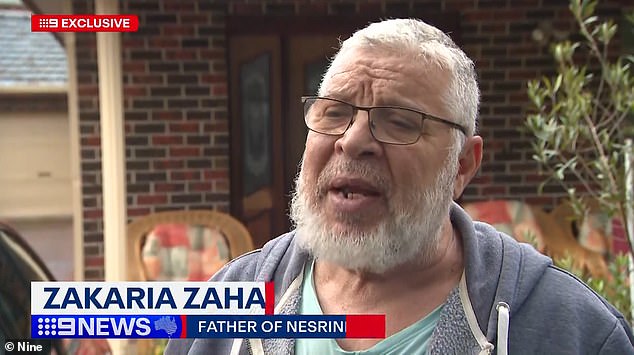
The father of a recently-returned ISIS bride has described her involvement with the terror group in her early 20s as a young person’s ‘mistake’.
Nesrine, Amina and Sumaya Zahab, along with Hyam Raad and six children, landed in Sydney on Qatar Airways flight QR908 from Doha about 5.30pm on Friday.
Another two women and seven children landed in Melbourne about 4.30pm.
The group, formerly linked to ISIS fighters, was not charged by the Victoria and NSW Joint Counter Terrorism Teams on their arrival.
In an interview outside his Bankstown home, Nesrine Zahab’s father insisted that critics are ‘very wrong’ about his daughter.
‘I thank the Australian government very much, it’s the best country in the world,’ Zakaria Zahab told reporters on Wednesday, The Daily Telegraph reports.
‘When you’re young, you do so many mistakes. You don’t get charged on that mistake. This is not the end of your life. You start again.
‘We are very happy. Who wouldn’t be happy if his daughter comes back after 10 years? Who wouldn’t be?’

‘When you’re young, you do so many mistakes. You don’t get charged on that mistake. This is not the end of your life. You start again,’ Mr Zahab said of his daughter’s involvement in ISIS

The father of ISIS bride Nesrine Zahab (Nesrine is pictured in 2019) has said his daughter made a ‘mistake’ and critics of her return to Australia are ‘very wrong’

The group were not charged by counter terrorism officers on their arrival (pictured)
Nesrine has previously claimed she did not willingly enter Syria and live under the Islamic State regime during a visit to the region at the age of 21.
In 2019, she told ABC News she had been on a holiday in Lebanon when she ‘snuck away’ to support refugees on the Turkish side of the Syrian border.
‘Who walks into a war zone? I was going to see Syrians, yes, because of what they’re going through,’ she said.
Ms Zahab claimed she was brought to a building in Syria where her phone and passport were taken and she was told she was an Islamic State citizen.
‘I found that I was in Syria, did I have a heart attack? Of course,’ she said.
‘Did I cry and scream and chuck a fit like a little girl? I chucked the biggest tantrum. Did it work? No. I’m still here.’
Prime Minister Anthony Albanese and his government have continued to insist that they have not supported the group’s return to Australia.
‘The government has not and will not provide any assistance to this group,’ Home Affairs Minister Tony Burke said on Tuesday.

Ms Zahab was one of 19 women and children, formerly linked to the Islamic State, who landed in Australia on Tuesday evening

Pictured, ISIS brides and children are ushered to cars as they leave the airport

The group’s return has faced opposition and condemnation across Australia
‘These are people who have made the horrific choice to join a dangerous terrorist organisation and to place their children in an unspeakable situation.
‘As we have said many times, any members of this cohort who have committed crimes can expect to face the full force of the law.’
‘ISIS brides’ describes women recruited by the Syrian-based terror group Islamic State (IS) and moved to Iraq or Syria to marry fighters and raise their children between 2012 and 2016.
Many of the women have spoken about being tricked into living in Syria, with some experts suggesting recruiters painted a utopian view of life with the terrorist group.
Following IS’s fall in 2019, the women and their children were placed in Al-Roj refugee camp in far north-eastern Syria. The men were either executed or imprisoned.
Boys held in the Al-Roj camp were transferred to adult prison once they reached their teenage years, sometimes slightly earlier.
The group of 19 women and children is the fourth contingent of families linked to ISIS who have returned to Australia.
On May 7, a cohort of 13 ISIS brides and their children touched down in Sydney and Melbourne after spending seven years in the al-Roj refugee camp.
Eight orphaned children came back to Australia under Scott Morrison’s government in 2019. Four women and 13 children were then allowed into the country by the Albanese government three years later.