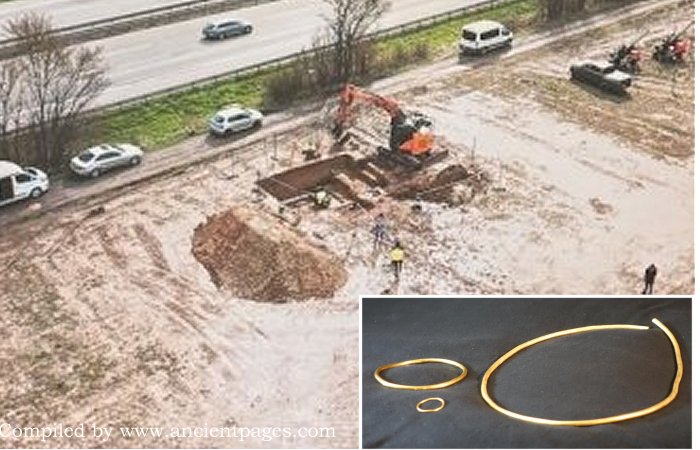
Jan Bartek – AncientPages.com – Archaeologists made an extraordinary discovery during a construction project near Bad Camberg, Germany. Guided by both instinct and chance, they uncovered one of Hesse’s most significant archaeological treasures: the grave of a high-ranking Celtic figure. The grave goods are exceptional.
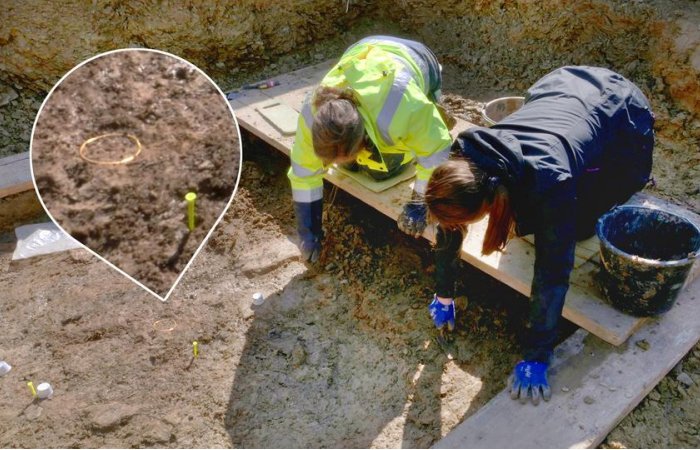
The archaeologists’ hard work in the mud was worth it. They discovered gold. Credit: Thomas Kurella, hr
One More Step Closer To The Celts
Since the Celts left no written records, archaeologists and historians rely on accounts from Greek and Roman times as well as on archaeological excavations. The Celts were not a unified people or a kind of proto-European nation, but rather lived in numerous independent tribal groups during the Iron Age.
The Celtic cultural community was characterized by its own Indo-European language, similar material culture, customs, beliefs, and way of life. From the Bronze Age cultures of Central Europe emerged the two classical Celtic periods: the Hallstatt (650-70 BC) and La Tène (470-50 BC).
Celtic society was not centrally organized and lacked a single king. In addition to chieftains and princes, druids served as intellectual and spiritual leaders of individual tribes. They acted as priests, healers, teachers, and judges. From the 7th to the 1st century BC, the Celts were the dominant population in southwestern Germany. Celtic culture remains a key feature of Baden-Württemberg, evidenced by thousands of burial mounds and a significant archaeological record.
While much is known about the Celts, each new archaeological discovery provides further insight into their history.
Discovery Of Mysterious Lines
Archaeologist Kai Mückenberger told Hessenshau that the recent discovery came as a surprise. Only a few months earlier, there was no sign of a Celtic grave on the unused land beside the A3 motorway near Bad Camberg (Limburg-Weilburg).
A geomagnetic survey revealed some unusual features in the images. Researchers saw two thin, parallel lines near the road that joined into a circle, which surrounded a sharply defined, dark rectangle.
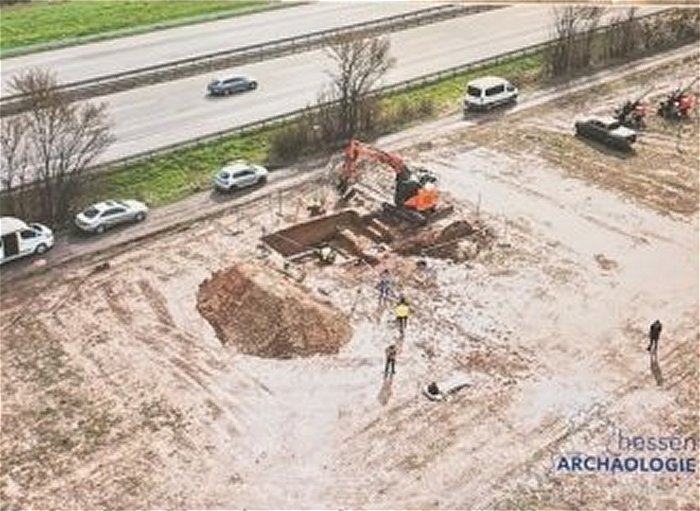
The site where the Celtic grave was discovered. Credit: Stadt Bad Camberg
At first, Mückenberger doubted whether it was really a princely tomb. But the find turned out to be just that, and the Celtic tomb was remarkable.
In the spring, Mückenberger thought they would find only traces of a settlement. He told the excavation team to go ahead, but he did not expect any major discoveries.
Later, a call came in saying the excavator had found metal—iron remains of a spearhead, a common grave good. This confirmed the presence of a burial chamber.
No Body But Gold
The archaeology team did not find the body of the Celtic individual, as both the wooden chamber walls and the remains had fully decomposed over time. However, the floor of the burial chamber revealed the valuable grave goods that had originally been placed with the deceased.
Among the items was solid gold: a set of three rings that the person had worn around their neck, on their arm, and on one finger at the time of burial. Even during the restoration, it became clear that the immense span of over two millennia had barely affected this jewelry.
Also spectacular are the components of a chariot that was found in the grave. Archaeologists and restorers at the State Office for Monument Preservation in Wiesbaden are currently examining the finds. Among the largest are the iron fittings from two wooden chariot wheels. These metal bands, known as “wheel rims,” once formed the wheels’ running surfaces.
The two chariot wheels, up to 1.20 meters high, were likely detached and placed upright against a chamber wall. They featured large, round hubcaps and sleeve-like axle fittings made of non-ferrous metal, possibly bronze, and likely once had a reddish-gold sheen. Remnants of the wooden axle remain embedded in one fitting.
Camberg Celtic Grave Ranks Among Europe’s Top Burial Sites
Because the artifacts are so fragile, the excavators didn’t uncover them on site; instead, they recovered them from a block of earth. They are now being examined by conservators at the State Archaeology Department in Wiesbaden. First, the blocks of earth are being X-rayed – a process that has already revealed some secrets.
For example, one find contains an Etruscan jug made of bronze sheet. Axel Posluschny, research director of the Celtic World at Glauberg, considers the combination of gold rings, a wagon, and a jug especially significant. He believes the Camberg “princely grave” ranks among the “absolute best” of its kind from this period in Europe.
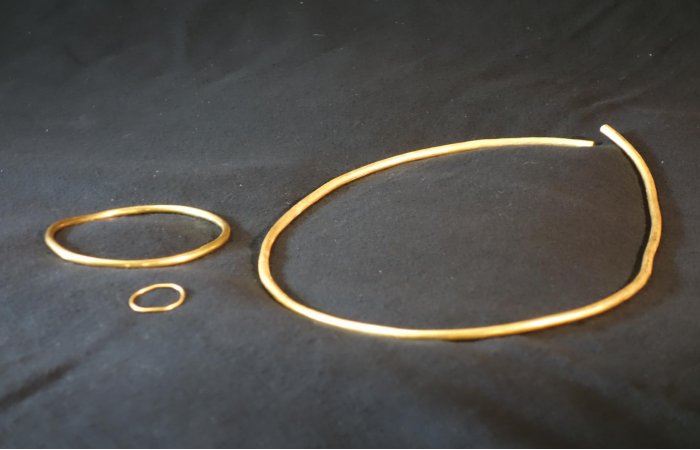
Gold jewelry for the neck, arm, and fingers is rarely found in Celtic graves from this period. Credit: Thomas Kurella, hr
The restoration workshop in Wiesbaden has cataloged about 100 artifacts from the Bad Camberg grave. Each object offers clues that could help restorers and archaeologists learn more about the person who was buried there.
Among the smallest artifacts are bronze beads, some of which might be glass or amber, rings that could have been part of a belt, a small knife shaped like a sickle, and clay pieces, including fragments from a lentil-shaped bottle.
Archaeological Detective Story – Who Was The Person In The Grave?
Are these grave goods associated with a woman or a man? According to Mückenberger, similar items have typically been found in men’s graves. He interprets the two-wheeled cart as a battle chariot, and the presence of a well-preserved spearhead further suggests a male burial.
However, this cannot be determined with complete certainty. A “princess’s grave” remains possible, although women’s graves from this period were often more richly furnished than the one in Bad Camberg.
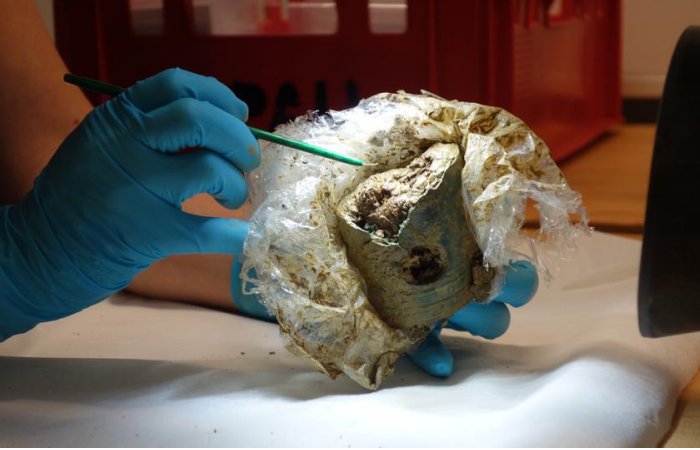
This axle fitting, along with pieces of wood, shows that parts of a wagon were also discovered in the grave. Credit: Thomas Kurella, hr
Are these grave goods associated with a woman or a man? According to Mückenberger, similar items have typically been found in men’s graves. He interprets the two-wheeled cart as a battle chariot, and the presence of a well-preserved spearhead further suggests a male burial.
Yet the answer remains elusive. The possibility of a “princess’s grave” lingers, even though women’s burials from this era usually featured far more lavish offerings than those found at Bad Camberg.
See also: More Archaeology News
What, then, can we truly say about the prehistoric individual from Bad Camberg? This person likely walked the earth at the dawn of the early Iron Age. The grave goods mirror the burial traditions of the first half of the fifth century BC, yet the striking combination of gold, cart, and jug sets this grave apart, hinting at someone of remarkable status.

Archaeologist Kai Mückenberger. Credit: Thomas Kurella, hr
Was the deceased a druid, a wise woman, or perhaps a warrior prince? The mystery endures. What is clear is that this individual stood above their peers in wealth, influence, or perhaps in ways lost to time. For district archaeologist Kai Mückenberger and his team, one fact shines through: the Bad Camberg grave marks the first Celtic “princely grave” ever discovered in the Taunus region.
“You only make a find like this once in your archaeological career,” says Mückenberger confidently.
Source:Hessenschau.de
Written by Jan Bartek – AncientPages.com Staff Writer