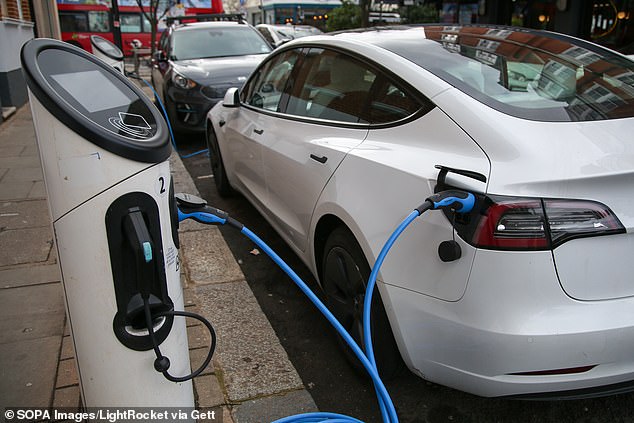
The Government has reaffirmed its commitment to taxing electric car owners for every mile they drive and revealed that vehicles can be tracked to calculate annual payments.
The Treasury on Monday published its response to a public consultation that saw more than 5,000 stakeholders raise concerns about the controversial electric vehicle excise duty (eVED) scheme announced by Chancellor Rachel Reeves in the Autumn Budget.
The eVED system will require EV owners to pay 3p for every mile driven from April 2028. Motorists with plug-in hybrid vehicles (PHEVs) – which run on both electricity and traditional fossil fuels – will pay a reduced rate of 1.5p per mile.
The additional tax, levied on top of the £200-a-year standard vehicle excise duty, is intended to ‘mirror the contribution petrol and diesel drivers make through fuel duty’, according to the Treasury.
Under the plans, motorists will make payments based on predicted annual mileage, with the figures verified using MOT records.
However, the consultation response also confirms for the first time that drivers will be able to opt into a system that uses vehicle connectivity technology to provide GPS-tracked mileage, avoiding the need for manual estimates.
The Treasury also confirmed that mileage rates will rise annually in line with Consumer Prices Index (CPI) inflation from 2029-30.
That is likely to anger some EV owners, particularly as fuel duty on petrol and diesel has remained frozen for 15 consecutive years and has been subject to a ‘temporary’ 5p-per-litre cut since 2022.

The Government has reaffirmed its commitment to taxing electric car owners for every mile they drive and revealed that vehicles could be tracked to calculate annual payments
The Government says the road-charging system is needed to ensure that ‘EV and PHEV drivers make their fair contribution to the public finances as fuel duty revenues decline.’
But motorists, industry experts and businesses have warned that the policy could cause a roadblock to EV adoption and undermine the Government’s net-zero ambitions.
Concerns raised during the consultation included the accuracy of drivers estimating their annual mileage, the burden on MOT centres to verify odometer readings, and motorists being taxed for journeys driven overseas when they are already being levied local duties.
Critics have also warned that the system could create new opportunities for mileage fraud through vehicle-clocking technology.
Despite these objections, the Treasury said it ‘remains committed to introducing eVED from April 2028’.
In total, 5,133 responses were submitted to the consultation. The vast majority (92 per cent) came from individual members of the public, although businesses, academics, charities and motoring organisations also took part.
According to the Treasury, common themes and concerns were identified using an ‘AI-assisted consultation tool’.

The Treasury published its response to a public consultation regarding the controversial eVED scheme announced by Chancellor Rachel Reeves in the Autumn Budget
GPS tracking and inflation-linked increases
The most significant developments in the consultation response relate to mileage tracking and future rate increases.
The system relies on motorists estimating how many miles they believe they will drive each year, making an eVED payment based solely on that forecast.
For instance, an electric Tesla Model Y driver who thinks their annual mileage from April 2028 to the end of March 2029 will be 12,500 miles will pay a charge of £375.
For every mile over this prediction, drivers will incur a secondary charge, while overestimations will see eVED credits carried to the next fiscal term.
For years, government advisers have advocated the use of telematics or black-box systems to more accurately monitor vehicle mileage. However, privacy concerns have led to strong opposition from many MPs and motorists.
The original eVED consultation document stated that the Government would not mandate telematics technology but remained open to using ‘various forms of technology on an opt-in basis’ to reduce administrative burdens.
Monday’s response provides more detail, confirming that any voluntary system would rely on a vehicle’s built-in connectivity features, allowing mileage information to be GPS tracked and transmitted through 4G or 5G networks.
‘Making use of mileage data that cars already report will be optional, but those that do opt in will benefit from a quicker, easier-to-use and more flexible system,’ the Treasury said.
The Government also reiterated that the 3p-per-mile rate will be uprated from 2029-30 and in future years in line with CPI inflation to ensure that the tax maintains its real-terms value.
While annual inflation-linked increases are common across many taxes, fuel duty has not risen for more than a decade despite previous intentions for it to increase in line with inflation.
Since 2011, the levy has remained flat at 57.95p for every litre of petrol and diesel despite the exchequer threatening to up it with RPI.
Rishi Sunak imposed a ‘temporary’ 5p-a-litre cut in March 2022 to ease the toll of surging fuel prices linked to the outbreak of war between Russia and Ukraine. However, the cut remains in place today, with Labour hesitant about abolishing it as oil prices remain volatile during conflict in the Middle East.

News that the 3p-a-mile eVED rate will increase in-line with CPI inflation from 2029-30 will enrage EV drivers who have seen duty paid on traditional fossil fuels frozen for 15 years
Two changes to the original proposal
The consultation has resulted in only two meaningful changes to the scheme outlined by the Chancellor eight months ago.
The first is the removal of garage-based mileage checks for newer EVs and plug-in hybrids.
Under the original proposals, vehicles under three years old – which are exempt from annual MOT testing – would still have been required to attend a test centre for eVED mileage verification.
Instead, owners will now be asked to provide ‘accurate mileage estimates’ using guidance and digital tools – or share mileage data through their vehicle’s connected systems.
The second change allows business users, finance providers and leasing companies to file bulk mileage estimates across fleets to reduce administrative burdens.
In its response, the Treasury said: ‘The Government considers that the design [of the eVED scheme] strikes an appropriate balance between supporting a fair and sustainable motoring tax system and maintaining incentives for the uptake of electric vehicles.’
Toby Poston, chief executive of the British Vehicle Rental and Leasing Association, said the changes do little to address wider concerns.
‘There is no avoiding the fact that you can’t create a smooth switch to electric vehicles by making them more expensive to own,’ he said.
‘The mechanics of the tax may have improved, but the timing is still wrong.’
Sue Robinson, chief exec of the National Franchised Dealers Association, said the government has failed to provide customers with ‘clear guidance’ on how eVED will work, which prevents them making ‘informed decisions when purchasing electric vehicles’.
She said: ‘The industry is working harder than ever to encourage greater EV uptake; eVED risks that additional costs for EV ownership could deter consumers from making the switch.
‘We’re concerned at the overcomplexity, the burdening cost to the industry and the reliance on the accuracy of the data.
Weak plan to tackle mileage fraud
One of the biggest concerns raised by critics is that eVED compliance relies almost entirely on odometer readings recorded during MOT tests.
That leaves the system vulnerable to mileage fraud, commonly known as vehicle clocking.
The availability of ‘mileage blockers’ – also marketed as ‘mileage freezers’ – has increased significantly in recent years. These devices are typically used to artificially suppress recorded mileage, either to boost a vehicle’s resale value or help motorists remain within mileage limits on finance agreements.
Online sellers claim the products are intended for off-road or research purposes only, allowing them to exploit legal loopholes.
However, investigations by the Daily Mail and This is Money found some devices being advertised as ‘totally untraceable’ and ’99 per cent undetectable’.
Unlike traditional clocking methods (when mileage is wound back), blockers devices prevent mileage from being recorded on the odometer and in the vehicle’s ECU – its electronic brain – while the car is being driven.
Doing so makes any mileage discrepancy impossible to detect during MOT tests.
Vehicle history-check companies, including CarVertical and HPI, estimate that around 2.3 per cent of UK vehicles already show signs of mileage manipulation.

Mileage blockers are devices that pause mileage displayed on a car’s clocks and records held in the vehicle’s ECU – its electronic brain

There has been an increase in the availability of mileage blockers in recent years driven by the popularity of car finance and customers attempting to avoid mileage-based penalties
The Government has outlined the measures it proposes to take to tackle mileage fraud head-on.
It says it plans to introduce a legal requirement for vehicles to have functioning odometers, create offences for odometer tampering and prohibit the supply or installation of devices designed to manipulate mileage readings.
It also intends to give the Driver and Vehicle Standards Agency, DVLA and police powers to require vehicles to undergo examination where there is reasonable suspicion of odometer fraud.
However, the Treasury said such powers are unlikely to be used frequently because safeguards will include confirmation of user-supplied mileage against MOT records and the use of algorithms intended to identify suspicious patterns.
The Daily Mail and This is Money believes this ad-hoc approach to checking for mileage fraud risks underestimating the growing scale and sophistication of vehicle-clocking technology.
Nick Connor, CEO of the Institute of the Motor Industry – the trade body representing garages up and down the country, agrees.
He has questioned how eVED can be ‘delivered safely and consistently’ if the system assumes every MOT garage can deal with EV mileage anomalies.
‘The risks around odometer tampering, mileage data being held in more than one place in a vehicle, and the central role MOT garages will play in recording mileage have been recognised in the Consultation response, yet there is no clear plan of how those risks will be managed on the workshop floor,’ he said.
‘Diagnostic capability varies significantly across the MOT network. Reading a dashboard odometer is one thing; investigating a disputed, missing or potentially tampered mileage reading on an electric vehicle is quite another.’
EV owners taxed when driving on foreign roads
Experts have also highlighted issues with eVED liabilities being attached to vehicles rather than individual motorists.
Under the proposals, mileage credits would transfer with a vehicle when it is sold and there would initially be no refund mechanism for vehicles declared off the road through a Statutory Off Road Notification, with unused credits transferred to the subsequent year.
The government also ruled out applying higher rates to motorists who drive longer distances and reduced charges for those who live in rural areas with little to no access to public transport and a mileage-based tax system will hit hardest.
It further confirmed that mileage accumulated overseas will still count towards annual eVED liabilities.
This means UK motorists will effectively be taxed by the Treasury for miles covered driving their cars on foreign roads on holidays.
With European neighbours also imposing tolls on motorways to tax drivers, this would result in a double sting for EV and PHEV owners.
For instance, a family driving their electric car from Calais to St Tropez for a holiday in the South of France hotspot will have to pay £43.68 in eVED for the round trip to HM Treasury.
This is on top of French motorway toll charges of between €250 and €270 – £215 and £230 – collected by local authorities.
The Treasury says that varying rates based on location and typical driving patterns – as well as excluding overseas mileage – would require more intrusive monitoring and conflict with efforts to ‘protect motorists’ privacy’.

Electric car drivers planning to take their vehicles on holiday will be charged eVED, the Government has confirmed. This is likely to be intensely opposed by EV owners
Ben Nelmes, chief executive of green think-tank New AutoMotive, warned that the policy could become politically problematic.
The pay-per-mile system for EVs and PHEVs, he said, ‘risks becoming an albatross around the neck of the next Chancellor and transport secretary’.
He added: ‘It is absurd that families heading off on holiday will be taxed by the UK Government for driving on French roads.
‘It is staggering that the DVLA’s legacy computer systems are unable even to process a simple automatic refund when someone sells or scraps their car.
‘That in itself should be a massive red flag for the incoming Government about the deliverability of this policy.’