Ed Miliband’s Net-Zero policies are akin to a form of ‘nimbyism’ that is destroying British industry with high energy costs and green taxes, according to the boss of the UK’s last aluminium smelting plant.
Tom Uppington, managing director of the Alvance British Aluminium plant in Fort William, Scotland, called on the Energy Secretary to ‘fundamentally look at the energy transition and what it is costing industry in the UK’.
He pointed out that while Miliband seemed content with hitting UK industry with measures to curtail carbon emissions that would push up energy costs, this was not applied to industry overseas, making it harder to compete on the world stage.
‘It’s almost this nimbyism. It appears that as long as the carbon isn’t produced in our backyard, he has a view of ‘I don’t care where it goes’,’ Uppington said.

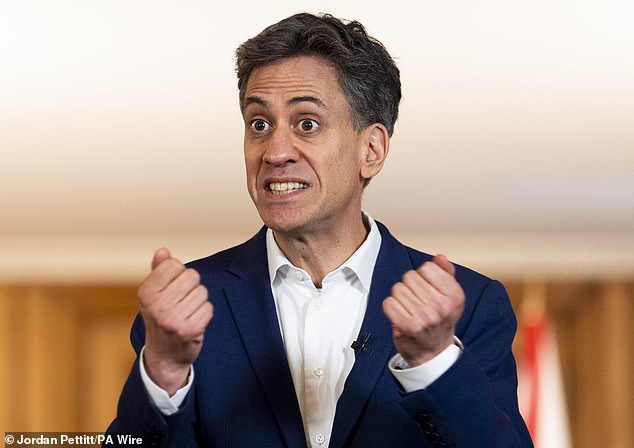
Set in his ways: Ed Miliband’s Net-Zero policies are akin to a form of ‘nimbyism’ that is destroying British industry
‘Not having access to cheap electricity bars us from being able to compete on the international market. When you are up against competitors who have much cheaper electricity, it’s challenging.’
The Alvance smelter has been enjoying a surge in demand this year after the outbreak of the Iran war effectively cut off supplies from the Gulf.
US tariffs of 25 per cent on UK aluminium, which are much lower than those applied to other countries, have also helped while the Government predicts domestic demand could quadruple from 1.8 million tons – mostly met by UK producers – to 8 million tons over the next decade.

Concerned: Alvance boss Tom Uppington
But Uppington has said that despite the rise in demand for its products, the smelter has only gone from using 68 per cent to using 75 per cent of total capacity, as ramping up production further would increase its energy bills to such an extent that the site would end up losing money.
He pointed out that electricity used by the plant – above what it generates through its own near-century old hydro-electric system – is subject to green levies based on the average level of UK carbon emissions which ignore how much Scottish electricity is generated from wind farms and hydro power.
‘We could be taxed on carbon emissions at the same level as a smelter in Indonesia using coal,’ Uppington said.
The plant is also dealing with a £500,000 hit from Labour’s Employers’ National Insurance Contributions rise, with its boss calling for a cut in general taxation to boost economic growth.
‘If you reduce taxes, it generally pushes more money into the economy,’ Uppington said.

Red hot molten aluminium is poured into moulds at Fort William for export to the United States

James Tangney, of Alvance, uphill from works, which is clobbered by sky-high energy charges if it uses any power above that provided by its own hydro-electric system
‘We could be exporting to Europe and further afield much better if conditions were more favourable, he added, arguing that action on energy prices ‘is what we need right now’. Aluminium is used in the defence, aerospace and food and drink industries, and is listed as a critical mineral by the British Government.
But just 32,000 tons of primary aluminium is made in Britain with trade body Make UK recently warning that the industry is shrinking. Three sites have closed since last autumn.
James Tangney, Alvance’s business development manager, pointed out that the decline in British aluminium production was occurring at the same time that demand was rising due to new technology. ‘Aluminium is important for electric vehicles, data centres, as well as traditional uses, but we don’t have the capacity to meet demand,’ he said.
A MakeUK spokesperson said: ‘Higher aluminium prices do not translate into improved viability because energy costs can overwhelm gains in price. Addressing elevated power costs will drive improvements in profit, stimulate growth and investment.’
The trade body said it wanted further action, such as backdating the British Industrial Competitiveness Scheme, which will cut bills for energy-intensive industries by up to 25 per cent.
It wants to see it backdated by two years rather than one year when it comes into force in April 2027.
It also called for action to stop UK scrap aluminium ending up abroad after 400,000 tons were exported last year to Asia.
DIY INVESTING PLATFORMS

AJ Bell
AJ Bell
Easy investing and ready-made portfolios

Hargreaves Lansdown
Hargreaves Lansdown
Free fund dealing and investment ideas

interactive investor
interactive investor
Flat-fee investing from £4.99 per month

Freetrade
Freetrade
Investing Isa now free on basic plan

Trading 212
Trading 212
Free share dealing and no account fee
Affiliate links: If you take out a product This is Money may earn a commission. These deals are chosen by our editorial team, as we think they are worth highlighting. This does not affect our editorial independence.
Compare the best investing account for you