


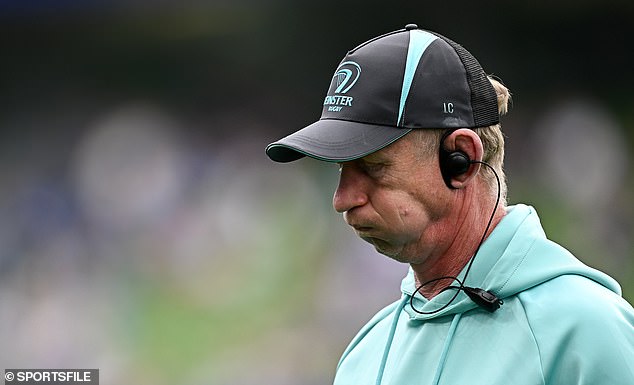
THEY are lying in the long grass for Leo Cullen today. Actually, it’s not even that long, the hunter hats and rifle barrels prominently positioned as they close in on Leinster’s head coach ahead of the Champions Cup final showdown with Bordeaux in Bilbao.
There are not too many fighting Cullen’s corner – large swathes of Leinster supporters have been on his case for ‘underachieving’ since the province last lifted this trophy in 2018, while the rugby media has been raining in digs since Cullen had an uncharacteristic pop at them after the nervy 29-25 semi-final victory over Toulon.

Vexed: Cullen was frustrated after Toulon match and had a cut at the media
However, while it is not a popular media stance to take, it is possible to see where Cullen was coming from when he had that go post-Toulon – because some of the narrative around the province and their head coach has been unfair.
It wasn’t so much the criticism of their inconsistency and stilted play over the course of a somewhat disjointed season – those observations are impossible to refute.
However, the underlying resentment and passive (oftentimes nakedly) aggressive swipes have been off beam and understandably frustrating for Cullen to endure.
Chief among them is the relentless accusation that Leinster somehow have an unfair advantage.
The province undeniably benefit from their positioning in Dublin, with a large population and corporate sector to tap into for support, but being based in a large city is no guarantee of success – ask Wasps, the esteemed London club that dates back to the 1860s but ended up in Coventry before going under a few years back.

Power source: St Mary’s celebrate winning the Leinster Schools Cup this year
Nor is the schools rugby system that sustains the Leinster squad so copiously an ‘unfair’ advantage.
That self-funding operation has been in place for well over 100 years. Leinster Rugby has simply prioritised the pathways to ensure a regular flow into the academy.
It may have left the Leinster club scene on the margins but it is not unjust or underhand – just smart.
Linked to all of this are the regular catcalls about the number of internationals and Irish Lions in Leinster’s squad – as though people would prefer if the province did not bring so much talent through their books.
This is a preposterous criticism and people forget their history.
Cullen’s predecessor as Leinster supremo was Australian Matt O’Connor – a coach who was not as concerned by promoting from within.

Flawed thinking: When Cullen’s predecessor, Aussie Matt O’Connor, favoured Kiwi Jimmy Gopperth (left) over Ian Madigan (right) at out-half, it had a direct effect on Ireland’s prospects at the 2015 World Cup when Johnny Sexton was unavailable for the quarter-final
When Johnny Sexton left for Racing 92 in 2013, O’Connor handed the No10 reins to a Kiwi nomad called Jimmy Gopperth.
Joe Schmidt had been nurturing Ian Madigan for the previous two seasons, so successfully that the understudy out-half was one of the standout players of the 2012-13 campaign, winning the Magners League golden boot and named in their ‘dream team’.
But O’Connor favoured Gopperth, which sabotaged Madigan’s and Ireland’s progress and, when Sexton was unavailable at the 2015 World Cup, Madigan’s readiness was not as pronounced as it should have been.
O’Connor also indulged other imports such as Quinn Roux, Kane Douglas and Zane Kirchner, none of whom ever really hit the mark and directly impinged on Ireland plans.
Since Cullen took over, there has been an overwhelming homegrown focus – it is not unusual for match-day squads to have 23 Irish players – with carefully selected overseas talent used as needed.
This approach has fuelled the most sustained, successful period in history for the national team – Cullen’s role in that is never acknowledged.
And, while Leinster are consistently hammered for their squad of ‘galacticos’, this is not the same as the heavyweights of the Top14 buying in the best players on the market and using their financial heft to land trophies.

Home fires: Cullen promotes homegrown players and it is not unusual for his match-day squad tto be entirely made up of Ireland qualified players – which benfits the national team hugely
This is a self-sustaining, financially prudent way for Leinster to go about their business – bringing players through the academy and earning national contracts is far cheaper than going to the market with chequebook open.
Overseas signings are kept to a minimum and carefully selected, not like the ‘Avengers assemble’ approach of the big French clubs and Saracens and Toulon back in the day.
Overall, Leinster rugby is a good business model (the RDS redevelopment will raise the bar again) and, with the chaotic operation in Munster disappearing down the drain and Ulster and Connacht only now starting to revitalise, Cullen and the province as a whole should not be resented for getting their house in order.
But they are resented, with many neutrals, in Ireland and beyond, rooting for Bordeaux today when, in reality, it is the French side who are the true heavyweights.
According to the financial experts, Leinster’s self-generated revenue sits around the €20million mark, while Bordeaux’s equivalent, known as ‘les produits l’exploitation’ is estimated at €37million.
Unlike Leinster’s, the Bordeaux squad is littered with imported talent, both from the southern hemisphere and other parts of France, but it still feels like there is greater pressure on Cullen and his team going into this final.
What people consistently overlook, perhaps deliberately, is that although Cullen’s official title is head coach, his is an overseer’s role.
His job is to put the pieces in place to propel Leinster towards success. The responsibility for getting them over the finish line lies with his senior coach.
First it was Stuart Lancaster, for the past few seasons it has been Jacques Nienaber making the onfield calls.

Tactician: Jacques Nienaber has responsibity for on-field direction but when Leinster suffer a bad defeat, most of the criticism from outside is directed at Leo Cullen
The South African is a two-time World Cup winning coach, but there have been serious tactical errors on his watch as Leinster have failed to close the deal in Europe.
Yet, he is not held responsible by the shooting gallery the way Cullen is and, when his patented blitz defence delivers, Nienaber is showered with praise with little of it travelling up the command chain.
The failure to start Jordie Barrett against Northampton last year is a black mark against everyone involved but Leinster should still have won that European semi-final and their failure to do so rests with Nienaber – yet it was Cullen who got the major kicking.
Based on all available evidence, Bordeaux should win today, they are justifiably favourites, but that will not spare Cullen if Leinster do lose.
In the 11 years since he has been at the helm, Cullen has presided over one European Champions Cup win, four other final appearances and five URC titles, as well as two URC coach of the year awards and overseeing a stream of quality internationals into the Ireland team during a period of unprecedented success.
By the by, he also captained his province to three European Cups as a player.

Inspirational: Leo Cullen with the European Cup in 2012, he captained Leinster to three titles
However, none of that will matter to the boo-boys and girls if Leinster lose today and that is not right.
There is an argument that he has been in the role for too long – leading to an inevitable staleness and desire for a fresh voice – but Cullen’s critics should be careful what they wish for.
While the Champions Cup has proved agonisingly elusive since 2018, Cullen has kept Leinster at the top of the tree all the while and that is worthy of respect.
Leo Cullen does not get the credit he deserves – he has a year left to run on his deal with Leinster and, win or lose today, he has more than earned the right to see it out.