



Rachel Feltman: For Scientific American’s Science Quickly, I’m Rachel Feltman.
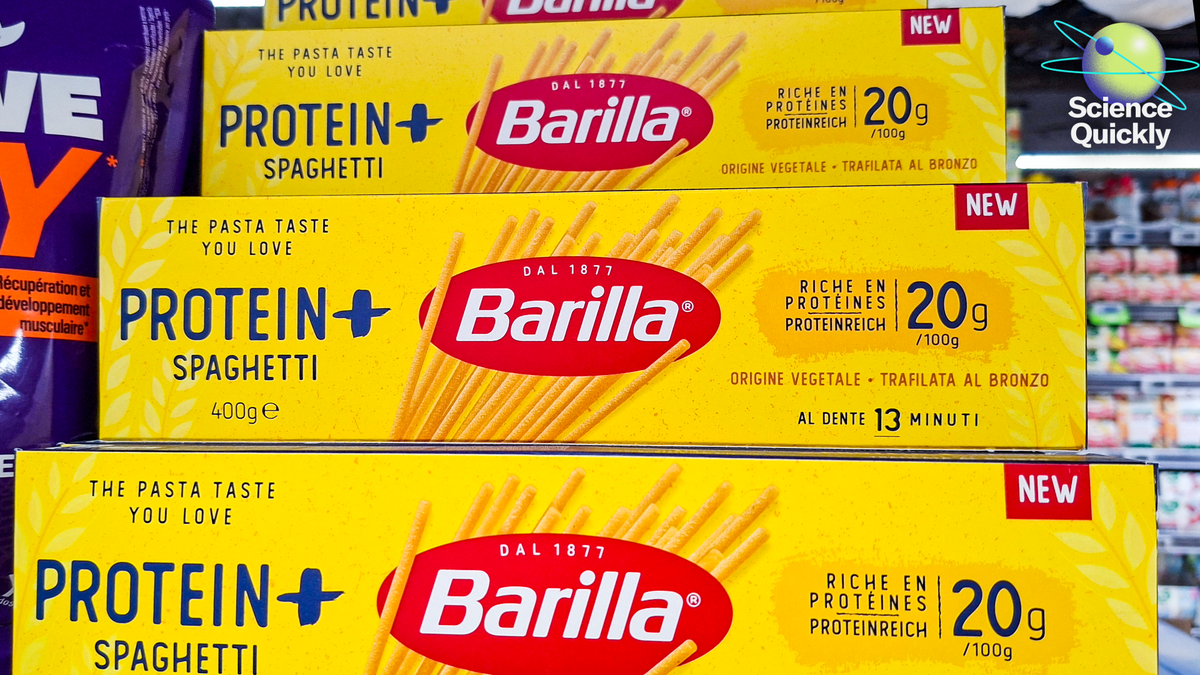
Go into any grocery store these days and you’ll see plenty of food-related fads, both new and old, being used to hawk products: You’ve got your paleo ketchups, gut-microbe-friendly sodas, and, my personal favorite, plant-based chips that are none-too-subtly billed as mimicking the singular taste of a Cool Ranch Dorito. But one of today’s biggest nutritional buzzwords is actually kind of basic: protein.
Influencers say we’re not getting enough, food marketers want us to know they’ve got it, and Robert F. Kennedy, Jr., seems to think more meat could do us all some good. But what does the science actually say about this buzzy macronutrient?
On supporting science journalism
If you’re enjoying this article, consider supporting our award-winning journalism by subscribing. By purchasing a subscription you are helping to ensure the future of impactful stories about the discoveries and ideas shaping our world today.
Here to tell us more is science journalist Bethany Brookshire, the author of a recent story on SciAm about this wave of protein enthusiasm.
Bethany, thanks so much for coming on to chat with us today.
Bethany Brookshire: Thank you for having me.
Feltman: So we’re here to talk about protein.
Brookshire: [Laughs.]
Feltman: Why, why are we talking about protein so much? Why is it everywhere? Are we getting enough? What’s happening? Could you just start us with, with your—a brief overview of your thoughts? [Laughs.]
Brookshire: [Laughs.] Having, having just written a carefully reported piece on protein, when people are, like, asking me, “What’s up with protein?,” my honest answer is, “I wish I knew.” I really do.
Feltman: [Laughs.]
Brookshire: There is a recent—and when I say recent, past 10, 15 years, it’s kind of been building—this idea that we need to get more protein …
Feltman: Mm-hmm.
Brookshire: That we’re not getting enough protein, that somehow we desperately need this and we could be our absolute best selves if we just hit the meat harder. And [Laughs] …
Feltman: Oh, what a phrase, but please do go on. [Laughs.]
Brookshire: [Laughs.] I do my best.
And it’s interesting because it has been embraced particularly by the “Make America Healthy Again” movement. Robert F. Kennedy, Jr., who is the current secretary for health and human services, when he unveiled his new upside-down food pyramid declared that “we are ending the war on protein.”
I am unsure of the genesis or reality of that particular conflict, don’t think anybody ever thought we were in a war on protein. [Laughs.] But there is kind of an idea in some wellness spaces that one of the things we all could stand to get more of is protein, and that’s kind of been growing over the past 10 to 15 years.
It started, as many of these wellness trends start, in the fitness and bodybuilding spaces …
Feltman: Mm.
Brookshire: And has now become much more widespread, to the point that you can go to a coffee shop and get protein-boosted cold foam on top of your latte, which is also protein-boosted.
Feltman: Right, well, and I’m glad you mention the idea of, like, protein-boosted products because, you know, one of the results of this obsession with protein is a lot of, for lack of a better term, sort of proteinwashing and a lot of focus on putting as impressive a number of protein per serving as you can on the front of a bag of something. What has your reporting told you about sort of how customers are responding to that?
Brookshire: I have not actually looked specifically into how customers respond to it. I can tell you, I did run a taste test of a certain very popular toaster pastry in its regular and protein-boosted forms amongst an n of 12 of various ages, genders, and etcetera. I can tell you that the vast majority—and when I say vast majority, I mean 11 out of my n of 12—preferred the regular pastry to the protein-boosted pastry. The one person who did prefer the protein-boosted pastry now is in possession of the rest of them, so. [Laughs.]
Feltman: [Laughs.]
Brookshire: It definitely can create—it depends on the product. Most of the products that I’ve come across are boosted with whey protein, which is derived from milk, and that can sometimes mess with the texture of something.
Feltman: Right.
Brookshire: And so often people find that different texture to be a little unusual or not what they’re expecting. And so that’s often what people react to when they’re reacting to a protein boost in a product.
Feltman: And so what does the data actually tell us about how much protein we need and how much people are getting, on average?
Brookshire: So this is interesting. [Laughs.] This is one of the more interesting things that I’ve come across kind of in my reporting. There is significant discussion among experts, among groups, as to how much protein we do need per day and whether or not we are getting enough of it based on those numbers. So if you’re willing to nerd out with me for a hot second.
Feltman: [Laughs.]Of course.
Brookshire: Okay. So we can start with what the base absolute basement amount of protein. Because let’s be clear, there are three, four basic nutrients that you need. Okay? It is protein, carbohydrates, fat and water, whether water counts as a nutrient. Eh. Anyway, you need those four things to make the chemicals in your cells and allow you to function, right?
You can get by without any carbs in your diet. You can. Your body can convert the rest of that. You can get by on a very, very low-fat diet. Your body can make up that difference. You cannot get by with no protein in your diet. You do need some protein in your diet. In particular, we utilize 20 amino acids in our daily cellular lives. Nine of those are essential amino acids, which means that we cannot physically make them ourselves—we have to get them from our diet. So we do need some protein.
Feltman: As one of my favorite short stories puts it, we are made of meat.
Brookshire: We are absolutely made of meat. [Laughs.] If by “meat,” you mean protein, then yes, we are made of meat. We are nothing but meat sacks. And so we do require protein in our diets.
How much of that is actually somewhat up for debate. So they did some studies in the 1980s, basically, where they took people and they gave them varying amounts of protein and then they saw how much of it they peed out. Because the idea is that your body seeks equilibrium. It will take that protein and use as much as it needs and then just excrete the rest—like, bye.
And based on those studies the estimated average requirement, the EAR, of the absolute basement protein you need to remain in homeostasis is roughly 0.6 grams per kilogram per day, okay?
Feltman: Okay.
Brookshire: So then when they were coming up with recommended daily allowances in the U.S., they were like, “We just wanna make sure everybody gets over 0.6, right, so we’re gonna say 0.8,” right? You get 0.8, you are definitely safe.
Feltman: Good buffer, yeah.
Brookshire: Right. Now people are questioning that, and they’re questioning it because that is the maintenance, right? That’s how much you get to maintain what you currently have. Is that the goal, right?
Feltman: Right.
Brookshire: Are we …
Feltman: A lot of us are trying to get shredded …
Brookshire: Right.
Feltman: Every day.
Brookshire: Are we trying to get up on the gains? And if that’s the case, you need more protein.
Also, there are some groups that do not get enough. To be clear there is no evidence that the population at large, your average human being, is not getting enough protein. We’re getting plenty. Most people are getting more [Laughs], up to [about] 50 percent more protein, than they actually need on a daily basis.
The groups that nutritionists are concerned about are, in particular, the elderly. So people who are elderly can often suffer from something called sarcopenia, aka muscle wasting. And they need more protein, but those people also have very strong long-term reductions in appetite, right? So they’re just not eating a lot of calories. And if you’re not eating a lot of calories, the proportion of protein in your diet needs to be higher.
Another group that some of the scientists I spoke to were slightly concerned about is people on GLP-1 drugs. Again, because you get huge reductions in appetite—really, really drastic ones. And so if you’re eating so little, the proportion of protein that you need really goes up in the diet, particularly with GLP-1s because we know that GLP-1s can cause muscle loss because there’s just so much weight loss going on.
So in those groups there are nutritionists saying we really need to pump some protein and make sure that people are keeping an eye on how much protein they’re getting. But on average, your average person, who is probably not meeting their daily gym requirements [Laughs] or whatever, is getting enough protein. They’re getting plenty. It’s fine. [Laughs.] Relax. We’re okay.
Feltman: [Laughs.] And are experts worried about any consequences that we might face writ large if people are focusing too much on getting as much protein as possible?
Brookshire: Yes. [Laughs.]
Feltman: [Laughs.]
Brookshire: And there’s several forms that concern takes. So in some populations—this is not every population; in fact this is kind of rare—but if you are someone who has kind of weak kidneys, getting really high levels of protein can be an issue because as I mentioned, when you have enough protein in your diet, you pee out the rest. Pee is processed through your kidneys, and if your kidneys are not up to snuff, the high-protein diet can become a problem. That’s pretty rare. Most people do not have that problem.
Another area that people are slightly concerned about is if you are, for example, “protein maxxing,” [Laughs] as the youths say, “protein maxxing”; you’re not “fiber maxxing” or …
Feltman: Mm, and you gotta fiber max.
Brookshire: Or—yeah—or “fruit maxxing” or “vegetable maxxing” [Laughs] or any of the other things. The thing I talked to several nutritionists about that they’re kind of concerned about is that the modern approach to nutrition, in many ways, has come down to macros, right? Get in your protein, get in your carbs, get in your fat, get in the micronutrients that you need—you gotta get all your x’s and y’s and z’s in a row and make your spreadsheet. And food is so much more than that. [Laughs.] And a diet is so much more than that writ large. And so they’re concerned that people are kind of relying heavily on, like, supplementing specific …
Feltman: Sure.
Brookshire: You know, nutrients, as opposed to eating just, like, some freaking food, man. Just, just eat food. [Laughs.] And so that’s another concern.
And the third concern that several nutritionists actually expressed to me: when people work on getting more protein, the vast majority of the time they get that protein from animal sources. Often, it’s whey protein, is, is often the protein that’s supplemented in ultra-processed foods. People will eat a lot of meat. And that’s, as we know, not great for the environment, right?
Feltman: Right.
Brookshire: Those proteins come from animals, which eat many foods and also burp many burps and fart many farts, and it’s not excellent for climate change. And so there are some people who are kind of concerned that as we work so hard to max our protein, that can be kind of a problem in terms of our impacts on the planet.
Feltman: So given that it’s not as simple as, “Oh, actually, everyone’s already eating too much protein,” or “Yeah, definitely, everyone needs to eat more protein,” what kind of research, what kind of data do we need to get to actually find the right nutritional solution for everybody?
Brookshire: So as I mentioned, you know, your estimated average requirement from studies in the ’80s is 0.8 grams per kilogram per day. I think it’d be kind of cool to actually, like, redo those studies and look at people at varying levels of activity, at varying ages, you know, things like that, and see what’s going on there—how much protein do we need?
And of course, there are many nutritionists who want to either raise the recommended daily allowance of protein to encourage people to get more protein, or in many cases they say we need it to be on kind of a spectrum; we need there to be some wiggle room. So most people who are relatively young, relatively healthy, like, 0.8 grams per kilogram to 1 gram per kilogram per day, that’s fine. That’ll do you. But as you get older, you may want to bump that up to 1.2 or even 1.5. If you’re someone who is spending a lot of time in the gym, really interested in building and maintaining muscle, you may actually want to increase those numbers.
So there’s kind of a move not necessarily toward increasing recommended daily allowances for everyone but acknowledging that we all have different nutritional needs and kind of thinking it—of it in terms of more what do you as a person with your lifestyle need, as opposed to what we all need to not die, which is what the recommended daily allowance is actually about: What do you need to not die? [Laughs.]
Feltman: [Laughs.]
Brookshire: And so there are nutritionists who say maybe we should increase it, and then there are others who are saying we probably don’t need to do that, so there’s debate within the community. I was very pleased to find out that it’s not, like, angry debate. [Laughs.]
Feltman: [Laughs.]
Brookshire: They were all very, very polite about it, which is quite nice. [Laughs.]
Feltman: The protein wars are actually very civil, so [Laughs], as it turns out.
Brookshire: They’re more, you know, comfortable protein discussions, probably over protein-boosted beer.
Feltman: [Laughs.] Wow.
Thank you so much for coming on to talk through this with us.
Brookshire: Thank you so much for having me.
Feltman: That’s all for today’s episode. Don’t forget to check out ScientificAmerican.com for more of Bethany’s reporting on protein and other topics. Tune in on Friday for a fascinating and important conversation about what our guest calls the Black womb crisis.
Science Quickly is produced by me, Rachel Feltman, along with Fonda Mwangi, Sushmita Pathak and Jeff DelViscio. This episode was edited by Alex Sugiura. Shayna Posses and Aaron Shattuck fact-check our show. Our theme music was composed by Dominic Smith. Subscribe to Scientific American for more up-to-date and in-depth science news.
For Scientific American, this is Rachel Feltman. See you next time!